CONSERVE & RESTORE - Oyster Restoration Center (ORC)
Our Mission | What We Do | What's New at ORC | Save Oyster Shell | Get Involved! | Directions Learn more about CBF's oyster restoration activities
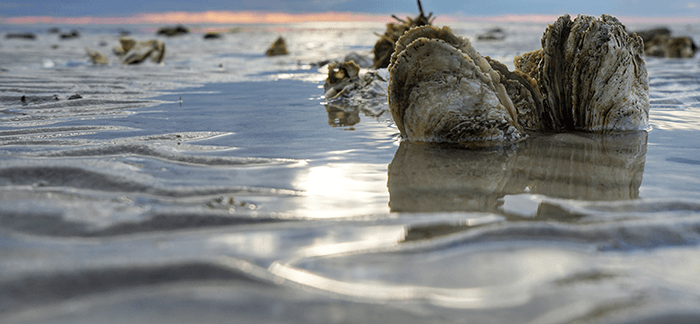
The Chesapeake Bay Foundation recognizes that saving the Bay is uniquely tied to restoring the native oyster, Crassostrea virginica. Historically, Chesapeake oysters were the Bay’s most valuable fishery. Ecologically, native oysters are equally important: they filter algae, sediment, and other pollutants. Oyster reefs also provide habitat for fish, crabs, and other Bay organisms. The Bay’s native oyster population has been estimated at as low as one percent of historic levels, making restoration critical to help improve the Bay’s water quality and increase its economic viability. In support of re-establishing this keystone species, CBF has established the Oyster Restoration Center (ORC). ORC serves as the central location for all of CBF’s oyster restoration activities in Maryland, and is located at 4800 Atwell Road in Shady Side, MD (Southern Anne Arundel County).
The mission of CBF's Oyster Restoration Center is to:
- Leverage greater public and private investment in the Baywide oyster restoration effort
- Engage citizens, students and decision makers in hands-on oyster restoration activities
- Create public awareness of the critical need to restore oysters
- Develop partnerships with community groups, institutions, agencies and organizations
- Serve as a platform for education and scientific research
- Produce oysters for local reef restoration projects
…thereby helping to reduce pollution, increase marine habitat, and save the Bay for future generations!
Back to Top
What We Do
Oyster Setting
ORC houses several large tanks for use in producing juvenile oysters, called ‘spat’. These setting tanks are loaded with oyster shell, and then filled with Bay water. Oyster larvae, usually produced by the University of Maryland’s Horn Point Lab, are then released into the tanks. After a few days, these larvae attach, or ‘set’, onto the old oyster shells, at which point they are called ‘spat’. CBF and our volunteers produce millions of spat at ORC each year, and transplant them onto restored sanctuary reefs.
Oyster Gardening
CBF’s Oyster Gardening program allows citizens and students to grow oysters alongside their docks. Gardeners raise the oysters from 'spat' to adult, and eventually plant them onto sanctuary oyster reefs. ORC serves as a hub for the Oyster Gardening program, and ORC volunteers help produce juvenile oysters and pre-cut materials for the program.
Learn more about oyster gardening in Maryland.
Learn more about oyster restoration in Virginia. Restoration Vessel Patricia Campbell
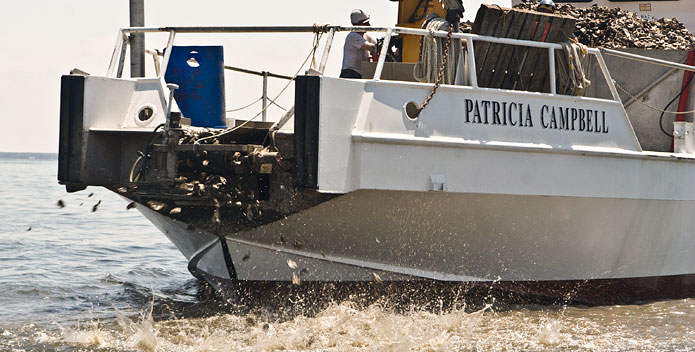
ORC is also the home port of the innovative oyster restoration vessel Patricia Campbell. With its state-of-the-art technology, it is the most advanced vessel in the Bay being used for oyster restoration. Using the Patricia Campbell, CBF staff builds reefs and plants them with juvenile oysters. Among the vessel’s highlights is its custom conveyor belt system for planting reef material and oysters with pin-point accuracy. This helps the crew build oyster reefs to exact specifications.
Back to Top
Get Involved!
CBF needs your help to restore the native oyster population. We rely very heavily on volunteer help to make our oyster restoration programs work and we are always looking for new volunteers. Our busiest season at ORC is May through October.
If you’d like to get involved at ORC, here are three excellent options:
- Contact MDOysterGardening@cbf.org to get added to our e-mail list. You’ll be notified when we need volunteers for hands-on field restoration projects.
- Take a tour of ORC! Groups or individuals can schedule a one-hour tour of the ORC facility and learn about oyster restoration on the Chesapeake. Please contact Karl Willey at kwilley@cbf.org or (410) 353-0564.
- Book an educational field experience for your group aboard the vessel Marguerite. This program can be structured to include a one-hour tour of ORC and focus on oysters and oyster restoration. Please contact our Education Scheduling Office at Educationcoordinator@cbf.org or call (410) 268-8816.
Back to Top
Directions to the Oyster Restoration Center
From Annapolis
Take Route 2 South to the intersection of Route 2 and Route 214 (Central Ave), just pat K-Mart. Go left on Route 214 (Central Avenue), then take a right on Route 468 (Muddy Creek Road) at Muddy Creek Liquors. You are now approximately 20 minutes away. Continue on Route 468 into Shady Side. You will pass the Post Office on your left. Make a right turn onto Snug Harbor Road (Moose Lodge on the corner) and follow the road around the bends. Turn left (Atwell Road) when you see the sign for Discovery Village, passing in front of Shady Side Elementary School, and follow signs to the property (4800 Atwell Road). You are now at Discovery Village. Look for the oyster setting tanks and the R/V Patricia Campbell behind West River Rigging.
From Baltimore
Take Route 97 south to Route 50. Exit towards Annapolis/Bay Bridge. Immediately exit onto Aris T. Allen (Route 665). The second exit will be for route 2 South (Edgewater/Solomons). Follow Route 2 and take a left on Route 214 (Central Avenue), follow and take a right on Route 468 (Muddy Creek Road). You are now approximately 20 minutes away. Continue on Route 468 into Shady Side. You will pass the Post Office on your left. Make a right turn onto Snug Harbor Road (Moose Lodge on the corner) and follow the road around the bends. Turn left (Atwell Road) when you see the sign for Discovery Village, passing in front of Shady Side Elementary School, and follow signs to the property (4800 Atwell Road). You are now at Discovery Village. Look for the oyster setting tanks and the R/V Patricia Campbell behind West River Rigging.
Back to Top
|