Regenerative Agriculture
Farms can improve water quality, build resilience, and fight climate change with holistic farming systems designed to work in harmony with nature.
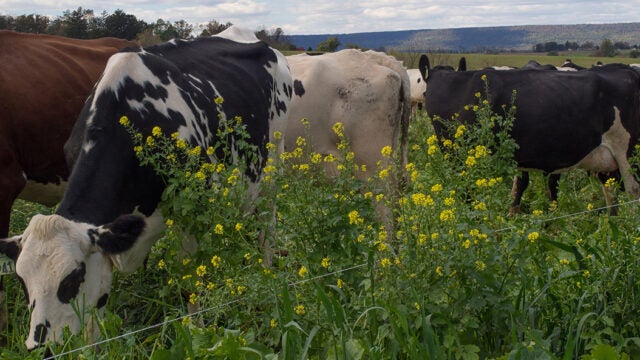
We’ve heard about growing sustainable food, but what if farmers could go beyond preserving the environment and actually improve it?
Regenerative agriculture describes holistic farming systems that, among other benefits, improve water and air quality, improve soil health, enhance ecosystem biodiversity, produce nutrient-dense food, and store carbon to help mitigate the effects of climate change. Regenerative farms span the spectrum from dairies to poultry operations to vegetable growers, but all are designed to work in harmony with nature while maintaining and improving economic viability.
Widespread use of conservation practices, like those used in regenerative agriculture, could significantly reduce the amount of pollution flowing into the Bay from farms.
Is regenerative agriculture different from sustainable agriculture?
The 1990 Farm Bill defined the term “sustainable agriculture” to include farms that satisfy human food and fiber needs while also enhancing environmental quality, making efficient use of resources, sustaining the economic viability of farms, and enhancing the quality of life for farmers and society as a whole. Though the definition speaks to enhancing environmental quality, the term “sustainable” can imply a system that simply maintains the status quo. Regenerative agriculture, instead, strives to improve ecosystem health.
Is regenerative agriculture a new idea?
The concept of regenerative agriculture is not new. Indigenous communities did not use plows or till the land. They terraced the land to prevent erosion, planted streamside buffers to protect sensitive areas, and grew both wild and domesticated foods. Over a century ago, farmer and scientist George Washington Carver used nitrogen-fixing peanuts to improve soil health, advocated for biodiversity on farms, and promoted the use of compost to improve soil.
Regenerative agriculture’s deep roots in farming culture and history provide a strong foundation for the future of food production in the Chesapeake Bay watershed.
What is regenerative agriculture?
Regenerative farming practices are designed to work in harmony with nature by incorporating these top five principles.
Regenerative farmers often minimize tilling their land, or forgo tilling all together so not to disturb the the physical, biological, and chemical aspects of the soil. They also seek to reduce or eliminate the use of chemicals, such as pesticides and chemical fertilizers.
Instead of tilling the land, regenerative practices include mulching, planting cover crops (crops that are not sold, but provide other benefits, such as soil improvement, water retention, weed suppression, and erosion prevention), and keeping the land as permanent pasture.
Diversity helps build healthy soils to better trap water and nutrients, can provide other sources of revenue for the farm, and can benefit pollinators and wildlife. Regenerative farms may vary crop rotations, plant multiple species of cover crops together, grow diverse forage in pastures, and maintain permanent vegetation (conservation cover) in some areas of the farm.
Roots stabilize the soil and continually cycle water and nutrients so these valuable resources don’t wash away. Regenerative farms can do this by planting cover crop seeds in the same fields as their primary crops, prior to harvest, to ensure the fields are never bare (a technique called overseeding); planting their primary crops directly into fields where cover crops are already growing (called planting “green” into cover crops); or converting cropland to pastures.
Livestock manure can add valuable nutrients to the soil, reducing the need for fertilizers, and permanent pastures can trap large amounts of carbon and water, reducing farm emissions and polluted runoff. Practices include rotational grazing—moving livestock frequently between grass pastures to allow plants time to regenerate—or grazing cover crops.
What are the benefits of regenerative agriculture?
Regenerative agriculture provides many benefits to farmers, the environment, and society.
Healthy soils are the foundation of regenerative agriculture. Regenerative agricultural systems not only help increase the diversity and health of life in the soil, but can also improve wildlife habitat and ecosystem biodiversity above ground. These systems increase the land’s ability to filter and retain water, making farms and communities more resilient to drought and floods, while reducing erosion and polluted runoff. They also increase the nutrients available to plants and naturally protect against pests, reducing the need for fertilizers and pesticides that contribute to pollution in the first place. Certain practices, like forested streamside buffers, also have a cooling effect on nearby land and streams—an increasingly important role as temperatures rise and threaten aquatic species, like trout, that need cool water to survive.
There is a symbiotic relationship between plants and the tiny organisms that live in the soil, called soil microbes. Plants, through photosynthesis, provide liquid carbon that feeds the soil microbes. In turn, microbes provide plants with nutrients like potassium, iron, calcium, and others that help them grow and stay healthy, ultimately providing nutrient-dense food for animals and humans that is free from chemical contaminants.
Healthy soils are also slower to dry out during periods of drought and have a greater capacity to soak water into the ground during heavy rainstorms, reducing flooding
Many of the same conservation practices that reduce water pollution by focusing on building healthy soils and maintaining permanent vegetation can also capture substantial amounts of carbon from the air and store it in the soil, helping mitigate the effects of climate change. They can reduce carbon dioxide emissions by reducing the use of farm equipment, as well as reduce nitrous oxide emissions by reducing the amount of nitrogen fertilizer applied to fields and increasing the amount of nitrogen used by plants. For example, CBF’s multi-year study of farms in the Bay watershed that converted conventional farmland to rotationally grazed pasture found an average reduction of 42 percent for net greenhouse gas emissions along with average pollution reductions of 63 percent, 67 percent, and 47 percent for nitrogen, phosphorus, and sediment, respectively.
Practices that build healthy soils also make the land more resilient to the impacts of extreme weather linked to climate change, like flooding and droughts.
Improved soil health can lead to higher crop yields, better forage quality for animals, and reduced risk due to increased resiliency to pests, drought, or floods. Cost savings from reduced use of livestock feed, synthetic fertilizers, herbicides, insecticides, and antibiotics can also have a positive impact on farm profitability. For example, a group focused on promoting solutions to climate change estimated that an investment of $57 billion in regenerative agricultural practices would yield a projected return of $1.9 trillion through savings on costly inputs like synthetic fertilizers and pesticides and increased farm profits.
How can farms become regenerative?
These top eight conservation practices can help farms become more regenerative. CBF advocates for policies and programs that support regenerative agriculture and works with farmers to integrate many of these practices into their operations.
Forested buffers, also called riparian buffers, are areas bordering stream banks that are taken out of crop production or pasture use and planted with native trees, shrubs, or grasses. They act as natural filters that slow water flowing off the surrounding fields and allow nutrients from fertilizer and manure to soak into the ground. They benefit both the farm and the streams by reducing erosion of soil, and farmers can select trees that provide additional benefits—such as shade for livestock or fruit and nuts that can be harvested as additional crops.
The trees also help with climate change by removing carbon dioxide directly from the air, moving carbon into the soil, their leaves, and branches. Each acre of forest buffer removes approximately 0.91 metric tons of carbon dioxide per year.
Livestock operations often grow corn and other crops to feed their animals. By converting this land to pasture, farmers can build their soil health and create a permanent cover of vegetation that traps soil, water, nutrients, and carbon. In addition, rotational grazing involves frequently moving livestock between small grass pastures, sometimes as often as once a day, rather than keeping livestock on the same area of land for long periods of time. This allows plants time to regenerate, preventing bare ground and keeping pastures more vibrant with healthier soil. By moving animals frequently, rotational grazing also spreads manure naturally over the land rather than concentrating it in one place.
For information on how to manage regenerative grazing, see our brochure Stepping Up Your Grazing Management.
Continuous no-till, also known as conservation tillage, reduces erosion and runoff by minimizing soil disturbances. Traditional plowing and tilling create deep furrows in the ground and turns soil over, leaving it unprotected and vulnerable to erosion by wind and water. By minimizing tillage, farmers can build their soil’s health and encourage beneficial microbial life. Healthier soils have a greater capacity to filter water and retain moisture, reducing runoff and keeping nutrients in the ground. Healthy, undisturbed soil can also store large amounts of carbon, keeping it out of the atmosphere and benefiting the climate.
Conservation crop rotation is rotating the types of crops grown on a piece of land in a planned sequence. Crops may alternate, for example, between those with deep roots and shallow roots or those that depend on or fix certain nutrients. Growing the same crop on the same land constantly gradually depletes nutrients in the soil. A well-planned crop rotation can reduce reliance on one set of nutrients, reduce pests and weeds, reduce the need for fertilizer, and improve soil structure and organic matter, which increases farm resilience and decreases soil erosion and flooding.
Conservation crop rotation is rotating the types of crops grown on a piece of land in a planned sequence. Crops may alternate, for example, between those with deep roots and shallow roots or those that depend on or fix certain nutrients. Growing the same crop on the same land constantly gradually depletes nutrients in the soil. A well-planned crop rotation can reduce reliance on one set of nutrients, reduce pests and weeds, reduce the need for fertilizer, and improve soil structure and organic matter, which increases farm resilience and decreases soil erosion and flooding.
Cover crops are not sold, but provide other benefits to the farm, such as soil improvement, water retention, weed suppression, and erosion prevention. They are typically grown at strategic times before or after cash crops, such as corn or soybeans, to ensure farm fields are continuously covered in vegetation. This both protects bare soil from erosion and makes sure any excess fertilizer in the field is held in plants, rather than washing off into waterways. Cover crops can also enhance the health of the soil. For example, certain crops add back nutrients that were depleted during the main harvest, while others help break up the soil with their roots—providing natural tillage without disturbing the soil overall.
Silvopasture—intentionally planting trees on grazing land—can enhance herd health by offering shade, shelter, better quality grazing, and reduced stress on livestock. Mature trees also reduce polluted runoff, sequester carbon, and contribute to healthier soils.
Nutrient Management Plans (NMPs) are documents that outline how much and when fertilizers should be used on a farm’s crops. This helps ensure that crops are able to use the fertilizer when it is applied, reducing nutrient runoff into local waterways and minimizing farmers’ fertilizer costs.
Installing fences along streams in pasture areas is a simple but essential way to reduce pollution on farms. Fences keep livestock and their waste out of waterways, reducing pollution and erosion and helping prevent the spread of waterborne disease. Water pumps and lines, and even solar-powered mobile watering stations, can provide viable alternative water sources for the animals. In addition, the purchase of necessary supplies and labor benefits local businesses. While streamside fences do not affect greenhouse gas emissions, they are often used together with other practices that do—such as streamside forest buffers and grazing systems.
Resources
Related Stories
-
 Blog Story
The Deep Roots of Regenerative Agriculture
Tens of thousands of years ago, farmers of color around the world pioneered ways of working the land that are critical for restoring ecological balance, clean water, and community today.
-
 Blog Story
Agriculture’s Future Is Now
What does a farm have to do with saving the Bay? How we can produce enough nutritious food while also reducing pollution and restoring the health of our waterways? Jared and Elissa Planz look at how CBF's Clagett Farm is answering those questions.
