March: Barnacles and Springtime
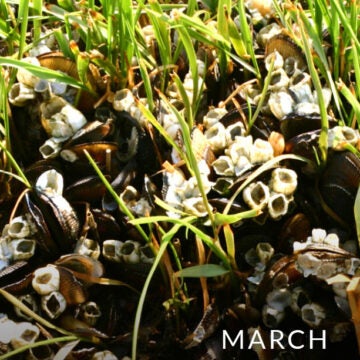
In March, you can see the tiny, wedge-shaped larvae of barnacles catching early spring plankton. They scull about with their six legs, not yet ready to settle and grow into the barnacles we know. Most Bay lovers have at least one good barnacle story. Invariably these tales involved hands cut by sharp shells, or speed- and fuel-robbing crust on boat bottoms. But these crustaceans do more than create havoc for humans. They create little ecosystems on dock and pier pilings and fallen trees. In this episode, John Page opens up the world of yet another small Bay creature that has a story that surpasses its tiny size.
Chesapeake Almanac Podcast
Episode 46
Copyright © John Page Williams, Jr. all rights reserved.
This is John Page Williams with another reading from Chesapeake Almanac. This entry is from the month of March and it’s entitled “Barnacles and Springtime.”
Copepods are not the only animals that an early spring plankton tow will catch. Mixed in with them will be wedge-shaped creatures with six legs each, skulling themselves around. They’re barnacle larvae.
Development of the tiny creatures is slow in cold water, and they have some changes to go through, so it’ll be a month or more before these early larvae settle on pilings or fallen trees or boat bottoms. Like the copepods, they will build to a peak later in the spring, but there are enough around now to make watching them interesting. It seems strange that these tiny, transparent animals can cause enough trouble to support a worldwide industry of boatyards and sophisticated paint manufacturers, as well as major controversies about toxic substances put into the paint to discourage them.
Everyone has at least one good barnacle story. Invariably these tales involve hands cut by sharp shells or speed- and fuel-robbing crust on boat bottoms. We tend to think of barnacles as rounded, empty shells that scrape like a wood rasp and cling as though held together by Superglue. It takes a sharp eye to watch a live adult in action.
Two hundred years, ago barnacles were considered mollusks, a kin to oysters and clams. But an early microbiologist set up an experiment to watch a few adults spawn. He raised the larvae and was surprised to find that they were actually crustaceans, kin to copepods, shrimp, and crabs. They molted, changed to a second larval form, settled onto a firm base in the tank, and metamorphosed into adults. The experience led him to closer examination of the adults, which of course showed them indeed to be crustaceans.
This group of animals, like their relatives the insects and spiders, have hard outer shells of protein and calcium combined into a substance called chitin, c-h-i-t-i-n, with bodies and legs jointed for movement. In the case of the barnacles, the outer shell, with which we’re all too familiar, is made of plates of chitin locked tightly together, with two sliding hatches of shell overhead that are opened and closed by muscles inside. Look at an encrusted piling at low tide. Open, empty shells are dead, but those with closed doors are live ones. When the water returns ,they will open up and the animals will begin to feed.
There is an old saying, attributed to Thomas Henry Huxley, that a barnacle stands on its head and kicks food into its mouth with its legs. It’s a good description, except that the adult barnacle does not have much of a head, and his nervous system is relatively simple compared to that of a mobile creature like a crab.
But the curved, feathery legs are graceful and beautifully coordinated. They sweep out of the shell and back in, picking up zooplankton (probably even including some of the barnacle’s own larvae) plus diatoms and other phytoplankton. The legs set up currents that sweep in smaller creatures like bacteria. The easiest way to watch barnacles is to find an encrusted chunk of wood or an oyster shell and put it into a pan or a bucket of water. The barnacles will close up during the transfer, but after a few minutes they will open and begin feeding again. Even now, in March, adult barnacles are feeding, especially on sunny, warm days.
It’s all too easy for us boatowners to take a negative view of barnacles. They not only foul a boat’s bottom themselves, but they offer good nooks and crannies where other creatures can attach, as well. A community of algae, worms, sponges, amphipods, and other tiny animals builds up around the shells.
On a boat bottom, this creates a royal mess. But consider the value of it growing on a piling. Sometime this summer, lie on your stomach on a dock and watch what is happening around its pilings. Crabs rest on them, but they also feed on the worms, amphipods, and grass shrimp that they catch there. White perch and spot nibble at the same foods, as well as nipping and crushing some of the barnacles themselves. The fish turn and roll, flashing in the dim light as they labor to get a purchase on stubborn shells. Enterprising fishermen know how to work a group of bridge or pier pilings for these panfish, and sometimes for the bigger rockfish, trout, or flounder that they in turn attract. Barnacles are problems on boats, but in other places they’re extremely valuable.
For more happenings around the Bay in March see our other Chesapeake Almanac podcasts.
Subscribe to this podcast at https://chesapeake-almanac.captivate.fm/listen
