Experiencing Sadness and Seeking Solutions After Severe Weather Strikes Lancaster County
The following was first published in LNP|LancasterOnline.
Over the course of the past month or so, my visits to Strickler Run, just south of Columbia, have revealed conditions that are nothing short of horrific.
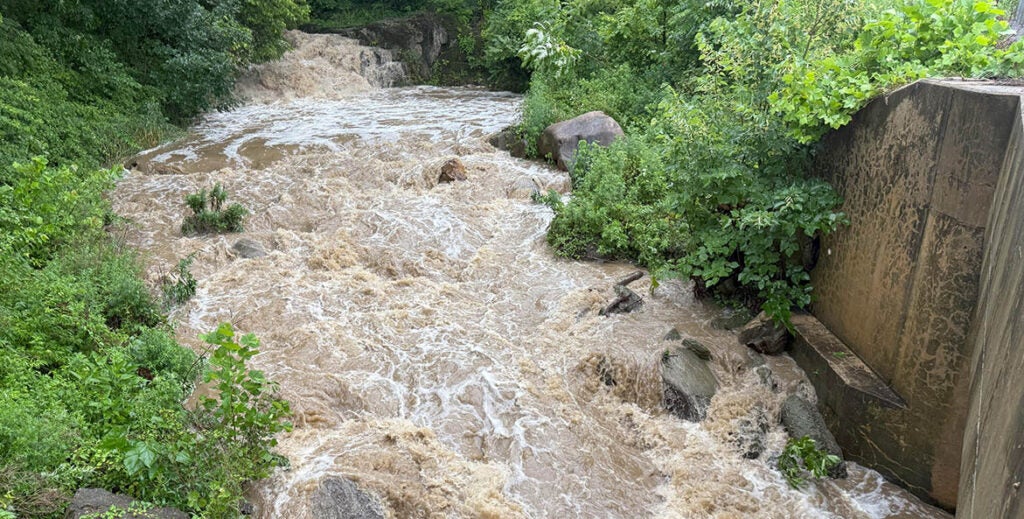
The occasion of a modest, mid-June thunderstorm was sufficient to turn this diminutive Lancaster County creek into a raging torrent of runoff and debris. I saw a gentle stream mutated into a polluted deathtrap.
With severe storms forecast on July 14, I placed a time-lapse camera along Strickler Run to document the garish transformation that was certain to unfold. After the deluge of about 8 inches of rain abated, I returned to find my camera—and the entire tree to which it was attached—had been swept away.
The costs of recovering damaged property and infrastructure are tremendous. As LNP|LancasterOnline reported, those same storms led to dozens of water rescues, leaving damaged homes and vehicles in their path.
But in the end, such material possessions can be replaced. Lives lost and hearts traumatized cannot. When extreme weather leaves such tragedies in its wake, we carry that grief forever.
As Pennsylvania senior watershed planner for the Chesapeake Bay Foundation, I am working with the local community to develop a strategy to rehabilitate Strickler Run. This plan will also encompass the other 12 streams entering the Susquehanna River between Chickies Rock and Safe Harbor Dam, collectively known as the Columbia-Manor River Tributaries.
Central to this effort is addressing how human choices exacerbate the dire consequences of extreme weather within the Susquehanna Riverlands Conservation Landscape.
When severe storms strike, they deliver water quickly and devastatingly. We compound this by continually replacing rain-absorbing vegetation and trees with runoff-generating pavement and roofs. The resulting flash floods displace families, lay waste to crops, damage infrastructure and spread hazardous debris, contaminants and waterborne pathogens. Most tragically, they also take lives.
Fortunately, by working together, we can mitigate flood risks while reducing the pollutants flowing into these waterways.
 Brian Gish
The Columbia-Manor River Tributaries project comprises a drainage area of 20 square miles, with 29 miles of streams (including the six of Strickler Run). Roughly 20,000 people across the boroughs of Columbia and Mountville, plus Manor and West Hempfield townships, call this area home.
Our team, with partners ranging from water quality experts to community members, is developing a local strategy to implement clean water practices such as planting forested stream buffers, restoring streams, fencing stream banks, sowing cover crops and adopting no-till agriculture. Combined, these practices diminish storm surges, retain valuable topsoil and reduce the volume of harmful pollutants and debris that is entering our waterways.
An innovative feature of this plan is its collection of small, adjacent streams, rather than a single, larger one and its tributaries. A diverse mix of urban, suburban, rural and natural spaces gives each of these waterways a unique character, with individual challenges and opportunities.
It’s novel and I’m excited about it.
This plan is more important than ever, as weather trends point to future events of greater severity and frequency.
The science communication group Climate Central reports that flood damage cost Pennsylvania roughly $2.8 billion in 2020 and that the figure could increase by 8% by 2050, based upon our current meteorological trajectory.
One inch of rain falling on an acre of impervious surface, such as streets and parking lots, produces 27,000 gallons of runoff. Stormwater passing over such hard surfaces often picks up oil, grease, garbage and lawn fertilizers and chemicals as it flows toward nearby waterways.
Last year, the report “Extreme Precipitation in a Warming Climate,” by Climate Central, noted that as global temperatures have climbed between 1958 and 2021, the heaviest storms now drop 60% more rain in the Northeast (including Pennsylvania, Maryland, the District of Columbia, New York and West Virginia).
For the current Atlantic hurricane season, the National Oceanic and Atmospheric Administration forecasts a 60% chance of an above-normal season. It sees 13 to 19 named storms developing, including six to 10 hurricanes, with three to five of those achieving Category 3 status or higher.
The U.S. Geological Survey operates a nationwide network of over 10,000 stream gauging stations that provide real-time data on water levels and streamflow. These stations are essential for tracking water quality, managing resources and forecasting floods. Pennsylvania has more than 300 of these stations.
All evidence suggests Lancaster County will not be spared the worsening impacts of extreme weather.
I returned to Strickler Run four days after it was transformed by the mid-June thunderstorm’s wrath. The stream, then modest and crystal clear, invited a family of five to splash and play in its cool waters, a welcome respite on a hot day.
Moments such as this—seeing this stream’s potential to overcome the challenges it faces—are why our watershed planning efforts are so critical.
