Shellfish Aquaculture
Shellfish aquaculture provides important economic, employment, and ecological benefits.
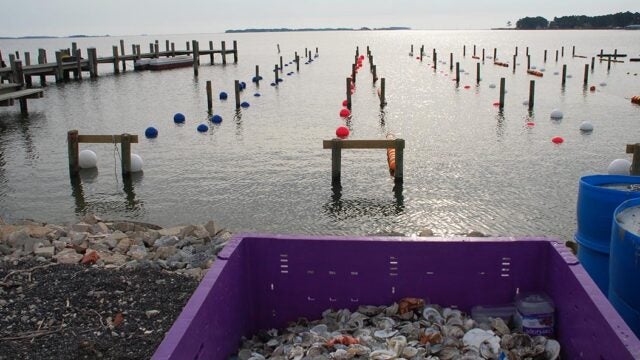
What is shellfish aquaculture?
Shellfish aquaculture is the process of cultivating oysters, clams, mussels, or other shellfish for food. By cultivating the Chesapeake Bay’s native oyster, Crassostrea virginica, oyster farmers help recover some of the oyster’s critical functions in the Bay ecosystem and economy.
Today, aquaculture supports a more than $30 million industry in Maryland and Virginia.
Why do we need aquaculture?
U.S. per capita seafood consumption ranks fourth in the world, yet we barely break the top 25 producers of aquaculture seafood globally. To satisfy our demand, we import nearly $19 billion in seafood, resulting in a $12 billion seafood trade deficit annually. Developing a profitable aquaculture industry would reduce the seafood trade deficit, create jobs in working waterfront communities, and provide consumers with fresh, locally-sourced products.
A report issued by Virginia Tech and Engle-Stone Aquatic$ shows how the industry provides valuable economic benefits and employment opportunities to Maryland’s coastal communities. It also supports a diverse suite of economic sectors from real estate and wholesale trade to food service.
Shellfish aquaculture also provides strong ecological benefits. Under natural conditions, oysters form large reef structures that support more than 300 other species, making it a keystone species in the Chesapeake Bay. Unfortunately, oyster populations and their reefs have been reduced to a small fraction of their historical abundance. Fortunately, recent studies have shown that oyster aquaculture gear provides novel habitat to many of the same species that live on oyster reefs. Our native Eastern oyster, Crassostrea virginica, is a prolific filter feeder and a healthy adult can filter 30-50 gallons of water daily, consuming the phytoplankton that grows on excess nutrients in the Bay. These nutrients are removed from the water and retained in the oysters’ shells and tissue, improving water quality. When the oysters are harvested, the nutrients are removed with them. In the future, quantifying these ecosystem benefits could allow shellfish growers to receive compensation under a nutrient trading system.
Support Shellfish Aquaculture
Our partners in the Chesapeake Oyster Alliance and the Maryland Shellfish Growers Network figured out new ways to bring the tasty bivalve to your plate. Find out where to buy Chesapeake Bay-farmed oysters and help a local company that is helping to save the Bay.
