Agriculture Cost-Share in Pennsylvania
Pennsylvania farmers want to help clean up their waterways, but need support. The Agriculture Conservation Assistance Program (ACAP) provides a true statewide cost-share program to help them apply best-practices.
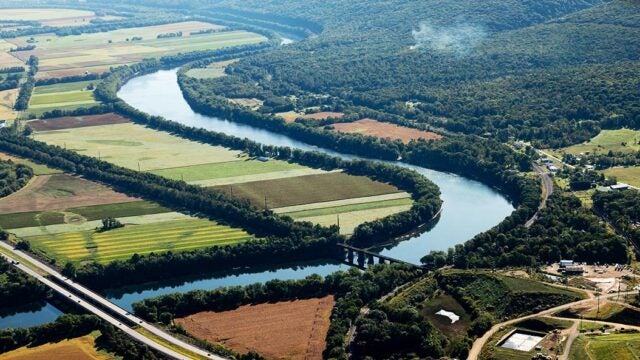
Agriculture is an integral part of Pennsylvania’s culture, heritage, and economy. It also serves, when done correctly, as a natural filter, soaking up rainfall and runoff before it reaches Pennsylvania’s creeks and the Bay downstream. But farmers need help to implement critical conservation practices to clean up the Commonwealth’s waters.
Pennsylvania’s farmers are stewards of the land. The Agriculture Conservation Assistance Program, or ACAP, is a statewide cost-share program to help farmers implement best management practices and leave a legacy of healthy soils and clean water.
Video courtesy Choose Clean Water Coalition
While Pennsylvania has financial assistance programs like the Resource Enhancement and Protection (REAP) program and the pilot Conservation Excellence Grant (CEG) Program, as well as USDA NRCS programs funded through the Federal Farm Bill, ACAP is different. Enacted in 2022 as part of the Clean Streams Fund legislation (SB 832/HB 1842), ACAP invested $154 million to establish a statewide program that will be directed locally by county conservation districts.
The legislature took another historic step in 2024, including $50 million from personal income taxes in the tax code as new recurring funding each August for the Clean Streams Fund. More than 71 percent of that is allocated to ACAP. The fund tackles the top three sources of stream impairment in the Commonwealth: some agricultural activities, acid mine drainage, and urban/suburban stormwater runoff.
In the Governor’s budget proposal for 2025-26, $50 million was again allocated to the Clean Streams Fund and ACAP.
ACAP provides financial resources to farmers to install conservation practices that work best for each farm and technical assistance funding to the conservation district to support farmer requests.
ACAP is working. As of February, 2025, $141 million was committed to 66 county conservation districts and Philadelphia. And $109 million was spent (under signed contract with farmers) and committed to 1,227 projects.
The result: healthy soils, clean water, thriving local economies to name a few—for the benefit of all Pennsylvanians.
How ACAP Works
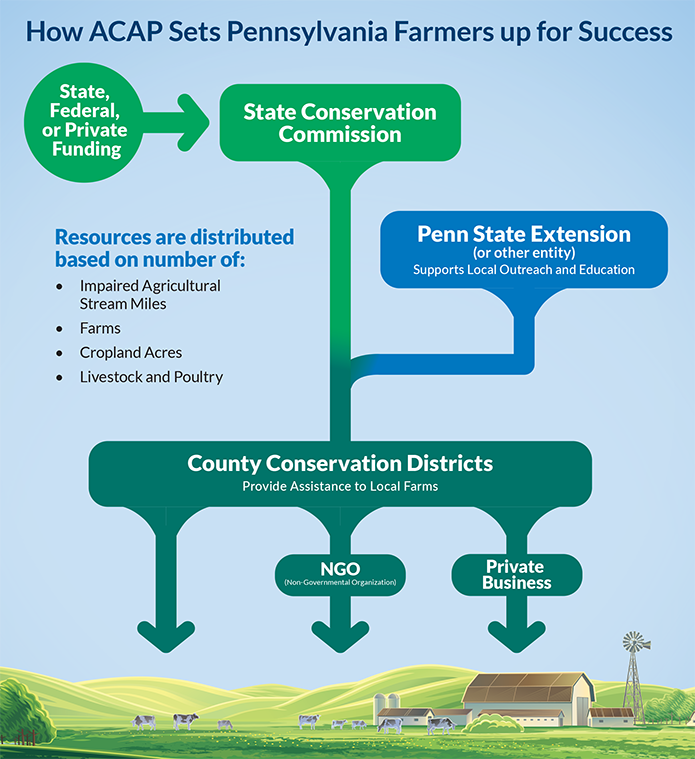
ACAP is modeled after Pennsylvania’s lauded Dirt and Gravel Road Maintenance Program, which is administered by the State Conservation Commission. Similar to that program, ACAP funding is distributed to county conservation districts based on areas with the greatest need for improvement. County conservation districts work with participating farmers and landowners, or with non-governmental organizations and farm consultants, to help design and implement soil and water conservation practices that will work best for each farm’s unique circumstances. There are no mandated practices in ACAP.
Like their role in the Dirt and Gravel Road Maintenance Program, the Penn State Cooperative Extension assists with education, training, and outreach to farmers and participating partners involved in the program.
 Chesapeake Bay Foundation
5 Ways ACAP Benefits Pennsylvania
More than 6,000 miles of Pennsylvania’s rivers and streams are considered impaired from agricultural activities. ACAP means critters like brook trout and the hellbender that rely on cool, clean water to survive will have cleaner, healthier habitat.
Most Pennsylvanians get their drinking water from lakes, rivers, and streams. ACAP helps keep pollutants out of sources of drinking water thus improving quality and reducing treatment costs.
Agriculture is Pennsylvania’s leading economic enterprise. ACAP helps boost local business and jobs, benefiting quality of life in communities across the state.
Agriculture is part of Pennsylvania’s culture and heritage. Cleaner, greener farmland means more iconic views sought after by the growing number of agritourists.
Agricultural production activities are a leading source of Pennsylvania’s nutrient and topsoil loss degrading the Chesapeake Bay. ACAP goes a long way in helping our community and our neighbors downstream.
Why Agriculture Cost-Share Is Important to Achieving Pennsylvania’s Blueprint Goals
Pennsylvania reduced its agricultural nitrogen pollution flowing to the Bay by 1.6 million pounds between 2010 and 2018. Farms will need to cut an additional 22.3 million pounds of nitrogen to meet the Commonwealth’s 2025 Blueprint goals under the Chesapeake Bay Clean Water Blueprint—roughly 93 percent of its total remaining reductions.
While the REAP program and other Pennsylvania financial assistance programs provide a positive foundation to build upon, they still fall far short of the level of investment needed in agriculture to successfully meet the Commonwealth’s pollution reduction goals.
5 Ways ACAP Benefits Farmers
County Conservation Districts, Penn State Extension, and others will help farmers with a plan tailored to their operation.
Adopting conservation practices fosters healthy soil that will help sustain plants and animals, break down dead vegetative material, control diseases, and improve soil structure.
No-till cultivation, cover crops, and other practices that improve soil health will strengthen nutrient cycling and natural pest resistance, reducing farmers’ need for costly fertilizers and pesticides.
Healthy soils filter water in wet weather, retain moisture during drought, moderate soil temperature, and keep soils and nutrients from running off your land.
For many farmers, farming is more than a livelihood. It’s their culture, their heritage, and their legacy. Passing down a productive operation with healthier soils and cleaner water can be key to the success of future generations.
What You Can Do to Help
The Clean Streams Fund and ACAP are historic investments in Pennsylvania. But with nearly 28,000 miles of impaired streams across the state, there’s more work to be done.
- Sign up for our Action Network to get important advocacy updates.
- Check our Action Center for tips and tools.
- If you want to know how you can do more, contact our Pennsylvania Grassroots Manager Carla Eissing at ceissing@cbf.org.
See and hear what others have to say about ACAP:
- A Shot in the Arm to Pennsylvania’s Farmers and Economy (video by Choose Clean Water Coalition)
- Pennsylvania Farm Bureau Conservation News Conference (video)
- Proposal would help Pa. farmers fund conservation plans (York Dispatch)
- Guest editorial: Pass Yaw bill to help farms get greener (The Tribute-Democrat)
