A Good Way to Make the Chesapeake Bay Cleanup Harder
The Chesapeake Bay Foundation has a pretty simple job: Save the Bay.
It’s also pretty simple to understand that dumping more pollution into the Bay makes that job harder. Or that suffocating heat makes it harder for the Bay’s cool-loving plants, fish, and animals to survive (not to mention cool-loving people). Or that flooded roads and businesses make it harder to get to work and school and doctor appointments.
That’s exactly what climate change is doing in cities, towns, rivers, and marshes all around the Chesapeake Bay. But as of this month, the federal government has a new rule that makes it a lot harder to stop the pollution that—quite literally—drives climate change.
CBF joined a lawsuit trying to stop the government’s new rule. We asked Ariel Solaski, our Director of Litigation, to explain what it’s all about and why CBF is part of it. [This conversation was edited for length and clarity.]
Q: On April 8, CBF, represented by Earthjustice, joined a coalition of organizations that are suing the Trump administration because it got rid of something called the ‘endangerment finding’. What is it?
A: The term ‘endangerment finding’ comes from language in the Clean Air Act. Before the U.S. Environmental Protection Agency (EPA) can regulate a type of air pollution, it must find that the pollution is dangerous to people or their environment. EPA did just that in 2009 when, based on a massive amount of scientific evidence, it found that greenhouse gases from vehicles and engines—pollution that causes climate change—are harmful and need to be regulated. That decision is what we call the ‘endangerment finding’ in this case.
Q: What does a rule that deals with air pollution from cars and trucks have to do with the Chesapeake Bay?
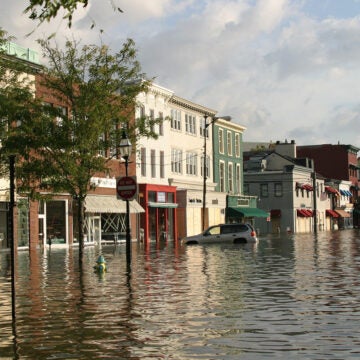
A: We know that greenhouse gases from any source, including cars and trucks, are contributing to climate change and that climate change is affecting the water. Stronger storms are washing in more pollution. Water temperatures are rising , which is a major concern for a lot of fish and aquatic habitats. Warmer water also holds less dissolved oxygen, which aquatic species need to survive. And then the combination of rising sea levels and sinking land is really a problem in the Chesapeake Bay region. Not only are people’s homes and businesses increasingly threatened by flooding and storms, but we’re also losing wetlands that are home to fish, shellfish, and birds.
We also know that more greenhouse gas pollution will make all of that worse. Transportation, including the cars and trucks we drive, is the largest source of greenhouse gas pollution in the country.
Q: Ok, so we know that climate change is a big problem for the Bay. What can we do about it, and how does the lawsuit fit in?
A: What CBF can and does do, along with so many partners, is work that reduces the harmful impacts of climate change on the Bay’s water and wildlife, and the people who live here. We do that through things like oyster restoration and living shoreline projects that help communities deal with flooding and erosion. We plant trees along streams and along streets to help cool things down and trap pollution before it gets to the water. And we also try to decrease our own impact through the design of our buildings, using things like solar power and green infrastructure to slow and filter stormwater runoff.
What groups like ours can’t do is control greenhouse gas pollution from cars and trucks. That is the federal government’s responsibility. With its new rule, the government said it won’t. That rule is final, so a legal challenge is the only next step. If it’s not challenged, it will stay in place.
Q: Why did CBF, specifically, decide to join the lawsuit?
A: CBF got involved because we want to protect and support all of the work that we and our partners are doing. And also contribute to the range of voices around the country that are painting a picture for the court of what climate change actually looks like for the communities and animals and forests that are being harmed.
We’re doing a lot of work to protect the Bay and all the creatures that live in it, and EPA isn’t doing its part. It’s trying to go backward, and that’s not fair or allowed by the Clean Air Act.
Q: What happens next?
Legally, there are a number of other lawsuits challenging the new rule, in addition to the one that CBF is part of. All of those have been combined and will now move forward in the U.S. Court of Appeals for the D.C. Circuit.
On a broader scale, the concern isn’t only about how this rule allows greenhouse gas pollution and climate change to continue unchecked. It’s also about the overall direction the federal government is taking on this front, not only refusing to work on slowing climate change, but also denying that it’s even a problem. And right now we need everyone to do their part if we want to help people and wildlife weather the storm and chart a collective path forward.
Related Stories
-
 Blog Story
Climate Rollbacks Risk Marylanders First
I’ve seen firsthand how climate change is transforming Maryland. Not in some distant land, but here at home.
-
 Blog Story
All in this Together
Lancaster native and CBF’s Director of Major Giving in Pennsylvania reflects on the organization’s recent efforts to block the Trump administration’s climate protection rollbacks.
