Agriculture
Regenerative farming practices and a healthy farm economy play an important role in local communities and in the water quality of our rivers, streams, and the Chesapeake Bay.
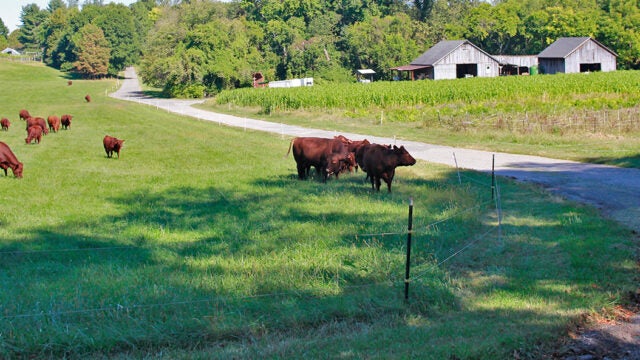
Approximately one-third of the Chesapeake Bay’s 64,000-square-mile watershed is dedicated to farming. Farmers play a critical role in keeping our waters clean. Currently the agricultural sector has the greatest opportunity to reduce pollution to the Chesapeake Bay.
CBF advocates for conservation programs that establish on-the-ground projects that limit polluting runoff while improving farm health. These practices include stream buffers, continuous no till, rotational grazing, conservation crop rotation, cover crops, silvopasture, nutrient management, streamside fencing, and other best management practices.
When farming with these practices, agriculture has the potential to not only sustain but regenerate the land, while also injecting money into the economy.
How Farms Impact the Chesapeake Bay
The way we farm has profound consequences for the health of our communities, our environment, and our local economies.
Farms have the potential to serve as either critical filters or pathways for polluted runoff to our rivers and streams. Conventional agricultural systems often consist of mono-cropping, heavy pesticide and herbicide use, and extensive tillage of the soil. These practices strip nutrients from the soil, erode topsoil, and lead to excess soil erosion and polluted runoff. Agricultural runoff contributes roughly 60 percent of the nitrogen and 45 percent of the phosphorus entering the Bay.
Stream buffers, continuous no till, rotational grazing, conservation crop rotation, cover crops, silvopasture, nutrient management, and streamside fencing, are just a few best management practices that can improve the health of rivers, streams, and the Bay. These practices also provide co-benefits: increased soil health, sequestered carbon, and improved farm resiliency.
Regenerative agriculture describes holistic farming systems that, among other benefits, improve water and air quality, enhance ecosystem biodiversity, produce nutrient-dense food, and store carbon to help mitigate the effects of climate change. These farm systems are designed on ecologically sound principles to work in harmony with nature, while also maintaining and improving economic viability and farm resiliency.
Practices that focus on building healthy soils and maintaining permanent vegetation can reduce nitrogen and phosphorus pollution, actively remove carbon from the atmosphere, and improve the land’s ability to withstand floods, drought, and other extremes linked to climate change.
In addition to reducing pollution, a 2022 CBF report, Agricultural Conservation Practices: Clean Water and Climate Smart Investments, found that fully funding the farm conservation practices needed to restore the Chesapeake Bay would inject $655 million annually into the region’s economy, including $269 million per year in higher earnings for businesses and workers.
What are the challenges to Bay friendly farming?
Farmers are making progress toward clean water, but there are still many challenges to reaching the scale of conservation needed to meet restoration goals.
Watershed-wide, farmers are adopting conservation and preservation measures. But they can’t do it alone. Federal and state government investments in conservation practices, like programs contained in the federal Farm Bill, are crucial to helping farmers reduce pollution, remain profitable, and improve water quality for everyone.
Conventional farming practices have left many operations vulnerable to the effects of climate change, which are already being felt across the Chesapeake Bay watershed. Extreme storms can lead to floods that wash away soil and fertilizers, damaging crops and carrying pollution into waterways. Eroded topsoil also decreases water retention, making farms vulnerable to drought, impacting farm yield and economic viability.
We’re losing agricultural land to sprawling suburban development and ill-conceived solar sites, diminishing profits, increases in the cost of fuel and other operational expenses, and a steep decrease in the share of consumer food dollars received by farmers. Preserving farms and open space is essential, because when farmed regeneratively, these lands serve as precious natural filters for our water.
Black, Indigenous, and People of Color (BIPOC) farmers historically were some of the original regenerative agricultural practitioners, but decades of systemic barriers blocked pathways to land ownership and led to unequal access to support programs and services. Farming has always been an economically challenging occupation for all, but immigrant, refugee, tribal, and BIPOC communities face much greater social and institutional barriers to owning and operating farms successfully.
How does CBF support clean water on farms?
CBF is working with local farmers to improve our lands and waters through regenerative farming.
CBF advocates for strong federal and state agricultural cost-share programs that help farmers adopt agricultural conservation practices by providing them with critical financial and technical support. These conservation practices are some of the most cost-effective solutions to address pollution, providing multiple environmental and societal benefits.
CBF also supports land use programs and policies that slow the loss of farmland to development and prevent sprawl.
Each spring and fall, CBF plants thousands of trees in an effort to keep farm pollution out of the Bay. Planting trees alongside streams is one incredibly effective way to keep pollution out of rivers and streams and aid streams in cleaning nutrients from the water. This practice forms what is known as a “forested riparian buffer” and when implemented on farms, greatly reduces the amount of agricultural waste in our waterways.
Increasing soil health has the dual benefits of reducing polluted runoff and sequestering carbon. CBF funds programs and initiatives that cultivate healthy soil throughout the watershed by promoting principles such as maximizing cover, minimizing soil disturbance, and increasing biodiversity. One practice that embodies these principles is rotational grazing, which involves frequently moving livestock between multiple pastures to allow plants time to regenerate, build organic matter, and create healthier soil. CBFs’ programs connect current and new grazing farmers and provides farmer-to-farmer mentoring, on-farm demonstrations, and other peer-to-peer experiences.
Located in Prince George’s County, Maryland, CBF’s Clagett Farm is a 238-acre working farm, that practices regenerative agriculture to demonstrate the benefits it has on soil health, food, and water quality. The farm has a 20-acre organic vegetable operation, grass-fed beef cattle and sheep, and a native tree nursery.
CBF supports opportunities to assist historically disadvantaged farmers in the region to implement agricultural practices to improve water quality, climate resilience, soil heath and farmers’ economic wellbeing. In conjunction with our on-the-ground efforts, CBF has also developed resource guides for beginning farmers in Pennsylvania and Maryland for finding assistance with loans, marketing, business development, conservation funding, equipment, and other needs.
What can you do to help farms achieve clean water?
We are all part of the food system. There are many ways to support healthy farms and improve water quality in our rivers, streams, and the Chesapeake Bay.
Supporting farmers that are implementing environmentally sound and beneficial practices is a great way to make your consumer dollars have an impact. Supporting local farms also has the potential to decrease the environmental footprint of your food. Wondering where to start? Check out the Buy Fresh Buy Local Food Guide.
Want to get your hands dirty while learning about regenerative agriculture? From May through November, volunteers are welcome to help plant, weed, and harvest. See our events page for available dates and information.
Each spring and fall, CBF plants thousands of trees in an effort to keep farm pollution out of the bay. Learn more about upcoming tree plantings and how you can join us on our events page.
Passed only once every five years, the federal Farm Bill is a package of legislation that has far-reaching impacts on the way food is grown, and the health of our communities and our waterways. Farmers across the watershed have used the Farm Bill conservation programs to convert to more environmentally friendly practices, bringing them healthier soil and increasing their bottom lines.
 Kelly O’Neill
Regenerative Agriculture
Regenerative agriculture describes holistic farming systems that improve water and air quality, enhance ecosystem biodiversity, produce nutrient-dense food, and store carbon to help mitigate the effects of climate change.
Agricultural Cost-Share Programs
State and federal agricultural cost-share programs let more farmers make important upgrades by providing them with critical financial and technical support.
 © Garth Lenz/iLCP
 © Laura LaRose/(CC BY 2.0)
Streamside Fencing
One of the most important farm conservation practices we can implement across the Chesapeake watershed—both for the health of our waters and the health of our farms—is that of streamside fencing.
Related Issues
-
Streamside Fencing
One of the most important farm conservation practices we can implement across the Chesapeake watershed—both for the health of our waters and the health of our farms—is that of streamside fencing.
-
Regenerative Agriculture
Farms can improve water quality, build resilience, and fight climate change with holistic farming systems designed to work in harmony with nature.
-
Agricultural Cost-Share Programs
State and federal agricultural cost-share programs let more farmers adopt farm conservation practices that reduce pollution.
-
Agricultural Cost-Share in Maryland
Agricultural cost-share programs provide farmers with funding that defrays the expense of installing conservation practices, many of which can be costly. Agriculture is an integral part of Maryland's history and cultural identity. It also serves as a precious natural filter, soaking up rainfall and farm runoff before it reaches streams and the Bay.
