Freshwater Mussels
Freshwater mussels are the fascinating, unsung heroes of rivers and streams across the Chesapeake Bay region. But many are in danger.
About Freshwater Mussels
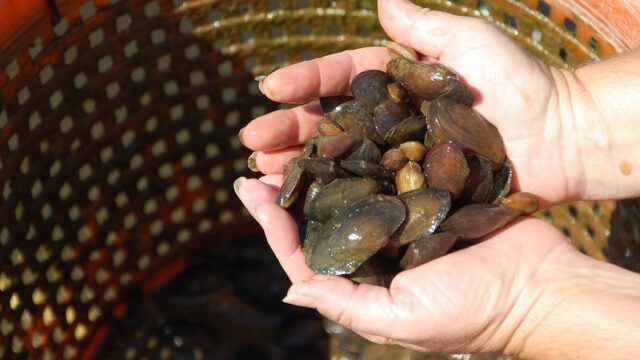
Freshwater mussels are bivalves with two shells that live on the bottom of rivers and streams.
More than 350 species of freshwater mussels once lived in North America. Of those, 25 species of freshwater mussels have historically been found throughout the Chesapeake Bay region. Unlike oysters, which live in saltwater, these mussels live on the bottom of rivers and streams where the water is fresh. Every Chesapeake Bay state and the District of Columbia has freshwater mussels. The Susquehanna, Potomac, Rappahannock, York, and James Rivers are all home to at least 17 or more species. Many of these species have very colorful names, like the creek hillsplitter, paper pondshell, and Eastern pearlshell.
Freshwater mussels cannot move very far on their own, but they’ve come up with a very cool way to get around: They hitch a ride on fish! In order to reproduce, adult freshwater mussels create a specialized ‘lure’ that looks like a small fish. They wave the lure around in the water to attract a bigger fish. When the fish bites the lure, it pops like a water balloon and releases tiny baby mussels that cling to the fish’s gills. In this way, the babies travel upstream and settle in new places. Once there, some species can live as long as 100 years.
Freshwater mussels, like oysters, filter the water as they search for food. This filtering can improve water quality and even help remove nitrogen—a major pollutant in the Chesapeake Bay—before it moves downstream. Beds of freshwater mussels on the bottom of streams also improve habitat by providing homes for many types of aquatic ‘bugs,’ called macroinvertebrates, that fish and other species eat.
In the past 200 years, the number of freshwater mussels and the number of places where they are found have both declined dramatically, according to Chesapeake Bay scientists. The federal government lists three of the region’s species as either endangered or threatened, while individual Bay states list 10 species. Endangered species include the dwarf wedgemussel, triangle floater, brook floater, Atlantic pigtoe, yellow lampmussel, Eastern lampmussel, green floater, tidewater mucket, Eastern pondmussel, and James spinymussel. However, there is still a lot we don’t know about the current state of freshwater mussels because monitoring is limited.
Threats to Freshwater Mussels
Freshwater mussels are considered the most endangered class of organisms in the country, with about two-thirds of species vulnerable to extinction.
Most freshwater mussels are used to living in free-flowing rivers and streams. Dams can create deep, lake-like reservoirs where many mussels can’t survive. They also change how water flows, leading to shifts in water temperature, water depth, and the amount of food that flows downstream. By preventing fish from moving upstream, dams can also cut off the connection between mussels and the fish they need to reproduce. Development and forest loss can also change how water flows through rivers and streams and threaten the places where mussels live.
Much of the pollution that threatens the health of the Chesapeake Bay threatens freshwater mussels. For example, mussels are very sensitive to ammonia, a form of nitrogen. Low oxygen driven by excessive nitrogen and phosphorus, as well as sediment, can also harm mussels. Other pollution of concern includes heavy metals, chlorides, pharmaceuticals, and microplastics.
Climate change is creating increasingly extreme storms and droughts. This can create rapid, intense increases in water flowing into rivers and streams or alternatively create long periods of low water, both of which can threaten mussels.
Invasive species like zebra and quagga mussels can directly harm or out-compete native freshwater mussels. Scientists have also documented unexplained, large-scale die-offs of freshwater mussels that they believe could be due to a combination of factors including disease.
What CBF Is Doing
CBF is actively working to raise awareness and improve freshwater mussel habitat.
A joint effort by CBF, the Florida Museum of Natural History, the Smithsonian Institution, and the U.S. Fish and Wildlife Service used 3D imaging technology to create models of freshwater mussels to use for education and outreach. The models were based on specimens from the Florida Museum of Natural History and the Smithsonian Institution and are now freely available online for the public to view. 3D-printed replicas are also used in CBF’s nationally recognized education programs and to train conservation biologists to identify all 300 species of North American freshwater mussels. CBF also plans to use the replicas for broader community outreach to grow support for mussel restoration. The project was one of the first supported by the Chesapeake WILD program, established by Congress in 2020 to aid restoration efforts in the Chesapeake Bay watershed.
In 2024, the Virginia Department of Conservation and Recreation released a new map that identified freshwater mussel habitat hotspots where restoration could have the biggest benefits for mussels and clean water. The map was funded as part of a grant to CBF from the Chesapeake Watershed Investments in Landscape Defense program, or Chesapeake WILD, which is administered by the National Fish and Wildlife Foundation.
CBF is working with the Pamunkey Indian Tribe and a coalition of partners to restore freshwater mussels in the tribe’s namesake river. The alliance’s work, which kicked off in 2026, will include targeted outreach to landowners in mussel hot spots, an investigation of whether the existing Pamunkey Tribe hatchery can be used to help grow freshwater mussels, as well as efforts to identify populations of threatened and endangered mussels and the fish they rely on for reproduction. The alliance is supported by a grant through the Chesapeake Watershed Investments for Landscape Defense (WILD) Grants Program.
What You Can Do
Freshwater mussels need your help.
Freshwater mussels live throughout the Chesapeake Bay region, but many people don’t even know they exist. By talking to family, friends, and neighbors in your community, you can help raise awareness. People protect what they care about, so this is an important step in building support for policies and actions that can protect and restore freshwater mussels in the rivers and streams near you.
Freshwater mussels are dependent on clean water and healthy streams. Restoration efforts, including planting trees along streams, can help improve habitat for freshwater mussels. Check out CBF’s volunteer calendar to explore opportunities.
What you do in your own home can have an impact on freshwater mussels. Being mindful about the amount of fertilizers, pesticides, and herbicides that you use can help prevent pollution from washing into streams where mussels live.
How to Get Involved
From signing up for an event to shopping our CBF Store, there are so many ways you can get involved in the Save the Bay movement.
