Press Release
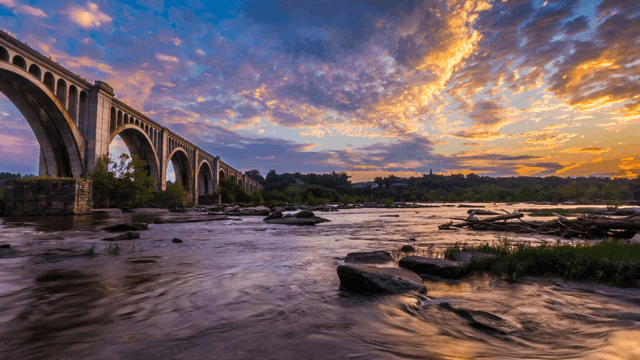
Richmond-area residents will discuss the most pressing environmental issues facing Central Virginia while building leadership skills at a free adult environmental course this summer held by the Chesapeake Bay Foundation (CBF). The program includes Tuesday night classroom sessions in South Richmond and a boat trip on the James River aboard a CBF education vessel. CBF’s Volunteers as Chesapeake Stewards (VoiCeS) class is the organization’s longest-running adult education course.
“Our VoiCeS program empowers individuals with essential skills and knowledge to create a positive impact on the environment and enhance the quality of life in Richmond and beyond,” said CBF Virginia Grassroots Manager Gabby Troutman.
Over the course of six Tuesday evening classes, expert speakers from the Richmond area will cover topics including:
- The health of the James River and Chesapeake Bay watershed;
- How trees are combatting extreme heat in Richmond neighborhoods;
- Richmond’s Climate Equity Index, identifying which neighborhoods are most at risk from climate change, and the city’s plans for creating resilient communities;
- Opportunities to engage in community science efforts to monitor air pollution in the Richmond region;
- RVAH20: The City of Richmond’s fight against stormwater and sewage pollution;
- Environmental justice issues impacting Virginia;
- Examining the state of Virginia’s crab, rockfish, and oyster fisheries;
- How to be an effective advocate at the local, state and federal level, and;
- Expanding urban agriculture to provide fresh produce in underserved communities.
The program will be held in South Richmond on Tuesdays from 6:30 p.m. to 8:30 p.m. from July 18 to Aug. 22 at Second Baptist Church, 3300 Broad Rock Blvd. Advance registration is required online or by e-mailing Gabby Troutman at GTroutman@cbf.org.
This course is free thanks to funding provided by CBF’s generous donors.
Summer is coming. As trees and plants have emerged from their winter slumber, so have outdoor projects for Pennsylvania homeowners. What many don’t realize is that one of those tasks, sealing driveways and parking lots, can pose significant risks both to human health and to aquatic life in our rivers and streams.
Sealants are marketed as a way to help maintain blacktop on driveways and parking lots. Although formulations of many available products vary, they all are intended to help keep the ravages of rain and snowmelt from forming and worsening cracks in paving, which can ultimately reduce the lifespan of macadam. Many products, whether do-it-yourself and professional grade, use coal and oil tars as the main active ingredients.
Tars have hundreds of compounds, including a class of water repelling ones collectively called polycyclic aromatic hydrocarbons (PAHs). Studies have found that PAHs increase the risk of lung, bladder, and skin cancers in humans, pets, and developmental delays in children. According to a study in the journal Environmental Science and Technology, people living near pavement sealed with coal tar have an elevated risk of cancer.
Humans and our furry friends are exposed to the coal tar sealant chemicals by walking on the surfaces and breathing in volatilized compounds. It has been documented that small children are most vulnerable, as they put their hands in their mouths and tend to get down on the ground.
The chemicals get into our houses and yards too. One study found that residences next to parking lots with coal tar-based sealcoat had PAH levels in house dust that was 25 times higher than residences adjacent to unsealed pavement.
When these chemicals get into rivers and streams, they can form a toxic brew for sensitive critters. One study found that runoff from areas with seal-coated pavement was acutely toxic to minnows and small water bugs. Researchers found that the PAHs in the runoff damaged the DNA of critters. Another study found that 100 percent of critters exposed to runoff from pavement sealed with coal tar products died within 42 days. Runoff from uncoated areas had mortality rates of less than 10 percent.
The toxic effects are long-term as well. In fish populations, PAHs in runoff have been found to cause lesions, liver abnormalities, tumors, and decreased juvenile growth. A study in Washington State tested runoff from coal tar-sealed pavement on juvenile salmon. Even after seven months, runoff from sealed areas killed 55 percent of juvenile salmon within 96 hours. Studies have found similar results in other species.
PAHs also tend to store in sediment, making them particularly troublesome for animals that live part of their lives in the mud or streambeds or eat critters that do, like many frogs, fish and salamanders. PAHs have even been found in young dragonflies.
Continued exposure to PAHs leads to concentrated levels inside the body, a process called bioaccumulation.
So concerning is the science on coal tar sealants that 12 states and Washington, D.C. have enacted bans on their sale and 17 have restrictions on use. Pennsylvania, and its multitude of local governments, are not among them.
The best way to reduce your exposure to coal tar sealant chemicals would be to have them removed from Pennsylvania stores. The next best thing is not to use them. Many homeowners have replaced asphalt with concrete or, even better, permeable pavers.
If you have to use a sealant, similarly priced alternatives that are just as effective are readily available. Asphalt-based sealcoats have less PAHs than coal tar. It will be better for your family’s health, your pets, and the health of our fish and wildlife.
This week the Southern Environmental Law Center (SELC) submitted comments on the Federal Energy Regulatory Commission’s (FERC) draft environmental impact statement for Transcontinental Gas Pipe Line (Transco)’s proposed Commonwealth Energy Connector Project and Columbia Gas Transmission’s Virginia Reliability Project (VRP).
The comments were submitted on behalf of the Sierra Club in partnership with Chesapeake Bay Foundation and Chesapeake Climate Action Network. The current draft EIS does not adequately address environmental justice impacts, alternatives that would avoid the Great Dismal Swamp National Wildlife Refuge, alternative methods for the Project’s waterbody crossings, and the alternatives to building the Southside Reliability Enhancement Project’s Compressor Station 168.
The majority of the communities in the projects’ paths are defined as environmental justice communities, which face disproportionate health risks from pollution. That includes many living in the vicinity of the proposed expansion of the gas-fired Petersburg Compressor Station.
“The communities that will be impacted by the construction and operation of this project deserve more scrutiny of this project and its potential impacts,” said Taylor Lilley, Environmental Justice Staff Attorney for the Chesapeake Bay Foundation.
The proposed expansion of the Petersburg Compressor Station would increase emissions of many pollutants that threaten public health, including increasing nitrogen dioxide and sulfur dioxide to unhealthy levels higher than air quality standards. People in environmental justice communities live as close as 1,200 feet from the compressor station site. The census tract next to the project site is in the 89th percentile for levels of people suffering from asthma and 69th percentile for low-income population.
“Replacing the existing gas units with electric or hybrid units would add capacity while improving local air quality. The fact that the gas companies didn’t even consider an electric option shows a glaring lack of concern for the people burdened by pollution from the Petersburg Compressor Station,” Lilley said.
Threats from the Petersburg Compressor Station, combined with other nearby industrial facilities, will only increase health risks to the community from polluted air. Air pollution will eventually fall back to the ground and waterways, increasing pollution to Virginia rivers, streams, and the Chesapeake Bay.
Columbia Gas has said the VRP will help meet greater demand for power in the Hampton Roads region of the state. Specifically, the project will replace existing 12-inch diameter pipes with 24 inches pipelines along a 49-plus mile route, from Sussex to Chesapeake, with construction starting as early as 2024.
As a result, the project is proposing to increase the horsepower of the Petersburg compressor station, increasing the pollution of an already cumulatively disadvantaged community. A final EIS must fully evaluate the Petersburg compressor station as well as alternatives to what is currently proposed.
“Alternatives to increasing the Petersburg Compressor Station’s horsepower and thus the pollution of an environmental justice community needs to be explored, including the ‘no action’ alternative.” said Lynn Godfrey, Sierra Club’s Just Transition Program Manager.
Greg Buppert, Senior Attorney and leader of SELC’s regional gas team, said “people across the state are watching these projects.”
“These are two projects that we and others are watching closely. Communities in this part of the state are being hit on every side. Rising sea levels and increased flooding. Dealing with the impacts of past bad projects and pollution. The climate and environmental justice impacts must be fully explored, taken into consideration, and addressed.”
The Chesapeake Bay Foundation (CBF) mourns the loss of Dr. Beth McGee, CBF’s Director of Science and Agricultural Policy. Since coming to CBF in 2003, Beth played a crucial role in assessing the health of the Bay, leading the science of Bay restoration, and helping CBF craft policy solutions.
A scientist at heart, she had a unique ability to translate her knowledge into terms that were easy to understand, and she enjoyed her role advising other Bay scientists and communicating the Bay’s challenges and solutions to the public and elected officials.
Just as important as her ability to make complex science easier to understand was her ability to shape and affect policy. To achieve environmental change, she believed, science must support policy decisions. Then those policies need to become legislation or regulations that are effective. Over the last 20 years, she helped achieve those goals.
Dr. McGee had a Bachelor’s degree in Biology from the University of Virginia, a Master’s degree in Ecology from the University of Delaware, and a Ph.D. in Environmental Science from the University of Maryland. She once said, “Find your passion, make it your job, and you’ll never work another day in your life!”
Alison Prost, CBF Vice President for Environmental Protection and Restoration, offered these thoughts.
“The Chesapeake Bay lost a giant today. Although small in stature, few have contributed as much to the science and policy of Bay restoration as Dr. Beth McGee. Her love and connection to the watershed and the Bay drove her. And her intellect never let her settle for the status quo. When Beth talked, the Bay restoration community listened and acted on her advice.
“Beth was dedicated to science and the facts, and was always open to new research and ideas. Her colleagues, both inside and outside of CBF, were the beneficiaries of her knowledge, kindness, and sense of humor.”
Thousands of volunteers across Virginia picked up about 100,000 pounds of litter Saturday as part of Clean the Bay Day, a Chesapeake Bay Foundation (CBF) annual event and Virginia’s largest and longest-running litter and shoreline cleanup.
On June 3, more than 3,000 volunteers gathered at about 200 sites in Richmond, Hampton Roads, the Eastern Shore, Northern Virginia, the Shenandoah Valley, and at Virginia State Parks. While numbers are still being reported and likely to increase, preliminary totals show at least 97,795 pounds of litter and debris were removed from beaches, parks, shorelines, streams, rivers, and lakes spanning an estimated 314 miles. In addition to those numbers, 841 members of the military and volunteers in recent weeks have removed 10,305 pounds of litter as part of Clean the Bay Day.
“It’s wonderful to see how this iconic event brings people together to make a positive impact in their communities. Parks, beaches, and waterways across Virginia are cleaner now thanks to the work of thousands of volunteers,” said CBF Grassroots Coordinator Lisa Renée Jennings. “These cumulative efforts contribute to healthier rivers and streams, and a cleaner Chesapeake Bay.”
As usual, the most common items found during this year’s cleanup were plastic and glass bottles, aluminum cans, plastic bags, and cigarette butts. But volunteers recovered many larger items, including a treadmill, a tractor tire, a toilet, a railroad tie, a mattress, a lounge chair, a countertop, an oven door, a car bumper, and a big leather office chair.
Participants also recovered many unusual items, including an immersive survival suit, a mini dirt bike, a ship’s bumper, one plastic hippopotamus, a wooden duck blind, a terracotta pipe, rubber hose, a kitchen sink, a kindle, a “just married” flag, and a $10 bill.
Among the volunteers were many elected officials, other community leaders, service members, Scout groups, small businesses, large corporations, and thousands of other Virginians. Since 1989, Clean the Bay Day has engaged hundreds of thousands of volunteers who have removed millions of pounds of debris across Virginia.
The local community is invited to learn more about the Marsh Creek Watershed and plans to restore and protect it at a free public event in Centre County, Pennsylvania, on Thursday, June 8.
“Envision Marsh Creek” will take place from 6 to 7:30 p.m. at the Bald Eagle State Park Environmental Learning Center, 149 Main Park Road, Howard, PA.
In addition to details about plans coming together to improve streams within the 44 square-mile watershed, there will be group discussions, questions and answers, free native plant seeds and fishing kits while supplies last, and refreshments. The public will also meet and hear from the Marsh Creek Conservation Partners behind the project.
A watershed-wide restoration and protection plan for the 88 miles of Little Marsh and Marsh Creeks is being coordinated with public and partner input with collaboration by Chesapeake Bay Foundation (CBF) Watershed Coordinator Caitlin Glagola.
The goal is to improve the health of the creeks. Some segments do not meet water quality standards because of excess sediment. Although the presence of sediment in streams is natural, excess sediment entering waterways from human disturbance can degrade habitat and food sources for aquatic life.
Glagola also coordinated with a group of partners to develop a restoration plan for the Halfmoon Creek Watershed that became eligible for federal funding after being approved by the Pennsylvania Department of Environmental Protection and Environmental Protection Agency.
“In Marsh Creek we are finding that fishing is a literal hook for recreation, so the community is interested in work centering around building and enhancing aquatic habitat,” Glagola said.
Glagola added that community conversations are key to success at Marsh Creek. “We want to make sure that whatever we put into the plan is something that the community is behind, that they support and agree with,” she said. “Science can tell you one way to do it, but blending science with local knowledge and values are what is going to be successful.”
The entrance to the Environmental Learning Center is located near the lower parking lot accessible from Marina Road. After entering the park, proceed to the first intersection and make a right turn onto Marina Road and then take the first right turn into the parking lot.
Partners to be at the event on June 8 include CBF, Centre County Conservation District, Trout Unlimited, Penn State Extension, U.S. Youth Fly Fishing Team, Pennsylvania Department of Conservation and Natural Resources, Pennsylvania Fish & Boat Commission, Bald Eagle Paddlers, Chesapeake Conservancy, and Herbert, Rowland & Grubic, Inc.
There’s still time to get tickets to attend Chesapeake Bay Foundation’s (CBF) Bands in the Sand beach concert, the waterfront party of the year that helps CBF fund its Bay-saving mission.
Each summer 1,600 guests gather on the shores of the Bay to dance the night away to the music performed by top live bands while enjoying all-you-can-eat food and drink.
General admission tickets for the June 10 event are on sale for $200 each. It takes place from 5:30 to 10 p.m. on Saturday, June 10 at the Philip Merrill Environmental Center, which is at 6 Herndon Ave. in Annapolis.
This year’s event features the bands The Last Revel, Misspent Youth, and Jah Works as well as some of the best local food and drink from Annapolis-area restaurants The Choptank, Boatyard Bar & Grill, and Caliente Grill.
Bands in the Sand is important to CBF’s mission to Save the Bay. Thanks to the support of sponsors and attendees, CBF has raised over $4 million from this event in previous years to help fund our organizations’ education, restoration, and advocacy efforts.
Each general admission ticket also includes a tax-deductible donation of $100.
Tickets can be purchased through the CBF website. The event has typically sold out in the past, so we encourage people who want to attend to purchase tickets online.
Following an emergency action setting new limits on the striped bass fishery, the Atlantic States Marine Fisheries Commission is holding four virtual hearings this month to seek input from the public. The Chesapeake Bay Foundation (CBF) urges those who care about striped bass and the health of the Chesapeake Bay to make their voices heard.
While striped bass struggle to recover from a dramatic decline, recreational fishing pressure on striped bass along the Atlantic Coast in 2022 was nearly double that of previous years. On May 2, the ASMFC voted to implement an emergency action to decrease the maximum size limit for most striped bass fisheries to 31 inches. The ASMFC also voted to initiate a new Addendum intended to reduce mortality in both the recreational and commercial fisheries by considering changes to recreational size limits, season closures, and maximum size limits.
CBF supports these actions by ASMFC to aid the comeback of this iconic fishery. The ASMFC virtual public hearings will be held via webinar at the following times:
- Wednesday, May 17, from 5:00 p.m. to 7:00 p.m.;
- Monday, May 22, from 6:00 p.m. to 8:00 p.m.;
- Tuesday, May 23, from 5:00 p.m. to 7:00 p.m., and;
- Wednesday, May 31, from 6:00 p.m. to 8:00 p.m.
Registration is available at this link, and more information is at this ASMFC press release.
CBF Senior Regional Ecosystem Scientist Chris Moore issued the following statement.
“We are at a pivotal point that will determine the future of striped bass in the Chesapeake Bay and along the Atlantic Coast. Just as the striped bass population struggles to recover, recreational fishing pressure is increasing. Considering the increase in recreational fishing over the past several years and high reported catches, especially by New England anglers, these numbers point to a need to move in a more conservative direction.
“Everybody with a stake in a healthy striped bass fishery should attend these ASMFC public hearings and speak in favor of continued decisive action to protect and rebuild the striped bass population.”
In a win for forest protections and clean water, a Harford County judge today ruled in favor of the Chesapeake Bay Foundation (CBF) in a lawsuit against a developer that was proposing to clear about 220 acres of forest, including 49 large and ecologically valuable trees, to build warehouses.
Judge Diane Adkins-Tobin found that neither Harford County nor the developer, BTC II I-95 Logistics Center LLC and Harford Investors LLP, provided a factual basis for granting the developer a waiver from the requirements of Maryland’s Forest Conservation Act to clear the forested land known locally as Abingdon Woods.
The law requires that developers preserve large and mature trees, known as specimen trees, and forested land, unless preservation would deprive the property owners of rights “commonly enjoyed by others.” If so, a property owner could request a waiver from the forest protection requirements and the county could evaluate that request. In this case, the judge found that Harford County never provided any factual basis as to how the developer would be deprived of their property rights by following forest retention requirements in state law.
Judge Adkins-Tobin ruled that Harford County must now review its previous findings and, if it can, provide facts as to why the county granted the developer the waiver from the Forest Conservation Act requirements. The ruling sends a message to jurisdictions and developers in Maryland that boilerplate language granting variances to sidestep Forest Conservation Act requirements is unlawful.
CBF has been pursuing this case through the different levels of Maryland’s judicial system since first bringing the lawsuit in 2019. In 2022, CBF secured a landmark ruling from Maryland’s Supreme Court that found forest conservation plans for development projects can be legally challenged after being approved. Prior to that ruling, citizens interested in challenging forest conservation plans had to wait until the full site plan for a project was approved. That ruling along with the one made today should give citizens more power to quickly challenge deficient planning department decisions that give developers the ability to sidestep state forest protections.
CBF also secured a halt and then an injunction to stop tree clearing at the Abingdon Woods site in Sept. 2022 after the developer began clearing trees at the site in July. More than half of the specimen trees were cleared after the county granted a grading permit for the site even though this lawsuit was moving through the court system. CBF secured the halt and later the injunction after the Maryland Supreme Court ruling was issued in late August. CBF’s immediate attempt to stop the cutting in July was unsuccessful in court until the Maryland Supreme Court ruling was released. It’s now unclear how the county can make the case that the trees should or should not be removed when many have already been cleared.
CBF’s Director of Litigation Paul Smail issued the following statement in response to the ruling:
“This is a major victory for citizens to ensure that the Forest Conservation Act in Maryland can be used to protect forested land from unceasing encroachment by developers. The judge’s ruling sends a message to counties and developers that there must be a clear factual basis for granting waivers from the state’s requirements to protect forested land.
“Most developers won’t suffer hardship by preserving forests and large trees that benefit residents’ physical and mental health, the enjoyment of their property, and improve water quality. That’s why we’re urging government agencies to follow the law, do the research and analysis, and if they must grant a waiver to a developer, make sure they provide a factual basis and required findings as to why this benefit was provided to the developer and not to other property owners.
“In this specific case, we remain concerned that the developer cleared many of the specimen trees that the Forest Conservation Act would have protected had the law been followed. Those trees were cleared while this case was being adjudicated, despite attempts by CBF to halt the destruction. We’re now evaluating what options we may have to correct this wrong.”
A new report from the Chesapeake Bay Program’s Scientific and Technical Advisory Committee evaluates why progress to restore local rivers, streams, and the Chesapeake Bay has been slower than expected and looks at ways to accelerate efforts to reduce pollution.
The report, titled A Comprehensive Evaluation of System Response, identified both challenges and opportunities for change. The challenges noted include:
- Bay water quality standards were met in 27 percent of Bay waters in 1985, improving only to the mid-30 percent range in 2020.
- Non-point source implementation is not happening fast enough and is less effective than expected.
- Tens of millions of pounds of nitrogen reductions are needed to achieve the goal, but a decade of implementation has produced only 3.5 million pounds of nonpoint-source nitrogen reductions.
- Complete attainment of water quality standards remains in the distant future.
- There is significant uncertainty about historic non-point source management efforts including the benefits, how these efforts influence behavior, and whether they are implemented as prescribed.
- Current programs have failed to implement highly effective practices, such as forested buffers, at the rate needed.
- Implementation of agricultural best management practices is not producing the reductions expected (response gaps) particularly for phosphorous. Contributing factors could include:
- Ground water lag times,
- That practices and programs are not as effective as expected, and
- That there is incomplete understanding of how nitrogen and phosphorus, particularly from manure, are used on the landscape.
The report also cited these opportunities for change:
- Improvements are possible but fundamental changes in our incentive programs and policies are needed.
- Better target funding to areas generating the most pollution.
- Shift metrics from simply installing practices to achieving pollution-reduction outcomes.
- Because there are limits to voluntary adoption, new and refined requirements and approaches may be necessary.
- Expand the focus of monitoring from attainment to better understanding water quality responses to pollution reduction.
- Expand the focus from solely reducing pollution to improvements in living resources. For instance, practices such as living shorelines have substantial habitat benefits that are not captured by water quality assessments alone.
- Refine the Bay Program’s adaptive management tools to address its limited capacity to evaluate uncertainties and response gaps.
Following the release of the report, Chesapeake Bay Foundation President Hilary Harp Falk issued this statement.
“Since the first Bay Agreement was signed 40 years ago, following the science has been at the heart of restoration efforts. This latest scientific report highlights the enormity of the challenges we still face while providing incredible insight into where we might refocus our efforts. It should be required reading for everyone in the Bay movement.
“As we face a third missed deadline, it’s time to take a hard look in the mirror and realize that we cannot rely on more money alone to meet the goals. While additional investment is still needed, we must drastically change and accelerate our approach to reducing the pollution running off the land.
“We can still leave clean water to the next generation, but only if Bay leaders listen to the science, target efforts more strategically, and begin paying for the outcomes that matter most to local communities and the Bay downstream. This is a time for bold leadership from the entire Bay Partnership.”
