Press Release
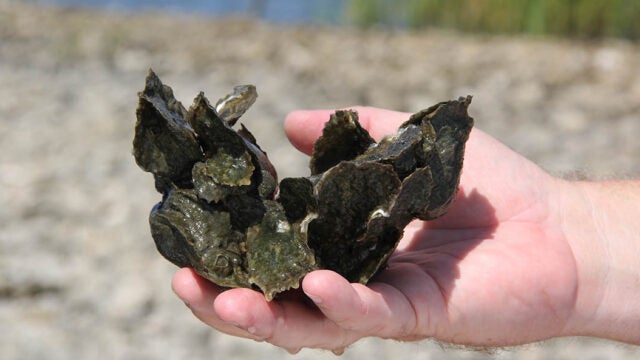
Other Milestones Include Mobile Oyster Barges Anniversary & “Shellabration”
The Chesapeake Bay Foundation (CBF) celebrates a near record-breaking year for its oyster gardening program in Virginia as November marks Virginia Oyster Month.
This comes as CBF joined partners to participate in the “Shellabration” in Hampton, as well as commemorated the five-year anniversary of the beloved barges that make up CBF’s cutting-edge mobile oyster restoration center. All three developments marked milestones for CBF during Virginia’s month dedicated to this iconic Chesapeake Bay bivalve.
This year’s oyster gardening program saw the second-highest ever participation with 627 volunteers across Virginia’s tidal waterways raising and returning over 110,000 oysters in 2024. Significantly, the number of oyster gardeners who raise their oysters at public docks and marinas rather than private waterfront property doubled to 64 families and organizations.
“It changed the trajectory of my life. At first, you start raising oysters to give back to the planet,” said Claire Neubert, a public oyster gardener for CBF at the Hampton docks. “I live in an urban environment, and it’s amazing to find these babies flourish given all the challenges they face. At the end of the day, it really becomes a question of who’s growing who.”
Oyster gardeners raise baby oysters to adults over the course of a year. The oysters grow in wire cages off docks to eventually be planted on sanctuary reefs. Because adult oysters can filter up to 50 gallons of water a day, the oysters returned to CBF this year as adults will end up filtering more than 5 million gallons of water a day.
“There’s nothing quite like the connection between these baby oysters and their foster parents. The dedication and love it takes to raise these oysters, from cleaning cages to sending them off to live out on sanctuary reefs, is nothing short of special,” said Jessica Lutzow, CBF’s Virginia Oyster Restoration Specialist.
Floating Oyster Restoration Center Marks Five Years
At the same time, CBF’s mobile barges marked five years since their 2019 christening as the Prudence H. and Louis F. Ryan Mobile Oyster Restoration Center. These two linked barges hold six 850-gallon tanks and can travel from one Virginia river to the next, allowing CBF to restore local oyster populations more efficiently. By giving oysters a place to attach to recycled shells and other alternative substrate such as reef balls before their planting on nearby sanctuary reefs, these barges have been instrumental as the Chesapeake Oyster Alliance marks 6 billion oysters added to the Bay.
After cleaning, CBF expects the barges to be briefly reunited in the coming weeks prior to one of the barges moving to the Hampton River for oyster restoration work.
A ‘Shellabration’ in Hampton
Most recently, the CBF oyster team hosted educational demonstrations November 16 on the oyster’s life cycle for the third annual “Shellabration,” a free festival in Hampton honoring the Chesapeake Bay and organized by the Downtown Hampton Development Partnership.
“Shellabration is great way to educate and engage the community in the exciting plans that are creating synergy around oyster restoration in the Hampton River,” CBF’s Virginia Oyster Restoration Manager Jackie Shannon said.
Learn more about CBF’s oyster restoration work in Virginia.
Bloombox, Zoetropolis Cinema Stillhouse, and the Chesapeake Bay Foundation (CBF) will celebrate and support efforts for cleaner waters in Lancaster County as part of ExtraGive on Friday, Nov. 22.
“Our important end-of-year giving season gets underway with Lancaster ExtraGive,” said Julia Krall, CBF Executive Director for Pennsylvania. “We appreciate how generous donors through Lancaster ExtraGive have been for our critical work for more resilient local rivers and streams and look forward to their support again on Nov. 22.”
That day, CBF staff and a rainfall simulator will be on location at Bloombox’s Second Chance Plants at 1201 Harrisburg Pike in Lancaster (corner of Dillersville Road) from noon to 3 p.m. The rainfall simulator demonstrates how water runs off different land uses.
“We can raise an additional $3,000 between noon and 3 p.m., thanks to a match by David Bender,” said Brenda Sieglitz, CBF Director of Major Giving. “Feel free to join us in person at Bloombox for in-person conservation demonstrations and activities.”
“We are thrilled to host an in-person event with CBF at our retail location to allow customers to experience our partnership in real time,” said Bloombox Co-Founder David Zablocki. “Attendees will be able to learn about ways they can positively impact the health of the Chesapeake Bay, all while getting into the Christmas spirit surrounded by locally and sustainably sourced wintergreens.”
Later in the day Nov. 22, CBF staff will be at Zoetropolis Cinema Stillhouse on 112 N. Water St., in Lancaster for ExtraGive from 6 p.m. to 9 p.m. They will meet and greet the public with clean water-inspired goodies and plenty of information. According to Zoetropolis, the groups Gentilo and Carlos Elliot Jr./Phase Materia are playing that night. Doors open for that at 7 p.m.
“The Chesapeake Bay Foundation is a natural choice for us to support the ExtraGive,” said Nate Boring, founder of Lancaster Distilleries. “Their work to preserve and improve the conditions of our streams and ultimately the Bay are second to none. Please consider choosing the Chesapeake Bay Foundation for your donations now during the ExtraGive as well as throughout the year.”
CBF is in the early stages of coordinating its third watershed management plan within Lancaster County; this one on the 17.6 square-mile Conejohela Flats area, including the Boroughs of Columbia and Mountville, and Manor and West Hempfield townships. CBF’s previous plans were for the Pequea Creek and the Upper Conestoga River.
CBF also collaborates with local partners to plant a multitude of trees in Lancaster County through CBF’s Keystone 10 Million Trees Partnership.
Donate and learn more about Lancaster ExtraGive.
The Keystone 10 Million Trees Partnership (K10) is at it again, doing the dirty work of adding 130,000 new trees for Pennsylvania during the fall planting season.
“We were able to distribute the trees across 30 different locations throughout Pennsylvania, to over 100 of our partners,” said Marley McKind, Manager of the Keystone 10 Million Trees Partnership for the Chesapeake Bay Foundation (CBF). The Partnership is coordinated by CBF and has grown to over 300 partners.
Roughly 28,000 miles of Pennsylvania’s rivers and streams are damaged by polluted runoff and the legacy of coal mining. Trees, especially when planted as riparian buffers, are the most cost-effective tools for cleaning and protecting waterways.
Trees filter and absorb polluted runoff, stabilize streambanks, and improve soil quality. They also help address climate change by cooling the air and sequestering carbon.
“Seeing the level of enthusiasm and passion for planting trees from our partners, communities and individual landowners throughout the Keystone State is what makes this work worth doing,” McKind added.
Katie Ruth, Executive Director of Pennsylvania Interfaith Power & Light, said PA-IPL received requests from its volunteers for about 35,000 K10 trees for the fall season and has 33 volunteer-led distribution sites across the Commonwealth.
“The majority of our distribution locations are within the Chesapeake Bay watershed,” Ruth said. “We have committed network partnerships in 20 Pennsylvania counties and have reached program participants in an additional 35 counties. This represents 85 percent coverage of the state’s 67 counties.”
Grants for a tree planting coordinated by award-winning volunteers and another grant for tree survival are also supporting the Partnership.
A $4,000 grant from The GIANT Company and Keep Pennsylvania Beautiful® will provide new trees that will be planted at McCaskey High School in the City of Lancaster on Nov. 9. The effort will be led by Mira Lloyd Dock Partnership Diversity Award recipients Marlisa Yoder-Bontrager, and twin sisters Keisha and Tarsha Scovens. The Dock Award is presented by the K10 for conservation and environmental justice work in under-represented communities.
A $75,000 tree survival grant to the K10 by the Foxwynd Foundation of Chester County, will help newly planted trees along Pennsylvania streams live longer, grow stronger, and have a better chance to clean and protect local waters.
Maintenance in riparian buffers, supported by the Foxwynd grant may include straightening, removing or replacing tree shelters after storms, and checking for competing vegetation inside shelters. Other work could include removing bird nets from shelters with trees growing out the top, applying herbicides, and mowing around trees.
As new trees go into the ground this fall, the Partnership is looking ahead to 2025. “As we look forward to next year, we’re excited to continue fostering connections, streamlining tree distributions, and getting more trees in the ground,” Marley McKind added. “As we like to say, it all adds up to clean water!”
Learn more about the Keystone 10 Million Trees Partnership.
On Friday, October 18, Maryland policymakers, environmental partners, and farmers visited two Frederick County farms that are improving soil health, water quality, climate resilience, and biodiversity through regenerative agriculture.
The event, coordinated by Chesapeake Bay Foundation (CBF) and Mobilize Frederick, demonstrated regenerative agriculture in action and highlighted its benefits for both local farmers and the environment. Regenerative agriculture practices such as crop diversification and rotation, and rotational livestock grazing, can improve soil health and mitigate a farm’s carbon footprint.
“Maryland farmers are on the forefront of regenerative farming innovation. And its benefits are clear,” said Rob Schnabel, CBF Restoration Scientist. “Agriculture can continue to be a problem for the Chesapeake Bay, or can be the solution. The farms spotlighted at this event are a prime example of regenerative agriculture being a solution for water quality and quantity, as well as climate resilience and biodiversity.”
Event attendees toured two Frederick County farms that are implementing regenerative agriculture practices, including Holterholm Farm, a grazing dairy farm, and Open Book Farm, a diversified grazing and vegetable farm.
“The key to regenerative agriculture is that it’s a systems approach,” said Ron Holter, fifth-generation farmer of Holterholm Farm. “It’s healthier for our farm, it’s healthier for the environment, and it’s healthier for our community.”
During the event, presenters showed the immediate water quality benefits of these practices through rain simulators, slake soil tests, and greenhouse gas emissions and sequestration calculators. Presenters included representatives of CBF, University of Maryland Extension, U.S. Department of Agriculture’s Natural Resources Conservation Services, Maryland Department of Natural Resources, and other partners.
“Climate change is affecting the weather patterns in Frederick County, with more frequent droughts alternating with flooding rains,” said Karen Cannon, Mobilize Frederick Executive Director. “Regenerative agriculture is the key to mitigating the impacts of climate change and helping the county’s farmers build a sustainable local food system.”
The top principles of regenerative agriculture include:
- Minimizing negative disturbances like tillage and pesticides that can impact soil biology;
- Always keeping soil covered with crops to prevent erosion;
- Diverse plant cover;
- Prolonging root life to maintain photosynthesis and sequester carbon, and;
- Adding livestock for grass grazing and manure probiotics that encourage deeper root growth.
Implementing these practices across the Chesapeake Bay watershed would be one of the fastest and most cost-effective ways to meet the Chesapeake Clean Water Blueprint‘s clean water goals. States including Maryland must invest in the financial and technical assistance that farmers need to implement regenerative practices to meet these pollution reduction goals.
Learn more about regenerative agriculture and how it benefits the health of the Chesapeake Bay.
This project is made possible through a grant from the National Fish and Wildlife Foundation.
Kati Grigsby, the Chesapeake Bay Foundation’s (CBF) Hampton Roads Restoration Coordinator, was named as a Top 40 Under 40 professional by Inside Business this week.
This prestigious award by Inside Business recognizes exceptional young professionals in the Hampton Roads region for their leadership, innovation, and dedication to their communities.
As the Hampton Roads restoration coordinator, Grigsby plays a crucial role in CBF’s efforts to restore and protect the Chesapeake Bay. Her work involves identifying, designing, permitting, and implementing projects such as living shorelines, vegetated buffers, and rain gardens. These efforts protect homes and communities from erosion, storms, flooding and sea level rise.
“I am incredibly grateful to be recognized by Top 40 Under 40,” said Grigsby. “It is an honor to be among such a talented group of individuals who are making a positive impact on our community. I am passionate about my work at CBF and am committed to continuing to restore the Chesapeake Bay for future generations.”
In 2022, Grigsby managed the installation of a 718-foot living shoreline of oyster reefs and marsh vegetation at a waterfront home in Portsmouth, Virginia. Just this past year, she’s overseen the installation of more living shorelines from the Eastern Shore to Hampton.
Rather than hard barriers like bulkheads or riprap, living shorelines use natural systems to make waterfront property more resilient to erosion and sea level rise. Living shorelines also reduce pollution, beautify the waterway, and create habitat for wildlife.
“Kati is a valuable member of CBF and our community,” said Ann Jurczyk, CBF’s Virginia Manager of Urban Restoration. “Her passion for environmental restoration and her commitment to making a difference are inspiring. We are proud to have her as part of our team and excited she received this well-deserved honor.”
Grigsby’s dedication to her work is evident in her professional goals. In the next five years, she aims to restore 3,000 linear feet of the Hampton River shoreline, including the installation of acres of intertidal oyster reefs and thousands of wetland plants. She also hopes to continue to support the restoration of Mattanock, the Nansemond Indian Nation’s land on the Nansemond River.
Learn more about Kati Grigsby and her work at the Chesapeake Bay Foundation.
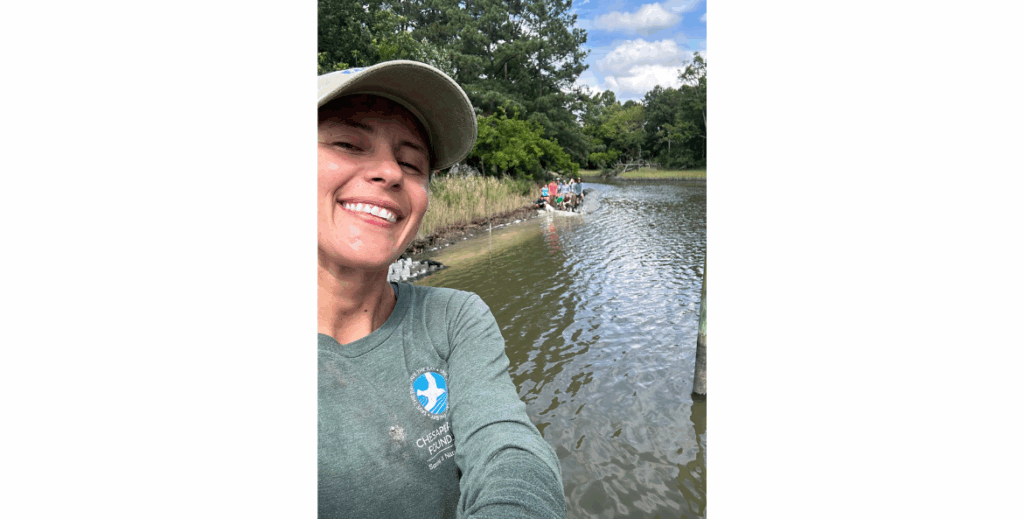 Kati Grigsby
Chesapeake Bay Foundation Partners With ODU in “Healing Through the Land” Event
The Chesapeake Bay Foundation (CBF) is proud to partner with Old Dominion University (ODU) for a “Healing Through the Land” panel discussion with Tribal leaders on Oct. 21.
The discussion will explore the connections between land stewardship, health equity, and the lived experiences of Virginia’s Indigenous citizens. This event, part of the year-long Big Read initiative at ODU funded by a National Endowment for the Arts (NEA) grant, will take place on Oct. 21 at 6 p.m. in the Big Blue Room, Chartway Arena.
The free discussion is open to the public and will highlight how the generations-old relationship Indigenous people have with the land shapes their health and well-being today. CBF’s Virginia Policy Manager Jay Ford will moderate a panel discussion with Tribal leaders throughout Virginia.
“The Chesapeake Bay watershed is vital to the health and well-being of countless communities, and Indigenous people have a deep-rooted connection to the land that has shaped their lives for generations,” said Lisa Renee Jennings, CBF’s Hampton Roads Grassroots Coordinator. “By exploring this relationship and its impact on health equity, we hope to inspire meaningful conversations and action.”
“Healing Through the Land” is part of ODU’s 2024-25 NEA Big Read theme, “Health Equity: Where We Live.” The initiative promotes a shared reading experience of “Sitting Pretty: The View from My Ordinary Resilient Disabled Body” by Rebekah Taussig, which highlights themes of health equity, diversity and inclusion.
According to ODU’s Office of Institutional Equity and Diversity, ODU will host several programs throughout the year touching on these topics and diving into important conversations about accessible healthcare and the well-being of all communities. Learn more details about the event and register.
A grant of $500,000 to the Chesapeake Bay Foundation (CBF) was one of a dozen new grants totaling more than $3.4 million announced this week that will improve water quality and fish and wildlife habitat in parts of Pennsylvania’s Chesapeake Bay watershed and other watersheds.
The grants, announced on Wednesday, are funded by the Section 319 Grant program from the U.S. Environmental Protection Agency (EPA) and selected by the Pennsylvania Department of Environmental Protection (DEP). The Section 319 Grant program provides funding to projects that address nonpoint source runoff, such as from certain agricultural activities.
The grant to CBF is for designing and implementing 100 new forested riparian buffer acres and maintaining existing buffers on agricultural lands, prioritizing projects in Lancaster, York, Cumberland, Franklin, Adams, Bedford, Centre, Clinton, Lebanon, Lycoming, Mifflin, and Juniata counties.
Trees and shrubs planted streamside as forested riparian buffers absorb and filter runoff before it reaches the water.
Julia Krall, Chesapeake Bay Foundation (CBF) Executive Director for Pennsylvania, said:
“The 12 grants awarded from the EPA and selected by the DEP amplify Governor Josh Shapiro’s commitment that the Commonwealth ‘is all in,’ and plans to continue its clean water work to benefit local waters and the Chesapeake Bay for the long haul.”
Kristen Heberlig, CBF Resiliency Program Manager in Pennsylvania said:
“The $500,000 grant to CBF strengthens our forested riparian buffer work already underway in critical Lancaster, York, Cumberland, Franklin, Adams, Bedford, and Centre counties. Just as important, it allows us to expand the vital conservation practice of buffers in Clinton, Lebanon, Lycoming, Mifflin and Juniata counties.
“The investments help continue our decades-long partnerships with farmers in Lancaster County and elsewhere. The supported projects help landowners create a legacy of healthy soils and resilient farms.”
Data-driven tool to help guide Chesapeake Bay restoration, conservation efforts
The Virginia Department of Conservation and Recreation this month released a new map that identifies potential habitats of native freshwater mussels, the most imperiled group of animals.
Virginians can check the map to see which species of mussels might be in their local river or stream. Natural resource agencies and organizations can use it to prioritize restoration work where it could help save these at-risk mollusks.
Efforts to protect and restore habitats for freshwater mussels, which serve a critical function in filtering water, have been gaining momentum in the Chesapeake Bay watershed and across Virginia.
Biodiversity data specialists at the Virginia Natural Heritage Program at DCR created a mussel richness map of hotspots where planting native trees and plants along streams and implementing agricultural best management practices could have the biggest benefit for clean water and mussel habitat. Existing forests that are important for the quality of water associated with significant mussel diversity may be targeted for conservation.
The map is part of a project funded by a grant to the Chesapeake Bay Foundation.
Nineteen mussel species occur in the Chesapeake Bay watershed of Virginia. The map shows where and how many mussel species habitats may be found in various rivers and streams. To view the map, visit the Natural Heritage Data Explorer and select the “Potential Freshwater Mussel Richness” layer.
“Sixty-six percent of mussel species are at risk due to habitat alteration, pollution, and invasive species,” said Joe Weber, chief of biodiversity information and conservation tools for the Virginia Natural Heritage Program. “Freshwater mussels perform vital ecosystem services and functions, including helping to purify water for humans and wildlife, and they are key components of diverse and resilient freshwater systems.”
“Freshwater mussels represent a rich natural resource that there’s still so much for us to learn about,” said Dr. Joe Wood, CBF’s Virginia senior scientist. “This effort represents a significant step toward helping us understand, protect and restore freshwater mussel populations and foster investment in these imperiled species. It provides a pragmatic tool to prioritize restoration in areas that would have the biggest impact for ensuring these vital species don’t decline or go extinct. This will improve the effectiveness of future restoration efforts to protect Virginia’s streams and rivers and ensure these valuable creatures inhabit our waterways for generations to come.”
The map and comprehensive Chesapeake Bay-wide mussel restoration planning initiative for the Virginia Chesapeake Bay Watershed are supported by a grant to CBF from the Chesapeake Watershed Investments in Landscape Defense program, or Chesapeake WILD, which is administered by the National Fish and Wildlife Foundation.
Amazon and the Port of Virginia Each Donate $100,000 to CBF for Climate Resiliency Project
Over 100 volunteers joined the Chesapeake Bay Foundation (CBF) and the City of Hampton to complete a living shoreline at Bluebird Gap Farm that will enhance native habitats and stabilize shorelines.
Amazon and the Port of Virginia volunteers planted 500 plugs of black needlerush, 500 plugs of smooth cordgrass, and 50 bushy seaside oxide, marking the completion of a 158-foot living shoreline at Bluebird Gap Farm earlier this month. That work followed the installation of 16 coconut fiber coir logs and the placement of 100 tons of sand by CBF and volunteers in the preceding weeks.
Living shorelines are a sustainable and environmentally friendly approach to protecting waterfront property from erosion. By utilizing native wetland plants, grasses, shrubs, and trees, along with natural materials like the coconut fiber rolls, living shorelines create a natural barrier that dissipates wave energy and promotes shoreline stability.
“We are incredibly grateful for the invaluable work of the many volunteers, including Amazon and the Port of Virginia volunteers,” said Kati Grigsby, Restoration Coordinator at the Chesapeake Bay Foundation. “Their hard work and dedication in addition to our partnership with the city of Hampton were instrumental in making this project a success. This living shoreline will not only provide critical habitat for fish and wildlife but will also help to improve water quality and protect Hampton’s shoreline from the threats of climate change.”
The three-week project involved bending and heavy lifting, but the volunteers rose to the challenge, working tirelessly to install the coir logs, spread the sand, and plant the plugs. Their efforts have resulted in a significant enhancement to the Bluebird Gap Farm property and helped improve the overall health of the Chesapeake Bay.
“We’re proud to join with the Port of Virginia to support the Chesapeake Bay Foundation’s important work to help protect the Bay for future generations. Rebuilding living shorelines and restoring the oyster population in the Bay can help improve water quality, prevent erosion, and provide habitat for the diverse fish and wildlife that call the Bay home,” said Carl Berger, director of export operations, global logistics at Amazon.
Amazon and the Port of Virginia have each committed $100,000 to the Chesapeake Bay Foundation project, supporting the Bluebird Gap Farm Living Shoreline project entirely and additional Virginia shoreline restoration initiatives in the coming months including oyster restoration efforts.
“The Port of Virginia is committed to sustainability, and we are pleased to partner with like-minded organizations such as Amazon and the Chesapeake Bay Foundation in supporting initiatives like this that help protect our natural resources,” said Stephen A. Edwards, CEO and executive director of the Virginia Port Authority. “We are looking forward to working together on future projects that improve our environment and communities.”
Conejohela Flats, Little Fishing Creek areas up next for CBF watershed management plans
The Chesapeake Bay Foundation (CBF), local residents, and other conservation organizations will be working together to create watershed management plans that will improve water quality in Lancaster and Centre counties.
After creating two watershed management plans, each primarily in Lancaster and Centre counties, CBF is turning its attention to local streams in the Conejohela Flats and Little Fishing Creek areas, which do not meet water quality standards.
The plans are designed to restore and protect local streams for the health, well-being, and quality of life of watershed residents. Water quality experts and local residents work together to develop the plan to implement strategies like planting riparian buffers, stream restoration, streambank fencing, cover crops, no-till agriculture and more.
The final plans are consistent with Countywide Action Plans that contribute to local commitments toward achieving goals of Pennsylvania’s final Phase 3 Chesapeake Bay Watershed Implementation Plan.
The Conejohela Flats plan will focus on 17.6 square miles in Lancaster County, containing 10 streams and totaling 25.5 miles in length, 89 percent of which are impaired due to agricultural or stormwater runoff. All 10 tributaries feed directly into the Susquehanna River. With a population of about 20,000 people, the watershed includes the Boroughs of Columbia and Mountville, and Manor and West Hempfield townships.
Conejohela is a Native American word that means “kettle on a long, upright pole.” It refers to a Native American settlement from the early 1700s and a group of islands and mud flats in the Susquehanna River.
Columbia is an Environmental Justice community and the urban core of the watershed. The town’s rich history includes falling just one vote shy of being chosen as the nation’s capital and halting the Confederate Army’s northern advance ahead of the Battle of Gettysburg.
“The neat thing about this plan, is that its focus is a collection of small, adjacent streams, rather than a single, large one and its tributaries,” said Brian Gish, CBF Pennsylvania Senior Watershed Planner. “It’s a diverse mix of urban, suburban, rural, and natural spaces, all connected by the Susquehanna. It’s novel and I’m excited about it.”
“The locally driven work in these tributaries is important for clean and clear water in Lancaster,” said Allyson Gibson, Director of Strategic Partnerships and Programs for Lancaster Clean Water Partners.
“Plans for water quality improvement projects that our riverland communities will do give us specifics that add momentum to a countywide initiative. Whether the creek water runs into a stream or into the mighty Susquehanna, it all matters. We’re collaboratively improving all of it, together.”
The Little Fishing Creek Watershed, in Centre County and a small part of Clinton County, comprises 25 tributaries. Over 8 of its 58 miles of streams are impaired due to sedimentation. It is 42 square miles with roughly 3,450 residents.
“Little Fishing Creek stood out for a watershed management plan,” CBF Pennsylvania Senior Watershed Planner Caitlin Glagola said. “Trout Unlimited and others have been doing work on Fishing Creek, so it is a way connect with some efforts happening downstream.”
“Key goals of ours include improving local water quality and promoting watershed stewardship, which is why we are looking forward to partnering with CBF on the Little Fishing Creek watershed plan,” said Ivie Foster of the Centre County Conservation District.
Planning processes for the Conejohela Flats and Little Fishing Creek projects are in the preliminary, information-gathering stages. “When these plans are being developed, we want to let local people know what is going on and make those connections early on,” Glagola said.
“Partnerships are the biggest assets,” Glagola said. “If you have a plan in place, it is only effective if we and partners make sure that what we’ve collectively worked toward and put into it writing gets set into action.”
Previous plans coordinated by Gish and Glagola in Lancaster and Centre counties are being put into action. They are being referenced to leverage funding and put into practice by conservation districts and others to inform where clean water efforts should be made in their respective areas.
Gish coordinated management plans for the Pequea Creek (Lancaster and Chester counties) and Upper Conestoga River (Lancaster, Berks and Chester counties) watersheds.
Glagola has coordinated management plans for the Halfmoon Creek (Centre and Huntingdon counties) and Marsh Creek (Centre County) watersheds.
The Pequea and Halfmoon plans were approved by the Pennsylvania Department of Environmental Protection (DEP) and U.S. Environmental Protection Agency (EPA) and are now eligible for federal funding.
The Upper Conestoga River and Marsh Creek plans have been submitted to the state DEP for review.
When CBF developed the previous watershed management plans, partners included county conservation districts, local watershed and conservation organizations, academic institutions, state and local government agencies, local businesses, planning agencies, landowners, farmers, and residents.
“In Marsh Creek, we really upped the ante on communications and community engagement,” Glagola said. “These are voluntary, not regulatory plans. It’s about providing resources and hearing from landowners about what they want and building that into the plan.”
“We try to build on previous plans, add new levels of analysis, and make each plan better than the previous one,” Gish said. “In Conejohela, I’m taking a deeper dive into land use and development, making the growth dynamics of western Lancaster County a key part of a future-focused approach.”
