How Has the Government Shutdown Threatened Chesapeake Bay Restoration?
Farmers working on conservation projects get hit hard
It’s official. As of November 5, 2025, the government shut down is the longest in U.S. history. While it finally looks like it may be coming to an end, the shutdown’s toll on our region will be long-lasting. In addition to the hardships the federal workers and agencies that protect our waterways face, our region’s farmers are navigating unnecessary shutdown challenges to doing conservation work that’s good for clean water.
The instability and distrust created by the shutdown is a significant setback.
“We talk a lot about trying to make conservation easy, but the shutdown doesn’t make it easy,” said Felicity Zimmerman, a CBF restoration specialists who works with farmers in Virginia.
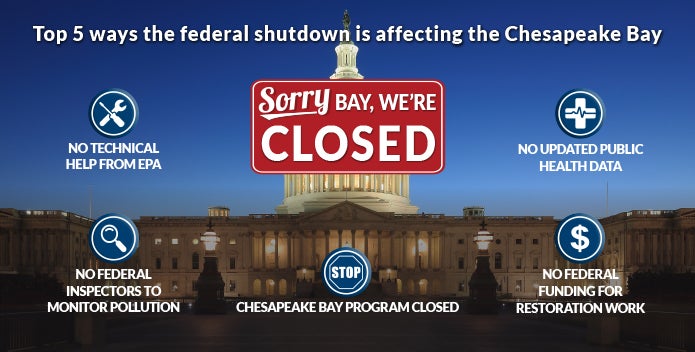
So, what exactly does this record-breaking shutdown mean for the Bay cleanup?
- Grant programs that improve air, water, and wildlife habitat, provide hands-on environmental education for students, and provide recreational opportunities to the public, can’t pay landowners, community groups, or other grant recipients. They also can’t evaluate grant applications, award new grants, or do the day-to-day work of restoring stream banks, planting tree buffers, and other projects that protect and conserve our region’s natural resources.
- EPA inspectors who monitor compliance with the Clean Water Act, the Clean Air Act, and other environmental laws aren’t able to hold polluters accountable for illegal emissions of toxic chemicals or other pollutants that harm the air we breathe, the waterways we boat, fish, and swim in, and the land where children play and farmers grow food.
- Employees of EPA, the U.S. Geological Survey, and the National Oceanic and Atmospheric Administration can’t monitor important indicators of the Bay’s health like pollution levels, stream flows and coastal flooding. Nor can they conduct research on questions like how climate change affects Bay fisheries or how PFAS bioaccumulate in game fish people catch and eat. This leaves gaps in data needed to decide which conservation practices to use or where those practices can produce the best results. It also denies the public crucial information on everything from fishing and boating conditions to whether a favorite beach is open.
- Engineers, soil scientists, and other experts with the Natural Resources Conservation Service (NRCS) can’t help farmers devise conservation plans, implement conservation practices, or determine whether a farmer’s land includes wetlands or highly erodible soil. NRCS employees work directly with farmers to design, implement, and maintain conservation practices. Closed NRCS offices mean farmers and the contractors they hire aren’t reimbursed for upfront expenses they’ve incurred and don’t get answers to pressing questions about a program they’re enrolled in. Landowners and contractors are left waiting when NRCS staff aren’t available to attend important planning meetings.
How does the shutdown affect farmers working on conservation projects?
When it comes to saving the Bay, conservation-minded farmers who participate in voluntary cost-share programs that reduce pollution to waterways are among the people hardest hit by the shutdown. In communities where farmers are wary of the federal government, the shutdown only adds to the distrust. Multiple shutdowns like we’ve seen in recent years have amplified that distrust. Even worse, the total effect may be enough to discourage neighbors from doing their part.
“It’s definitely left a big gap in conservation work and resources for farmers—everything from technical assistance on the farm to field days,” which give farmers a chance to talk to NRCS staff and learn about conservation programs, said Zimmerman.
“And the projects themselves,” she said. “It doesn’t matter at what stage somebody’s at, whether they’re just exploring cost-share options or they’re in the middle of a project or they’re in a contract and they’ve got questions. There [are] impacts at every stage.”
CBF Virginia Restoration Specialist Alston Horn said a prolonged shutdown can cause damaging ripple effects, especially on expensive projects like stabilizing stream banks and fencing livestock out of a stream that require farmers to hire contractors and work with multiple groups.
“If the NRCS is not functioning, the contractors [that farmers use] aren’t getting reimbursed. Our partners aren’t getting reimbursed,” Horn said. “At some point, somebody’s going to have to find funds to make it happen or the landowner’s going to have to find a loan to cover it.”
Many farmers are already reluctant to work with the federal government, Horn said. “So, a delay in payment and somebody having to take out a loan, that might hurt some localities, unfortunately.”
“I hope that doesn’t stop folks from trying to do the right thing for their farm, their local water quality, and ultimately, the entire Chesapeake Bay.”
From farmers to engineers to scientists, the shutdown shows how vital strong federal support is for successfully restoring our waterways. Each day the shutdown continues sets us further back and raises the risk of a crisis we can’t contain.
Repeated shutdowns—there have been 16 in the last 10 years—don’t just delay day-to-day progress. They can drive farmers away from conservation programs that are good for their farm as well as the Bay. It’s a relief that we’re on track to reopen the government after this record-breaker. But Congress and the White House need to break the whole cycle of shutdowns before the damage to the Bay and its rivers and streams becomes irreversible.
Related Stories
-
 Blog Story
USGS “Sentinel Scientists” Perform Vital but Unseen Role in Bay Restoration
Investments in USGS science illuminate hidden threats and pay data-driven dividends for the Bay watershed.
-
 Blog Story
Two Childhoods, One Bay
From flaming rivers to cleaner air, explore how 55 years of environmental action—and inaction—shape the world our children inherit.
