In Search of Spring (Peepers)
They are the voice of the season. But how do you find a frog that’s the size of a thumbnail, lives on the edge of vanishing pools, and sings under the cover of night?
Sometimes you get the itch to find a frog. The same way you start dreaming of flip flops and moving that pile of junk you haven’t touched since last fall (it’s time!). I’m speaking for myself, of course; maybe you’re fine hearing that unmistakable peeeeep on the year’s first warm night and moving on with your business.
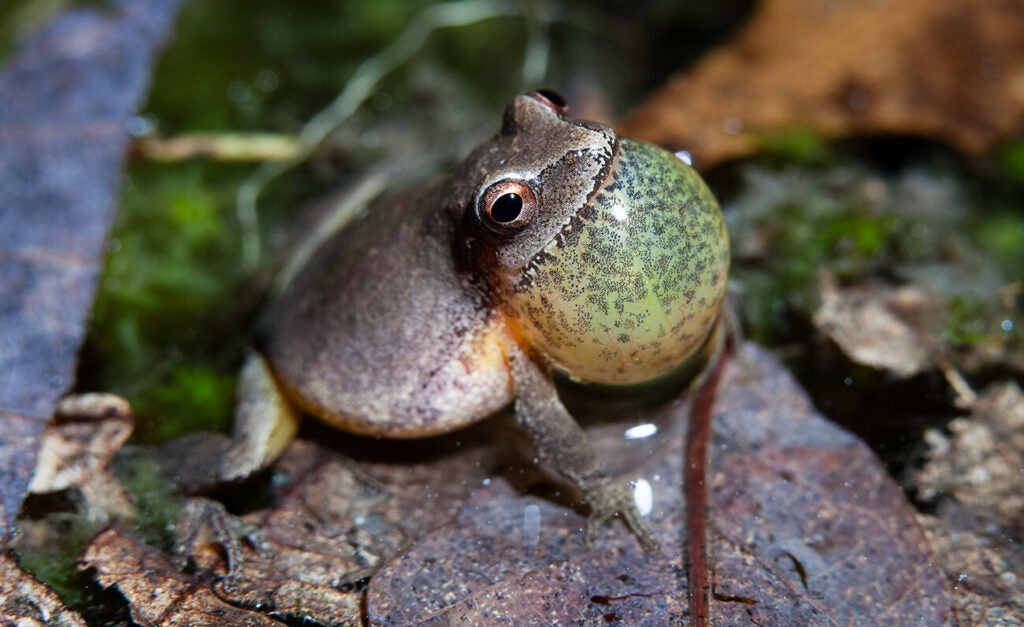
Let me convince you otherwise. That sound is coming from tiny frogs, Pseudacris crucifer, the spring peeper. Tiny frogs!
Frogs that are just slightly bigger than a thumbnail, small enough to fit in a thimble. Tiny frogs that can sing louder than a lawn mower. Tiny frogs that create their own antifreeze so they don’t become frogsicles when they huddle down for winter. Tiny frogs that live in magical, disappearing ponds in the forest. Who doesn’t want to find tiny frogs?
How to Find a Spring Peeper
Want as I might, I had no luck. Every warm evening over the past month the spring peepers near my house sang, but every evening I failed to find them.
I shared my spring-time obsession and frustration with Lauren Guzman, an educator and manager at CBF’s Phillip Merrill Environmental Center in Annapolis , who also happens to be a Maryland Master Naturalist. Can we go find some frogs?
She was enthusiastic. But similarly unlucky in frogs.
“On my walks I hear them, and I think there are so many. There must be thousands here. They are so loud,” she told me. “But then I go up to the little swamp area and I see nothing. I see nothing!”
 Will Parson/Chesapeake Bay Program
We went searching anyway. Spring peepers, she explained, are out and about this time of year because they are looking for love (more accurately, a mate and somewhere to lay their eggs). The distinctive peep is the male frog calling out for a partner, and there are several things on the would-be couple’s wish-list:
- A fish-less puddle (er, pond).
Spring peepers, like many other species of frogs and salamanders, need a source of fresh water for their eggs to hatch and grow from baby tadpoles into adults. Their favorite is something called a vernal pool. Some pools are as big as ponds, while others are literally a shallow spot in the ground that fills with rain and melting snow in spring. What all vernal pools have in common is they don’t last—they are here from spring to late summer, and then they disappear. And that’s just how the frogs like it.
“The frogs and salamanders need these vernal pools because they’re super protected,” says Guzman. “Fish don’t tend to live in here because the water disappears throughout the year, so it’s usually pretty safe for the frogs to lay their eggs and be safe from predators.” - Warm nights and romantic lighting.
Peepers are most active in the evening, or soon after dark. Warm and rainy nights in early spring are ideal, when the temperature starts to climb above 40 degrees Fahrenheit. In Maryland, that often begins in early March.
“Essentially during the wintertime, the frogs are under all the leaf litter,” says Guzman, showing me a thick pile of fallen leaves. “That’s where they hide or sort of nestle and bury themselves into the mud. They’re still here in the forest. Once they kind of thaw out and wake up from their wintery sleep, after that 40-degree night, that’s when they make their way to the vernal pools.” - A cozy retreat.
You will probably hear peepers in an amazing number of places once you start listening—fields, small rows of trees, even shallow ditches.
“You never know what little pool could be behind your house that amphibians are using to mate and lay eggs,” says Guzman. But, she says, “they may not spend too much time there. They go back into the woods.”
How to Keep Finding Spring Peepers (Even if You Only Ever Hear Them)
I’m not here to tell you that spring peepers are the key to saving the Chesapeake Bay. But they are part of what makes this area magical and worth saving. Luckily spring peepers have been pretty resilient, but more than 40 percent of the world’s amphibian species—which include frogs and salamanders—are threatened with extinction.
They are especially vulnerable to pollution because they breathe through their skin and begin their lives in fresh water, says Guzman. Climate change that brings extreme heat or cold or droughts, the destruction of their vernal pools, or heavy rainfall that washes pollution into the water can all harm frogs.
“Amphibians are just getting hit on all fronts,” she says.
To keep them around (and help out a lot of other animals that depend on clean water), you can:
• Grow plants and trees that are native to your area, or consider having “no mow” areas if you have a yard. This will help attract the insects that frogs and salamanders eat.
• Be mindful of the stuff you put on your lawn or outdoor spaces, and use only the right amount. Frogs and salamanders can breathe through their skin, so they are particularly sensitive to anything that washes off into the water when it rains.
• Consider keeping fallen leaves instead of raking them up. Many frogs use fallen leaves for protection over the winter.
• If you do come across a frog, always respect it! “Observing is great, but if you’re really wanting to catch them up, always have wet hands. Just like with a fish, you never want to touch them with dry hands,” says Guzman.
We never did find a spring peeper. Just as we abandoned an hour-long search of a vernal pool near CBF headquarters, the chorus started. Of course, nary a peeper to be seen. But plenty to sing about.
Related Stories
-
 Blog Story
Showing—and Growing—Our Mussels
Freshwater mussels are truly a class unto their own—and they’re showing new signs of life in the Chesapeake Bay watershed.
-
 Blog Story
A Mixed Bag for Menhaden, but More Opportunities Ahead
A debrief on efforts to protect the Bay's most important fish in the 2026 Virginia legislative session.
