Showing—and Growing—Our Mussels
There are signs of life for the Alewife Floater in Virginia, thanks to new discoveries from CBF and DWR.
Pigtoe. Pocketbook. Muckets.
Some of their names might sound like animal body parts, places to keep loose change, or errant sounds, but freshwater mussels are truly a class unto their own—and they’re showing new signs of life in the Chesapeake Bay watershed.
Virginia Department of Wildlife Resources (DWR) staff surveys, a part of CBF’s Chesapeake WILD Grant, documented five species of mussels–Eastern Elliptio, Roanoke slabshell, Carolina Slabshell, Variable Spike, and Alewife Floater—during a recent survey of the Pamunkey River, which stretches about 100 miles in eastern Virginia and flows into the York River.
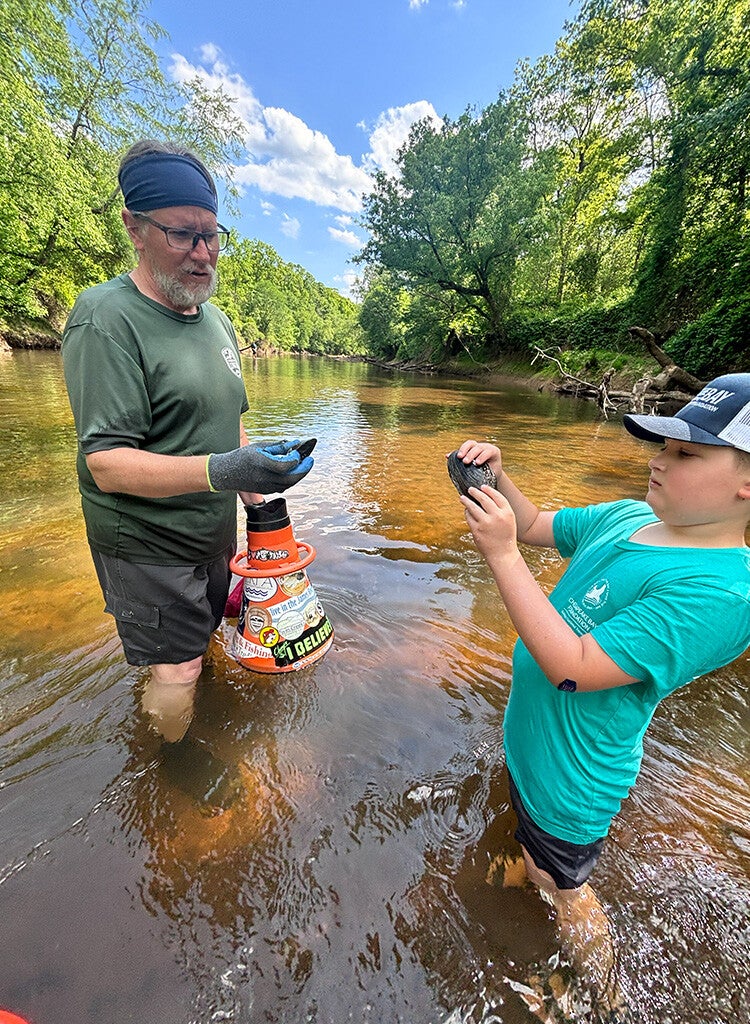 Joe Wood/CBF Staff
It was the furthest upstream record of Alewife Floater and the first record of a Roanoke Slabshell documented in the Pamunkey—part of an exciting discovery for the most imperiled class of organisms in the country.
“Surveys this spring documented species we have not observed before in the Pamunkey,” said Brian Watson, State Malacologist for DWR. “Because there are so many places where mussels haven’t been surveyed, these efforts are invaluable at telling us what lives where—and can help clue us in about places that are primed for new restoration efforts.”
Significantly, officials removed Ashland Mill Dam in the South Anna River in Hanover County north of Richmond several years ago as part of a broader environmental restoration effort.
The dam had prevented river herring from reaching the South Anna, which Alewife Floaters depend upon to reproduce. CBF is planning an Alewife Floater planting in the near future in hopes of recolonizing this part of the river now that the passage is open for herring.
“These new discoveries are great to see—and exactly the kinds of changes we were anticipating for the local ecology when we spent years working to remove the dam,” said Dr. Chas Gowan, a stream ecologist and retiring professor at Randolph-Macon College.
Why Mussels?
CBF rightfully focuses a significant amount of time and resources on oyster restoration—but mussels are likewise a key resource for promoting Bay health.
Freshwater mussels provide critical bay ecosystem benefits like filtering water, creating habitat, and removing excess nitrogen.
They’re also considered the most imperiled class of organisms in the country, with about two-thirds of species vulnerable to extinction—making restoration efforts in the Bay watershed all the more important.
“It’s a shame that many people are unaware of just how cool freshwater mussels are,” said Joe Wood, Virginia Senior Scientist for the Chesapeake Bay Foundation. “These organisms that really cannot move far on their own and typically live in systems where water flows only one way need a way to keep from getting washed out.”
They also reproduce in one of nature’s more unique ways: by baiting fish with what basically amounts to a lure made of their own tissue and then getting baby mussels to latch onto the fish for a ride upstream. The mussels will use the fish’s resources to grow and later drop off as a fully formed juvenile mussel. They also can clean and filter up to 15 gallons of water a day.
For the first time, the Chesapeake Bay watershed agreement, revised in 2025, also mentions mussels, calling for the development of comprehensive freshwater mussel conservation plans for 10 tributaries and implementing recommendations from at least five of those plans by 2040.
“It’s great to see decision-makers throughout the watershed recognize the importance of freshwater mussels to Bay ecology,” Wood said.
Snorkeling, Mapping, and eDNA
Virginia DWR used snorkeling to help identify the species in the Pamunkey and South Anna Rivers in April, and the department has been a valuable partner with CBF in working to discover where restoration opportunities exist.
The Virginia Department of Conservation and Recreation (DCR) also uses a map tool to identify potential habitats of freshwater mussels—part of a project funded by a grant to CBF.
Nineteen mussel species occur in the Chesapeake Bay watershed of Virginia. The map shows where and how many mussel species habitats may be found in various rivers and streams. To view the map, visit the Natural Heritage Data Explorer and select the “Potential Freshwater Mussel Richness” layer.
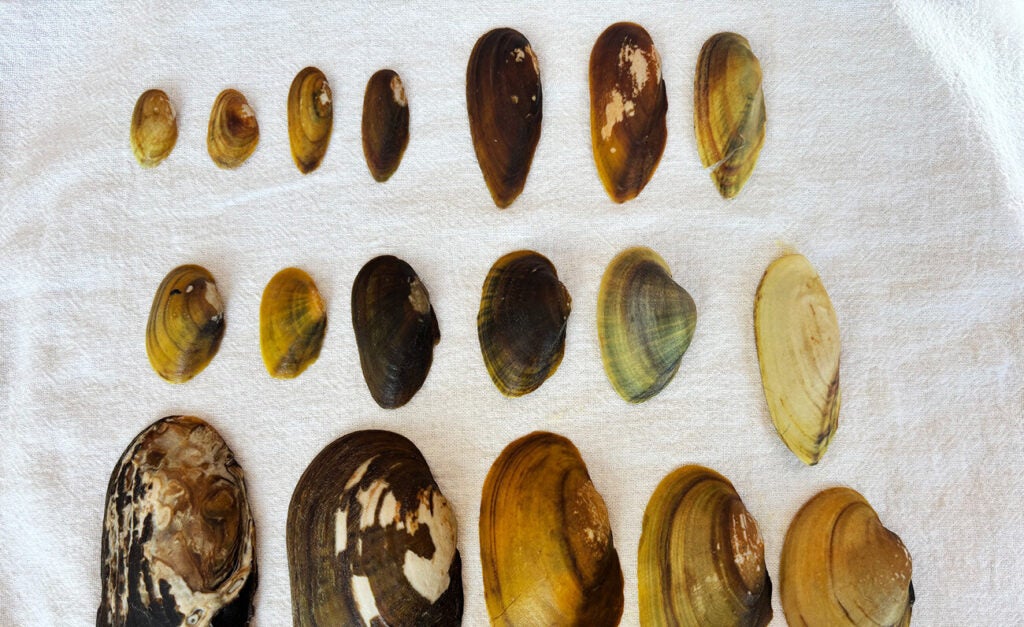 Joe Wood/CBF Staff
Environmental DNA, or eDNA, sampling—where scientists sample the water for traces of genetic material—is another tool experts are using in the Bay watershed to determine whether there are remnants of mussels or other species indicating that a given area might be conducive for mussel restoration efforts.
A New Alliance
As part of a grant to CBF, the Pamunkey Freshwater Mussel Alliance held its first in-person meeting in April in Mechanicsville to talk about restoration opportunities and the historical significance of mussels for people in Virginia.
Representatives from the Pamunkey and Mattaponi tribes, both of whom have fish hatcheries on their respective reservations, along with representatives from DWR, DCR, and CBF were among those who attended.
Part of the CBF grant entails looking into whether the hatchery on the Pamunkey reservation can serve as a suitable location to grow freshwater mussels in the area.
CBF is also aiming to do an Alewife Floater planting in the South Anna River in the near future.
“The mussels we’ll be planting in the South Anna River really could not reproduce there up until the last several years,” Wood said.
“Since Alewife Floaters rely on anadromous fish and the South Anna was dammed until recently, the planting will be returning a species to a river where they’ve been extirpated for nearly a century.”
Related Stories
-
 Blog Story
In Search of Spring (Peepers)
They are the voice of the season. But how do you find a frog that’s the size of a thumbnail, lives on the edge of vanishing pools, and sings under the cover of night?
-
 Blog Story
A Mixed Bag for Menhaden, but More Opportunities Ahead
A debrief on efforts to protect the Bay's most important fish in the 2026 Virginia legislative session.
