Time to Pause Menhaden Fishing in the Chesapeake Bay
Public opinion, scientific advisors, and warning signs in the Bay itself all point to one conclusion: it’s time to pause industrial fishing for menhaden in the Chesapeake until science can show it is sustainable.
Atlantic menhaden are a critical forage species in Chesapeake Bay, and one of the most controversial. Because these small, nutrient-packed fish are such a critical food source for many other species, there have been longstanding concerns that the large-scale industrial fishery that harvests more than 100 million pounds of menhaden from Virginia’s Bay waters each year could disrupt the Bay’s food chain.
Now, as warning signs escalate and industry efforts continue to block necessary scientific research, there is a growing consensus that the fishery should be put on pause. An overwhelming 92 percent of Virginia voters believe the state should leave more menhaden in the Bay, according to a new public opinion poll commissioned by CBF and conducted by New Bridge Strategy and FM3 Research.
Five key points explain how we got here:
- The wildlife and watermen who depend on menhaden are struggling.
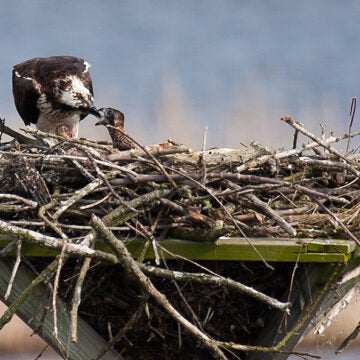
Research in 2024 showed that in recent years osprey chicks are starving at unprecedented levels around tidal waters of the Chesapeake Bay, where they typically depend on menhaden for food. Separately, a May 2025 survey by Dr. Bryan Watts of The College of William and Mary’s Center for Conservation Biology documented a 90 percent decline of nesting osprey on Virginia’s Delmarva Peninsula, indicating a collapse of the population along the seaside of Virginia’s Eastern Shore, a frequent area for industrial menhaden fishing.In addition, Maryland and Virginia watermen that catch menhaden on a much smaller scale for bait are reporting catches declining by more than 70 percent in recent years. These watermen use stationary pound nets, which can serve as an effective gauge of menhaden numbers.
- There are too many unanswered questions.
Scientists do not fully understand the industrial fishery’s impacts on Bay fisheries and habitat, and the threats to businesses and livelihoods that depend on a healthy menhaden resource. Currently, management of the Atlantic menhaden fishery is based on science for the coastwide population from Maine to Florida. But this leaves open questions about the impacts of highly concentrating menhaden fishing in and around the Chesapeake Bay, a critical nursery habitat, and there is no existing data to determine whether this level of harvest is sustainable here.The Virginia Institute of Marine Science (VIMS), Virginia’s primary scientific advisory body, summarized these concerns in a letter on April 7 this year:
“It is perhaps the wisest course of action to take a precautionary approach and give serious consideration to reducing purse seine fishing in Chesapeake Bay,” the letter said. “The reality is that data on menhaden abundances in Chesapeake Bay, their movements between the Bay and the inner continental shelf, localized depletion resulting from fishing, and the ecological impacts of the purse seine fishery all remain woefully inadequate and difficult management decisions must be made in this context.”
- Industry is blocking science and data.
There have been many attempts to gather the information needed to answer these questions. But for decades, the menhaden reduction industry—which uses spotter planes, enormous purse seine nets, and vacuum hoses to harvest more than 100 million pounds of menhaden annually form Virginia’s Bay waters—has consistently worked to delay critical science proposals and common-sense conservation measures.The opposition comes from Omega Protein, a subsidiary of the Canadian corporation Cooke, Inc., and its fishing partner Ocean Harvesters, which target menhaden in Virginia’s portion of the Chesapeake Bay and beyond. For several years, Virginia has worked toward a comprehensive study to better inform management of the Bay’s menhaden fishery, but industry opposition resulted in delaying necessary research funding the last two years in Virginia’s General Assembly. This happened after watering down legislation offered during the 2023 session that would have started a comprehensive science effort later that year. Perhaps most telling about the company’s long-term plan is the fact that Omega Protein’s team of lobbyists have instead requested an interim pilot of study methods, despite the industry having participated in consensus discussions that developed that same study plan.
In addition to delaying science, the industry opposed revisions to the Chesapeake Bay harvest cap in 2017 by the Atlantic States Marine Fisheries Commission (ASMFC), then by Virginia’s General Assembly in 2018 and 2019. Omega then doubled down and intentionally caught approximately 33 percent more menhaden in the Bay than allowed under the cap in 2019. Further, they consistently refuse to share basic fishing data with the public.
This industry wields immense political influence in Virginia to protect its bottom line to the detriment of menhaden, a public resource that benefits all in the Commonwealth and throughout the Atlantic coast.
- The public overwhelmingly supports leaving more menhaden in the Bay.
Against this backdrop, an overwhelming 92 percent of Virginia voters believe the state should leave more menhaden in the Bay, according to a poll of 600 registered Virginia voters conducted by a pair of research firms—one Republican and one Democrat—between July 30 and Aug. 5.The poll, commissioned by CBF, also found that 79 percent of voters support ending large-scale commercial menhaden fishing in the Bay until science can show what level of fishing is compatible with a healthy ecosystem. Large majorities also supported allowing commercial menhaden fishing in the ocean but not in the Chesapeake Bay (85 percent), as well as requirements for commercial menhaden fishing companies to publicly release data about where they fish and how much they catch (92 percent).
- The Bay can’t afford to wait and see—the time to act is now.
The Chesapeake Bay is rapidly changing and showing ongoing signs of ecosystem stress. Given the significant impact of climate change on the Bay’s fishery resources, in addition to intense fishing, stresses from pollution, climate change, and habitat loss could also be affecting menhaden. So even if the Bay could at one time support large-scale industrial fishing, with all of these pressures, it may not be able to support it now.Further delaying menhaden management reform and science—the two things fishery managers can actually control—only worsens the threats to all the wildlife, people, and businesses that depend on menhaden. These threats extend far beyond the interests of a singular foreign-owned company.
CBF therefore believes the best approach is to consider pausing industrial menhaden fishing in the Chesapeake Bay until science can show whether a concentrated fishery here is sustainable.
“With so many unanswered questions, we are risking the health of our cherished wildlife, the Chesapeake Bay, and the menhaden fishery itself,” said CBF Virginia Executive Director Chris Moore. “The best option is to pause industrial menhaden fishing in the Bay and move this capable fishery offshore while Virginia undertakes sorely-needed research.”
Photo above credit Theodore Roosevelt Conservation Partnership and CosmoVision Media.
Tell Virginia: Pause Menhaden Reduction Fishing in the Bay!
Take Action
Related Stories
-
 Blog Story
How Many More Osprey Chicks Must Starve to Death?
Some of the Chesapeake Bay’s best fishermen—osprey—are sending a loud warning: There aren’t enough fish in the Bay. It’s time to act.
-
 Blog Story
Coming Up Empty: Commercial Watermen in Maryland are Finding Fewer Menhaden
Commercial bait fishermen, who supply menhaden to other fisheries like blue crabs, are stretched thin as it gets harder to find fish.