Federal Farm Bill
Every five years or so Congress passes the federal Farm Bill, a critical piece of legislation that has far-reaching impacts on farm communities and the way food is grown. Right now, Congress is considering the next Farm Bill and it is critical that it includes updates that will support Bay region farmers. Nutrient runoff from farms is the largest source of pollution in the Chesapeake Bay. Updating the Farm Bill is our best opportunity to get federal funds and resources to farmers in our region and bolster efforts to restore the Bay.
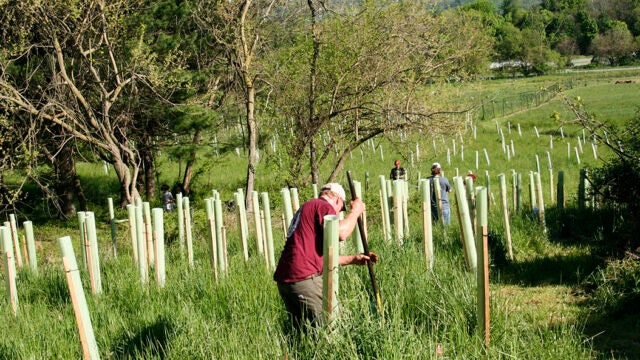
The federal Farm Bill is a package of legislation that has a large impact on farming communities across the United States—from how our food is grown to access to healthy foods for all.
The most recent Farm Bill was passed in 2018 and has since expired, threatening critical conservation programs that support our farmers. This is not uncommon. In fact, every Farm Bill since 2002 expired before a new bill could be passed. Although funding for some conservation programs was extended through 2031, the bad news is, farmers can’t use programs that weren’t extended to get new conservation practices in the ground until the Farm Bill is updated.
The good news is Congress can still pass an updated Farm Bill that supports conservation on farms in our watershed. On March 13, 2025, Bay Congressional leaders reintroduced a bill that packages together five key priorities for a Bay-friendly Farm Bill, titled the Chesapeake Bay Conservation Acceleration Act. We need Congress to update the Farm Bill with provisions that support the Bay’s farming community in adopting conservation practices.
Pledge to Stand With the Watershed’s Farmers!
Sign our petition today and stand with CBF as we work to secure the necessary federal investments in the new Farm Bill.

Farmers play a critical role in keeping our waters clean. Agriculture is the second largest land use in the Chesapeake Bay watershed and nutrient runoff from farms is the largest source of pollution in our waters. When soils and fertilizers wash off of farmland, they can smother waterways with sediment and feed large algal blooms that deplete the water of oxygen when they die and decompose. While a challenge, this means agriculture offers our greatest opportunity to reduce pollution into local streams and the Bay. Agriculture is also crucial to meeting the goals of the Chesapeake Clean Water Blueprint.
To do this, we must support the Bay’s agricultural community. Ask most farmers in the Chesapeake Bay watershed about water quality and they will tell you healthy soils, more resilient farms, and clean streams are important to them. The Farm Bill includes programs that enable farmers to implement Best Management Practices that restore our waters and improve farm earnings and productivity. And there are many successful examples of these practices in action, from CBF’s own Clagett Farm to the Mountains-to-Bay Grazing Alliance, as well as farms from around the watershed.
Farmers have long demonstrated that they are willing to invest their time, money, and effort to restore and protect local rivers and streams, but they need resources to make that a reality.
There are multiple U.S. Department of Agriculture (USDA) conservation programs included in the Farm Bill that offer farmers on-the-ground technical support and financial assistance to adopt conservation practices that help stop pollution at its source. By focusing on strategies that reduce runoff and boost soil health, USDA can help interested farmers improve water quality. Many of these same practices also fight climate change and build resiliency to its effects—like hotter temperatures, droughts, and extreme rainfall—that are already hitting farmers hard.
Unfortunately, these conservation practices aren’t getting on the ground fast enough. The deadline for cutting pollution from agriculture and other sources is fast approaching, but the Bay states are not on track to meet it. Pennsylvania has the largest gap to close and is the furthest behind. Congress can do its part in the new Farm Bill by increasing funding for these conservation programs, making policy changes to ensure the programs are efficiently and effectively implemented, and encouraging farmers to adopt practices that provide multiple benefits to their bottom-line as well as the environment.
What should the next Farm Bill do?
To maximize benefits from federal conservation programs, support our farmers, and meet our water quality goals, CBF supports including these Chesapeake Bay priorities in the next Farm Bill, as included in the Chesapeake Bay Conservation Acceleration Act.
There are four USDA conservation programs that, with much-needed updates and changes, could fully leverage Farm Bill financial and technical assistance to boost the adoption of conservation practices that improve water quality in the watershed.
The Conservation Reserve Program (CRP) and the Conservation Reserve Enhancement Program (CREP) are key programs that have been used for decades to install riparian forested buffers and exclude livestock from streams. These programs should be expanded to allow additional types of lands, like marginal pastureland or grasslands, that have positive impacts on water quality to be eligible for these funds. For CREP, we need to make it easier for farmers to enroll, simplifying the process for participating states to adopt new incentives and offering more attractive incentives to landowners.
Third, the Environmental Quality Incentives Program (EQIP), which is designed to help farmers get conservation practices on the ground, should prioritize grazing practices. Grazing practices benefit the environment in numerous ways, including reduce runoff and improve water quality.
Fourth, the Regional Conservation Partnership Program (RCPP) is a valuable tool for testing innovative approaches to conservation. It encourages public-private partnerships to address natural resource conservation challenges on farmland. The Chesapeake Bay watershed is one of eight Critical Conservation Areas for which the RCPP provides support for partners to work on regional conservation priorities.
Forested buffers are one of the most cost-effective ways for landowners to reduce pollutants into local streams and the Bay. They are also a key component of the Bay states’ plans to achieve the pollution-reduction goals of the Clean Water Blueprint. Unfortunately, implementation has declined dramatically in recent years and is not on pace to achieve state and federal commitments. Legislative changes that remove barriers to enrollment and make it easier for states to take advantage of program improvements and incentives for landowners will help re-invigorate this critical program and bring us closer to meeting our watershed buffer implementation goals.
In addition to improvements to CREP incentives and administration, the Farm Bill offers an opportunity to increase buffer plantings by creating a “turn-key” program under CREP for this region that would allow a third party to take on the responsibility for designing, planting, and maintaining forested buffers on private lands. This program is modelled after, and would build upon, the success of the partnership among the James River Association, Virginia Department of Forestry, and CBF that planted and maintains buffers for interested landowners. This program is responsible for planting 63 percent of all buffers in the James River watershed. Expanding this type of partnership into a turn-key pilot program funded through CREP would get more buffers on the ground throughout the watershed.
USDA established the Chesapeake Bay States’ Partnership Initiative (C-SPI) in 2022 to invest an additional $22.5 million in conservation program funding for farms in the Chesapeake Bay watershed, with a focus on providing assistance to Pennsylvania landowners. C-SPI aims to leverage locally led conservation and coordination to ensure funds are targeted to priority local watersheds. This additional investment is critical to allow Bay states to respond to the high demand among farmers for additional conservation support, as well as to provide targeted sign-ups for priority areas.
Technical assistance from USDA staff ensures that our farmers are equipped with the knowledge, tools, and expertise they need to implement effective conservation practices that benefit both water quality and their farms. Unfortunately, demand for technical assistance far exceeds current USDA staff capacity. The Farm Bill provides an opportunity to ensure that USDA recruits and retains well-trained, qualified staff to meet farmers’ technical needs. Expanding programming for high schools, community colleges, and technical institutions would go a long way toward expanding this workforce.
In the Bay, blue catfish are an invasive species. They were introduced in Virginia in the 1970s to create a recreational fishery, but have since spread to tributaries throughout the watershed. Blue catfish prey on native commercially and recreationally important Bay species, including the declining populations of our iconic blue crabs.
A thriving commercial market for wild-caught blue catfish provides both an economic opportunity for watermen and a critical tool to manage the impact of this destructive non-native species.
Currently, the USDA oversees all inspections of blue catfish, despite not being properly equipped to deal with the timely and highly variable harvests that define this fishery. Catfish are the only fish inspected by the USDA, while the Food and Drug Administration (FDA) handles food safety reviews for all other fish species. USDA requires in-person inspectors to examine the catfish before they go to market. Processing catfish in a dedicated space at a time when USDA inspectors are available has posed a serious hurdle to creating a robust commercial catfish industry in the Chesapeake Bay. The next Farm Bill can correct the problem by transferring inspection responsibility to the FDA.
These five priorities make up the Chesapeake Bay Conservation Acceleration Act and could easily be included into the updated Farm Bill. The Act is critical to ensuring we support Chesapeake Bay farmers and meet our water quality goals.
Related Stories
-
 Blog Story
Seven Steps to Writing a Bay-Friendly Farm Bill
Nutrient runoff from farms is the largest source of pollution in our waters. Reducing it is also the biggest opportunity to restore them. That’s why this year’s Farm Bill debate in Congress is so important.
-
 Blog Story
Why Is the Farm Bill Critical to Local Farms and Clean Water?
Farmers across the Bay watershed share their experiences leveraging important Farm Bill programs that support productive, healthy farms and waterways.