Press Release
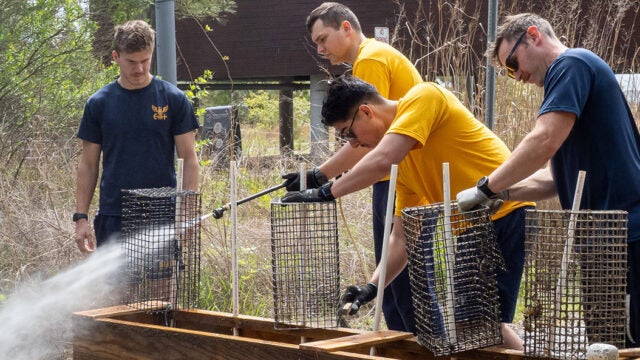
On Thursday, April 25, the Chesapeake Bay Foundation’s Brock Environmental Center welcomed 90 sailors and their families for a day of service known as the Thousand Points of Light. The City of Virginia Beach, which owns and manages Pleasure House Point with CBF, also hosted the volunteers and performed work on their portions of the property.
While at CBF’s Brock Environmental Center on Thursday, the volunteers removed invasive species, weeded gardens, moved oyster shells, as well as mulched and spread pine straw.
Inspired by George H.W. Bush’s support for volunteer service in his inauguration speech, and in celebration of the late president’s 100th birthday year, the day of service is aimed at giving back, strengthening community partnerships, and serving as a light for those in need. In his inauguration speech, Bush called on Americans to serve as a “thousand points of light” in their communities through volunteer service so that “we can find meaning and reward by serving some higher purpose than ourselves.”
Since the USS George H.W. Bush returned from deployment last April, 1,646 sailors from the crew have engaged in a total of 4,463 hours of volunteer service in the Hampton Roads area. The Thursday event continued that effort.
CBF’s Brock Environmental Center is one of the most sustainable buildings in the world, creating all its energy from solar and wind. It was also the first building to convert rainwater into drinking water.
Chesapeake Bay Foundation Leaders Joined Governor and Partners in Virginia Marine Resource Commission-led Celebration
Virginia Governor Glenn Youngkin celebrated Earth Day 2024 by announcing the achievement of a milestone in the state’s effort to restore oyster habitat in the Chesapeake Bay watershed.
Youngkin announced Monday the completion of over 200 acres of restored oyster habitat in the Lower York River, solidifying Virginia as home to the largest oyster restoration and replenishment effort in the United States.
The Lower York River milestone is the result of collaborative efforts spearheaded by the VMRC Shellfish Management Division. The support and funding provided by NOAA enabled the implementation of innovative restoration techniques and the monitoring of ecosystem health.
On Monday, Youngkin, along with Congressmen, delegates and representatives, commemoratively signed the final oyster shells to be added to the restored Lower York River oyster reef. These symbolic shells were then scattered on the oyster reef, marking the completed restoration of this Chesapeake Bay tributary.
Chesapeake Bay Foundation leaders joined Youngkin, Secretary of Natural and Historic Resources Travis Voyles, and representatives from Virginia Marine Resources Commission (VMRC), National Oceanic and Atmospheric Administration (NOAA), the Virginia Institute of Marine Science (VIMS), and oyster growers from across tidewater Virginia for the celebration.
The project is part of a 2014 plan by the Chesapeake Bay program to restore native oyster habitat and population in ten Bay tributaries across Virginia and Maryland by 2025. CBF has called for accelerating and expanding oyster restoration to 20 additional Bay tributaries by 2035 due to the overwhelming success of these efforts.
Chesapeake Bay Foundation President Hilary Harp Falk issued the following statement:
“It’s incredible to see how oyster restoration goals, which were set back in 2014, are now being met. This oyster restoration success is a prime example of how smart, targeted investments can help us turn prior challenges into one of our greatest strengths as a community. The Lower York River oyster restoration achievements underscores why we must continue to ramp up oyster restoration work for the next 20 Bay tributaries.”
Clean the Bay Day Scheduled for Saturday, June 1, at Sites Across Virginia
Registration is now open for Clean the Bay Day, Virginia’s largest and longest-running annual litter cleanup scheduled this year on Saturday, June 1. Thousands of people across Virginia will come together on the morning of June 1 for this event organized by the Chesapeake Bay Foundation (CBF).
Every year since 1989, on the first Saturday in June, these volunteers remove a massive amount of litter and debris from parks, streams, beaches, and trails. Sponsored by PRA Group, Clean the Bay Day relies heavily on around 60 partners to host, publicize, and run litter cleanup sites.
“Clean the Bay Day started off as a discussion among four residents sitting around a kitchen table. They wanted a way to clean up their communities but also experience the huge benefits when people come together toward a common goal of restoring the Bay and creating healthier neighborhoods. Now, for a few hours one morning a year, thousands of people become part of that dream. That wouldn’t have been possible without CBF’s partners,” said CBF Grassroots Coordinator Lisa Renee Jennings.
CBF and partners plan to host more than 200 cleanup sites across Virginia, including in Northern Virginia, the Richmond Area, the Shenandoah Valley, Hampton Roads, and the Eastern Shore. Since 1989, this Virginia tradition has engaged more than 165,500 volunteers who have removed approximately 7 million pounds of debris from more than 8,250 miles of shoreline.
“Clean the Bay Day gives the Suffolk community the chance to play a part in beautifying their communities, but also improve the health of the Chesapeake Bay,” said Daniel McDonald, Suffolk’s Litter Control Coordinator and a Clean the Bay Day partner. “Clean the Bay Day connects us to volunteers across the state to reduce the litter and debris we contribute to this treasured natural resource. We know that a cleaner Bay means stronger protection for our neighborhoods from climate change threats, restored natural habitats for beloved wildlife, and cleaner air and water for our children.”
The most common items found during the cleanups are plastics, glass bottles, aluminum cans, and cigarette butts. Participants also often find unusual items. In previous years, that has included a recliner, a cash register, a car door, a 19th century horseshoe, and a homemade drone.
“Our neighborhoods and waterways in Norfolk are a conduit of plastics and debris to the Chesapeake Bay and then out to the open ocean,” said Sarah Sterzing, Program Manager for Clean the Bay Day partner Keep Norfolk Beautiful. “Our wetlands, marshes, and rivers transport it, creating a crisis for the natural systems and wildlife that call the Chesapeake Bay home. Clean the Bay Day is Norfolk’s opportunity to not only clean up, but educate and engage residents and partners to understand that we are all stakeholders in the health and future of this critical system. We need to realize that every day is Clean the Bay Day and do our part and inspire others to as well.”
Just like rainfall leads to polluted runoff, rain also washes litter from streets and parks into waterways. This leads to microplastics and other pollution far downstream in rivers and the Chesapeake Bay. Leaving sites cleaner sends an important message on reducing litter and plastic waste.
This year’s event starts at 9 a.m. and is open to all, from children to adults, individuals to businesses and organizations.
For questions, please send an email to ctbd@cbf.org or call 757-644-4122.
Appointments Come During Pivotal Time for Chesapeake Bay Restoration
Virginia Senators Richard Stuart and Jeremy McPike and Delegate Alex Askew, leaders on conservation and Chesapeake Bay restoration efforts, have been appointed to the Chesapeake Bay Commission. They will join Delegate David Bulova, who recently took over as Chair of the Commission, and Delegate Rob Bloxom, who has served on the Commission since 2018.
The Commission is a tri-state partnership that seeks to provide coordination and leadership of state legislative and policy actions to restore the Chesapeake Bay and its tributaries. The commission also provides important input to Congress on Bay policy and budget issues.
The Virginia representatives will serve on the commission during a pivotal time as leaders chart a path forward as we approach a critical deadline for Bay restoration goals in 2025.
Stuart’s district includes parts of the Northern Neck, Middle Peninsula, and Spotsylvania County. McPike’s district includes parts of Prince William County and Stafford County and Askew represents parts of Norfolk and Virginia Beach.
The appointments come several months after the January announcement of Virginia Delegate David Bulova as the commission’s chair. Bulova represents parts of Fairfax County and Fairfax City in the Virginia General Assembly. As a leader on environmental issues, he has worked closely with the Chesapeake Bay Foundation (CBF) during his tenure. In 2019, CBF named him Virginia Legislator of the Year.
Chesapeake Bay Foundation Virginia Executive Director Chris Moore issued the following statement.
“We are excited to continue our work with these Virginia representatives as we enter this critical stage of Bay restoration. The Commission’s bipartisan work is key to advancing Bay restoration legislative and budget priorities. Their strong track records on the environment in Virginia as well as Bay restoration will help pave the way for innovative and inclusive approaches to ensuring Chesapeake Bay can be preserved for generations. We congratulate Delegate Bulova, Delegate Bloxom, Delegate Askew, Senator Stuart, and Senator McPike on their appointments.”
Lancaster received an early Earth Day gift of 100 new trees during the weekend.
Dr. Zeshan Ismat of Lancaster City and Dart Corporation employees planted 100 trees on the company’s property at 110 Pitney Road, Lancaster, Saturday morning.
Dr. Ismat received a 2022 Mira Lloyd Dock Partnership Diversity Award from the Keystone 10 Million Trees Partnership for her conservation and environmental justice work in under-represented portions of her community. The Partnership is coordinated by the Chesapeake Bay Foundation (CBF).
The Dock Award presentation to Ismat, and Saturday’s tree planting, were made possible by partnership with the Arbor Day Foundation and Project UP, an initiative of Packaging Corporation of America and Boise Paper that aims to revitalize urban communities through tree planting. Recipients of the Dock Award receive trees and supplies to help advance their efforts.
Brennan Ka’aihue of Central Pennsylvania also received a 2022 Dock Award and planted trees and shrubs in Carlisle last fall.
“CBF is deeply appreciative and supportive of the work Dr. Zeshan Ismat has done in her community, making connecting to nature and land stewardship more accessible,” said Carla Eissing, CBF Grassroots Manager in Pennsylvania. “She truly embodies the spirit of the Mira Lloyd Dock Award and we’re honored to partner with her and Dart to plant more trees and be part of the climate resiliency work in Lancaster.”
Dr. Ismat started the Blackbirds Environmental Justice group to teach youngsters in Lancaster City about the environment in a fun way while emphasizing stewardship, community, and justice. She said the mission is getting people, particularly youngsters from marginalized communities, involved in the natural world.
“Our identity is tied to our land and if that connection is strained the community can suffer,” Dr. Ismat said. “Everybody talks about climate change, and it is difficult for a lot of people to connect with these issues unless they are actually connected with the land. Little things like digging in the ground can help to feel connected and give you agency and ownership over your land and want to take care of it and think about the larger scale issues.”
Ismat is a geology professor at Franklin & Marshall College and before Blackbirds she was working on anaerobic digesters, putting compost into barrels to collect methane that forms naturally and can then be used for power.
“As part of Dart’s environmental stewardship efforts, our employee Community Action Teams always look for opportunities to clean up our neighborhoods and improve our planet,” said Matt Hess, Human Resources Business Partner for Dart Container’s Lancaster, manufacturing facility. “Planting trees improves soil and water conservation, helps regulate extreme temperatures and increases wildlife habitat – and they are beautiful additions to our property for our employees to enjoy.”
CBF launched the Keystone 10 Million Trees Partnership in 2018 with a goal of planting 10 million trees for Pennsylvania to help meet the state’s Clean Water Blueprint.
Mira Lloyd Dock is recognized as the first Pennsylvania woman to lead the way in forest conservation. She was an advocate for Penn’s Woods and in 1901 was appointed to the State Forest Reservation Commission by Pennsylvania Governor William Stone.
Five years ago this month and clad in a blue “HELLBENDER DEFENDER” t-shirt, Governor Tom Wolf signed legislation designating the Eastern hellbender as Pennsylvania’s official state amphibian. Gathered around him was an excited group of passionate teenagers who made it happen.
Those original “Hellbender Defenders” have been inspired to pursue careers in the fields of conservation, education, and the environment. The former Chesapeake Bay Foundation (CBF) Student Leadership Council (SLC ) members are working toward master’s degrees in Environmental Education, Wildlife Science or Conservation Biology, and studying Environmental Science and Outdoor Recreation Leadership.
The signing of Senate Bill 9 on April 23, 2019, was the crescendo of a three-year campaign by the students who had set out three years earlier to recognize the largest salamander in North America and create greater awareness of the critical need to reduce pollution in the Commonwealth’s rivers and streams.
“It is my hope that other student leaders across the Commonwealth may be inspired by our work,” SLC President Emma Stone said at the bill signing. “Making change is possible, no matter your age. All you need is dedication, support, and of course, a worthy cause. The hellbender is a worthy cause.”
“To think that future students get to learn about the hellbender is heartwarming because it will put this animal on their radar well into their adult lives,” Anna Pauletta said recently. She was president of the SLC when the hellbender campaign began in 2016.
Pauletta graduated from Cumberland Valley High School and then Penn State University in 2021 with degrees in Forest Ecosystem Management with a focus in Forest Biology and Wildlife and Fisheries Science, with a focus in Wildlife Biology. She also graduated with minors in Biology and Political Science. She is now serving as a paralegal specialist in the U.S. Army and plans to apply to law school in the fall.
During the hellbender campaign, the students studied hellbenders extensively, they met with state legislators, and installed nesting boxes in several Pennsylvania streams. They wrote the first draft of the bill that was sponsored by Senator Gene Yaw (R-Lycoming) in 2018.
Though the bill did not pass before the legislative session ended, the students persisted. When a new session began in January 2019, the measure was reintroduced as Senate Bill 9. The students helped guide the legislation to overwhelming passage by the Senate and House, and to the Governor’s desk.
“I am proud that we had the courage to do something rather unprecedented; that we got back up and kept trying after our bill didn’t make it through the first legislative session,” Stone said recently. She graduated from Carlisle High School and then Mansfield University in 2022 after studying Environmental Science and Outdoor Recreation Leadership.
The SLC hellbender campaign garnered local, state, and national attention, making it onto the front page of the Wall Street Journal and was a subject of the iconic Mark Trail Sunday comic strip. A radio station in Canada interviewed Stone.
“At the time it felt very overwhelming, and I am glad I got to understand that no matter your age you have a voice and can make an impact,” former SLC student Anne Puchalsky said recently. She graduated from Cumberland Valley and completed her bachelor of Science degree in Wildlife and Fisheries Science with a minor in Forest Ecosystem Management from Penn State. She hopes to obtain her master’s degree in Wildlife Science, or Conservation Biology.
Five years ago, Governor Wolf said the bill-signing ceremony was about more than a declaration of an official state amphibian. “It’s about reaffirming our commitment to protecting our waters in Pennsylvania,” he said. “Clean water is critical for the hellbender, and we need to continue to do our part to improve water quality in the Commonwealth so that the first state amphibian can thrive.”
Meanwhile, the most famous salamander in Pennsylvania continues to be celebrated. In October of 2023, the Eastern hellbender was recognized with a special Pennsylvania license plate that supports the Wild Resource Conservation Fund.
Recognition Highlights Career Dedicated to Environment
Peggy Sanner, former Virginia Executive Director of the Chesapeake Bay Foundation, received a top statewide environmental award for the pivotal role she played in building partnerships and advancing legislative and regulatory policy for a healthier environment for Virginians.
“Peggy has made an indelible mark on the conservation of Virginia’s waterways and in shaping environmental laws, regulations, and policies,” Chesapeake Bay Foundation Virginia Executive Director Chris Moore said. “I was honored to work alongside her, and the team at Chesapeake Bay Foundation is thrilled to see her recognized with such a well-deserved award.”
On April 11, Virginia Military Institute representatives presented Sanner with the Capt. Ron Erchul Environmental Leadership Award, which recognizes a Virginian who has made significant individual efforts to improve the environment.
Members of Virginia’s environmental community nominate candidates who are judged based on their vision, expertise, commitment, integrity, communication skills, accomplishments, and diplomacy.
The award announcement came April 11 during the final day of the annual Environment Virginia Symposium, which drew hundreds of people from state and local governments, nonprofit organizations, higher education, the private sector, Indigenous people, and tribal representatives to discuss pressing environmental topics ranging from climate resilience to emerging contaminants. The award is named for the late VMI professor Ronald A. Erchul, Ph.D., founder of the Environment Virginia Symposium.
Sanner retired in August 2023 after a career focused on environmental law and policy. She spearheaded policy that led to the implementation of agricultural conservation practices such as fencing cattle out of streams to reduce waterway pollution, banning phosphorus from lawn fertilizer, establishing a comprehensive nutrient trading program, expanding tree cover, and transferring menhaden fishery management from the General Assembly to the Virginia Marine Resources Commission.
Additionally, Sanner led collaborative efforts to ensure historic levels of funding for state clean-water programs to reduce pollution from wastewater, stormwater, and agriculture.
Sanner has also been a leading advocate in the development and maturation of Virginia’s clean water regulatory programs, including improving and protecting wetland preservation and mitigation policies, advocating for effective implementation and enforcement of the Chesapeake Bay Preservation Act, and ensuring stormwater and erosion and sediment control programs are backed by the best available science. She regularly appeared before the State Water Control Board and worked with CBF’s Litigation department to prevent harmful projects like the Atlantic Coast Pipeline and Fones Cliff Development, as well as to hold Clean Water Act permittees accountable.
As a mentor for many legal and policy experts and peers during her time with CBF, Sanner lived out her vision and commitment to tomorrow’s environmental leaders and to clean water.
A member of the Virginia State Bar, Sanner has practiced before state and federal courts, agencies, and boards on key legal and policy issues. Before joining CBF in 2010, she litigated environmental and other matters in courts across the country.
Sanner received her law degree from Rutgers University and holds graduate and undergraduate degrees from the University of Pennsylvania and Swarthmore College, respectively.
Maryland lawmakers voted for cleaner water and healthier communities this General Assembly session with the passage of legislation that will address the state’s influx of industrial sludge. The Chesapeake Bay Foundation (CBF), ShoreRivers, Chesapeake Legal Alliance, and local community members now urge Governor Wes Moore to sign House Bill 991 and Senate Bill 1074 into law.
Industrial sludge, sometimes referred to as food processing residuals (FPR) or dissolved air flotation (DAF) material, has been of growing concern to farmers and communities across the state. These are semi-solid leftovers derived from the rendering of protein, like poultry and seafood, that are then applied to farmland as an agricultural fertilizer. Overapplication and mishandling of this material allow it to runoff into waterways, putting local water quality and Bay health at risk. It also creates foul odors, harms neighboring communities, and causes health concerns.
“Improper handling and application of industrial sludge causes it to spill and run off directly into our local waterways and ultimately into the Chesapeake Bay,” said Alan Girard, Maryland Advocacy Director at CBF. “It’s also a major concern for the Marylanders living near these sludge application and storage sites that drink well water and live off the land.”
Since Maryland currently does not require a permit for industrial sludge use, its safe and proper handling has come into question. Unlike Maryland, neighboring states including Delaware and Virginia require a permit for handling and applying sludge, making it advantageous for rendering plants located there to ship their sludge to Maryland for disposal. According to a 2023 study by the University of Maryland, more than half of the industrial sludge land-applied in Maryland in recent years came from out of state.
“Pollution concerns from the use and storage of industrial sludge have increased rapidly on the Eastern Shore — underscoring the urgency for state action to protect local rivers and creeks and hold accountable anyone who chooses to misuse DAF material in the future,” said Matt Pluta, Choptank Riverkeeper at ShoreRivers.
“We thank our state legislators, the Maryland Department of Agriculture, and all the communities who came to the table to prioritize this issue and pass this legislation,” Pluta said. “The next step will be making sure there’s strong regulations in place to carry out the intent of the legislation, and we’ll continue to advocate that it’s done responsibly and with the health of our waterways in mind.”
Many community members across Maryland voiced their concerns with industrial sludge and supported legislation to regulate it.
“The smell of the industrial sludge being spread in our community has been unbearable, not to mention the negative environmental impacts,” said Jason Green, resident of Mayberry, Maryland. “We are glad that our calls for much-needed regulation have been heard and supported by our delegation and CBF and resulted in the passing of this legislation.”
The legislation will close a loophole in state oversight and keep Maryland on-par with neighboring states by:
- Requiring a utilization permit for the use, storage, and hauling of industrial sludge in the state;
- Ensuring local governments issue all necessary approvals before someone can utilize sludge;
- Authorizing the Maryland Department of Agriculture to enter and inspect any site where industrial sludge is used;
- Increase penalties for users who willfully violate Maryland’s nutrient management regulations.
These tools will help ensure industrial sludge is only used safely and effectively in Maryland, limiting odors and health concerns, as well as preventing nutrients from entering local waterways and the Bay.
Maryland residents who are passionate about their local rivers and streams and the Chesapeake Bay can now make a difference in their communities through the Chesapeake Bay Foundation (CBF)’s Volunteers as Chesapeake Stewards (VoiCeS) program. Registration is open for upcoming April and May classes in the communities of Cambridge and Prince George’s County.
VoiCeS engages local volunteers who want to play a more active role in their communities and Bay restoration, and gain a deeper understanding of the challenges and opportunities the Bay faces. Sessions are professionally led by CBF staff and include topics such as pollution, fisheries, oyster restoration, regenerative agriculture, and more. Graduating participants are recognized as CBF Certified Bay Stewards and invited to join CBF’s team of Clean Water Captains.
“CBF’s VoiCeS seminar provided me so much more than I ever expected,” said G. Rick Wilson, VoiCeS graduate from Laurel, Maryland. “My experience included more compelling stories about why we must protect our Bay; more guidance to show me how to become an effective advocate; more connections into the myriad of organizations dedicated to protecting the Bay; and finally, more friendships with like-minded colleagues who care. VoiCeS was an easy investment of my time that has returned so much more.”
VoiCeS programs include a series of online, collaborative sessions, as well as optional in-person field trips. Participants get hands-on educational experience that enhances their personal volunteer and advocacy journeys. Since the program was created in 2004, over 900 people across the Chesapeake Bay watershed have participated.
“The goal of VoiCeS is to give passionate Bay advocates new tools and experiences that can be applied in their own communities,” said Julieta Rodrigo, CBF’s Urban and Community Resilience Manager. “This year marks the program’s 20th anniversary. We’re thrilled to celebrate that milestone with the residents of Cambridge and Prince George’s County.”
Classes start in mid-April and run through mid-May. The six-week program, including four online Thursday evening sessions and optional field trips, is $25. Registration for the Prince George’s County program closes on April 10. Registration for the Cambridge program closes on April 11. All Maryland residents are welcome to register, though session topics have been tailored to these two geographies. Learn more and register here.
Environmental advocates celebrate progress for statewide watershed restoration program
Today, state legislators achieved a great victory for Maryland’s waterways by passing the Whole Watershed Act. The legislation (SB 969/HB 1165), introduced by Senator Sarah Elfreth (Anne Arundel) and Delegate Sara Love (Montgomery) in collaboration with a broad coalition of stakeholders, will pilot a highly collaborative, science-based approach to watershed restoration across the state.
Now, groups including the Chesapeake Bay Foundation, Chesapeake Bay Commission, Chesapeake Conservancy, Maryland League of Conservation Voters, and other environmental champions, state agencies, and restoration practitioners, are calling on Governor Wes Moore, whose support was critical to the bill’s passage, to sign the Whole Watershed Act into law.
The Whole Watershed Act promotes innovative, science-based approaches to waterway restoration efforts and is a direct response to conclusions in the 2023 Comprehensive Evaluation of System Response (CESR) report—an evaluation of water quality progress for the Chesapeake Bay. The legislation will utilize existing state funds to create a five-year pilot program targeting five Maryland watersheds that best represent the state’s diverse land uses, geographies, and impairments. The pilot projects will deliver not only water quality improvements, but also specific co-benefits like increased public access to waterways, wildlife habitat, fisheries improvement, and climate change resiliency. Target watersheds will be selected by and in close collaboration with local stakeholders and elected officials who will be critical in the design and implementation of restoration projects. Selected projects will be overseen by a State Management Team, made up of agency experts, to help find efficiencies in project permitting and funding, and to measure project results.
“The Whole Watershed Act is a beacon of what is possible, bringing all levels of government to the table to fund innovative, holistic projects on an expedited timeline,” said Sen. Elfreth. “This legislation ensures that we can be bolder, go bigger, and build smarter projects where they will have the greatest impact. The final product is the result of a deeply collaborative process, and I am proud to have worked alongside Delegate Love, the environmental community, state agencies, and colleagues in the General Assembly to craft and pass this critical legislation.”
“The Whole Watershed Act is an important piece of legislation that will foster innovative and collaborative new approaches to watershed restoration,” said Del. Love. “The bill will give groups doing on-the-ground work in Maryland watersheds the guidance, support, and funding to tackle comprehensive projects that maximize results on between legislative leaders, environmental champions, as well as the state and local governments. I am proud to have sponsored this legislation.”
The Whole Watershed Act was chosen as a 2024 legislative priority by the Citizens’ Campaign for the Environment, the largest environmentally-focused legislative coalition in Maryland.
“The Whole Watershed Act will accelerate meaningful results towards our Chesapeake Bay restoration goals,” said Allison Colden, Maryland Executive Director at the Chesapeake Bay Foundation. “Rooted in science and proven successes, the program is a direct response to the CESR report and will rapidly improve waterways included on EPA’s impaired waters list for the benefit of the Bay and local communities.”
“This bill is a transformative approach to watershed restoration in Maryland,” said Kim Coble, Executive Director at the Maryland League of Conservation Voters. “By allocating resources to diverse geographies and prioritizing Environmental Justice communities, this legislation sets a new standard for effective and equitable environmental stewardship. We believe the Whole Watershed Act puts us on a path toward achieving our restoration goals, ensuring the health of our waterways for generations to come.”
