Press Release
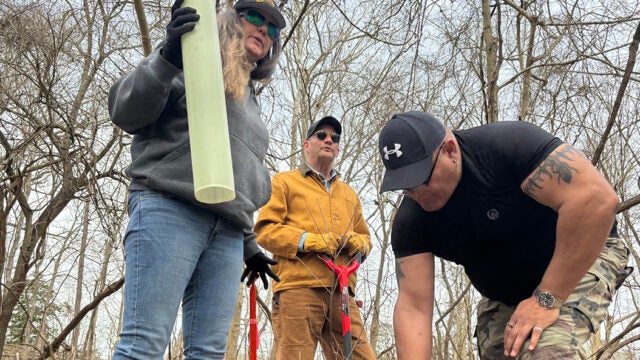
Volunteers and Chesapeake Bay Foundation Join Tribe in Project
The Nansemond Indian Nation’s efforts to heal and deepen their physical connection to their ancestral riverfront land took a significant step with the first tree planting in Mattanock Town on March 1.
“It’s incredible to feel the comradery and kindship for this project that is so valuable for the ecosystem,” Nansemond Indian Nation Chief Keith Anderson said. “It is a great honor to be a steward of this land.”
The Tribe, volunteers, and representatives from the Department of Forestry and the Chesapeake Bay Foundation planted dozens of native trees along the Nansemond River Friday. This kicked off a multi-day project where a total of 450 native trees are expected to be planted.
Native black gum, hackberry, and witch hazel trees were among the native plants that replaced debris and an invasive species known as privet that previously dominated the property. Buried beneath the soil, volunteers found oyster shells and scallop shells as big as their palms.
“I feel that I am on sacred ground. I feel a spiritual connection as I’m here helping restore this land,” said Mary Hill, a tree planting volunteer Friday and a member of the Chesapeake Oyster Alliance. Hill said she is the descendent of seven generations of African-American watermen and had ancestors with connections to the Nansemond Indian Nation.
Considered the cultural heart of the Tribe, the Nansemond River never left the spirits of the Nansemond Indian Nation even after centuries of displacement that date back to the arrival of colonists in the 1600s. According to the Tribe, their name meaning “Fishing Point” comes from the Coastal Algonquian language spoken by their ancestors, who lived in settlements along the Nansemond River for thousands of years.
Following federal and state tribal recognition, the Tribe committed to reconnecting its people to the local waterways through a variety of projects including oyster gardening, community events, and tree plantings.
On Friday, the Chesapeake Bay Foundation provided volunteers and expertise while the Department of Forestry showed volunteers how to plant the trees.
“You couldn’t walk in this area just a short time ago because it was filled with invasive species,” Chesapeake Bay Foundation Virginia Executive Director Chris Moore said. “It is very exciting to see so many partners come together for this comprehensive restoration effort that stretches from underwater up to the land.”
For more information on the Nansemond Indian Nation and their vision for cultural revitalization through river stewardship, check out the Tribe’s story map, Indigenous Life On The Nansemond River.
Legislation Protecting Virginians From Cancer-Linked Product Passes Committee
Virginians are closer than ever before to receiving protection from harmful toxic sealants commonly used to coat driveways.
For the first time since being introduced three years ago, a bill that bans toxic pavement sealants passed the Senate Committee on Agriculture, Conservation, and Natural Resources by a 11-3 bipartisan vote on Feb. 27.
House Bill 985 patroned by Delegate Kathy Tran, D-Fairfax, now heads to the full Senate for consideration. The bill cleared the House of Delegates by a 78-21 vote.
“This ban is a commonsense action to protect our children’s lives and our waterways from dangerous pollutants,” Tran said. “Young children up to six years old are particularly vulnerable. I have little kids, and they play on the driveway. No parent would want their kids being exposed to these toxic substances.”
Applied both commercially and privately, the sealant is a black liquid marketed as a pavement protector. These products contain high levels of polycyclic aromatic hydrocarbons (PAHs), which are toxic and carcinogenic chemicals that can harm people, birds, amphibians, fish, mammals, and plants. The bill would prohibit any pavement sealant with a PAH concentration greater than one percent by weight.
A USGS fact sheet shows that the excess cancer risk for people living adjacent to pavement treated with toxic sealants is significantly higher than for those living near unsealed pavement. There are also detrimental impacts to the environment.
“PAHs are definitely toxic. There really isn’t a question about that. When organisms, whether oysters, mice, or fish, are exposed to these products in research studies, they have caused negative health effects,” Chesapeake Bay Foundation Virginia Senior Scientist Joe Wood said.
Michael Jones, who owns Jones Striping and SealCoating in Petersburg, told Senate committee members that his company stopped using the toxic sealant in 2015 and switched to a safer alternative sealant.
“We did learn that it was a carcinogen. We learned it was toxic and harms the skin,” Jones said. “We did this for the health of our clients, our employees, and the environment. This still keeps us competitive.”
PAHs have been detected in several fish and waterways throughout Virginia, correlating to freshwater mussel decline in the Clinch River. PAHs have also been a driver of fish cancer in the Elizabeth River and three experiments indicated significant negative impacts of PAHs on various early life stages of the Bay’s native oyster. According to one experiment, mice exposed to these sealants develop “mutations in bone marrow, liver, lung, small intestine, and glandular stomach.”
These dangerous chemicals can enter the environment through skin contact, such as a child sitting on a coated driveway. They can also be loosened when a car drives over pavement, then be washed off by rain or transported by the car’s tires.
Stores like Lowe’s and Home Depot have stopped the sale of such sealants. Other types of asphalt sealants are available that are significantly less toxic, are priced similarly, and are widely available.
Most highway departments and road agencies, including the Virginia Department of Transportation, have not used toxic pavement sealants on asphalt pavement for many years. Virginia’s neighbors, Maryland and Washington D.C., have both instituted bans.
Prohibitions on the use of toxic sealants have shown to be effective, with some places showing a 50 percent decline in toxins in waterways after only a few years. The EPA’s Chesapeake Bay Program has prioritized PAHs as among the most critical toxic contaminant to rivers, streams, and Chesapeake Bay.
The bill includes a grace period for applicators who may have already purchased PAH sealant products to use their existing supplies.
The Virginia House and Senate unveiled separate proposed spending plans Sunday, which included needed investment in environmental efforts but also marked missed opportunities to support critical issues.
These proposals approved by the House and Senate money committees Sunday made amendments to the budget previously pitched by Governor Youngkin. The House and Senate budgets vary significantly in their proposed funding for conservation over the next two years.
The Chesapeake Bay Foundation (CBF) looks forward to working with legislators and the Youngkin Administration throughout the budget process to secure significant support for clean water, a climate-ready Commonwealth, agricultural conservation practices, and invasive species management. CBF is gratified the see the following investments in the state’s natural resources:
Agricultural and Tree Conservation
- Building off last year’s historic investment in farmers, legislators in both Houses proposed $231 million for each year of the biennium to the Virginia agricultural cost-share program. Practices like fencing cattle out of streams and planting streamside trees are among the most cost-effective steps Virginia can take to restore the Chesapeake Bay and improve water quality throughout the state.
- The House proposed a $20 million investment in a pilot program that would pay for verified, successful results in pollution reduction projects.
- With the state losing tree canopy at an alarming rate, the House included $1.16 million in funding to study the Commonwealth’s forests and conservation opportunities. Both chambers also proposed funding for a Department of Forestry policy specialist.
Wastewater Treatment
- The House budget included $400 million in bonds to fund upgrades at wastewater treatment plants essential to continuing our progress in reducing nitrogen, phosphorus, and sediment pollution.
- Stormwater runoff from roofs, sidewalks, and roadways remains a growing source of dangerous pollution and the focus of many local pollution reduction projects. But neither chamber proposed needed investment in the Stormwater Local Assistance Fund. This fund provides matching grants to localities for projects like rain gardens and stream restoration.
Climate Resiliency
- The House proposed $200 million over the biennium for the Community Flood Preparedness Fund, which supports local flood prevention and protection projects. This fund has been tapped by communities from Southwest Virginia to Fairfax to the Eastern Shore to the tune of hundreds of millions of dollars.
- The House conditioned their budget upon Virginia’s reentry to the Regional Greenhouse Gas Initiative (RGGI), a multi-state carbon emission reduction program. RGGI participation is key to Virginia’s climate adaptation and mitigation efforts as well as our clean water goals.
Tackling Invasive Species & Rebuilding Keystone Species
- The Senate restored $500,000 per year that had been removed for oyster replenishment activities. Oyster restoration efforts are vital to thriving waterways and local economies that until recently had long suffered from overharvesting, pollution, and disease.
- Efforts to strengthen the blue catfish industry enjoyed support from both chambers with the House investing $500,000 and the Senate $250,000 in the second year of the two-year budget. A robust commercial fishery for blue catfish will help reduce their predatory pressure on other commercial and recreationally important fishery species.
A conference committee of legislators will now negotiate a single set of budget amendments, which will need approval from Governor Youngkin before becoming law.
Chesapeake Bay Foundation Virginia Executive Director Chris Moore issued the following statement:
“The Commonwealth’s budget is an important opportunity for the state to invest in clean water and restore beloved ecosystems, as well as better protect our homes, businesses, and families as we build a climate-ready Commonwealth. CBF applauds the proposed investments in agricultural conservation, wastewater, and climate resilience. We look forward to working with legislators to ensure widespread support for programs that enhance Virginia’s waterways and protect residents from a host of environmental threats.
“Communities across the state are ramping up work to confront invasive species, protect their local economies, reduce pollution and better ready their communities for the reality of climate change. Passing a robust conservation focused budget will help demonstrate that Virginia lawmakers are committed to enhancing Virginia’s economically and ecologically important natural resources.”
As major climate change challenges loom, redoubling efforts to restore the Bay’s native oyster will pay dividends
With Chesapeake Bay oyster recovery at a crucial point, building on current momentum will increase resiliency to climate change in the region while creating multiple benefits for people and the environment, according to a new report released today by the Chesapeake Bay Foundation.
Recommendations in the report, titled “Hope on the Half Shell: Harnessing Oysters to Build Ecological and Community Resilience,” include targeting oyster restoration in 20 additional Bay rivers, equitably growing the oyster aquaculture industry, and modernizing management of the wild oyster harvest.
“Oysters are the bedrock of the Chesapeake Bay ecosystem, long recognized for their ability to provide habitat and improve water quality. But their benefits to communities and the ecosystem extend far beyond that,” said CBF Maryland Executive Director Allison Colden. “Oysters are key to adapting to climate change, supporting local economies, and cleaning up waterways. You can’t overstate their importance to the Bay.”
But oysters are at a critical juncture. Over the last century, Chesapeake Bay oyster numbers plummeted to just a fraction of historic levels due to disease, overharvesting, pollution, and habitat loss.
The decline of oysters and their habitat has exacerbated water quality issues, reduced productivity of key Bay fisheries, and left critical shoreline habitats like marshes and underwater grasses susceptible to erosion and loss.
Fortunately, the Chesapeake Bay is now home to some of the most successful oyster restoration projects in the world. Under the 2014 Chesapeake Bay Watershed Agreement, federal-state efforts are on track to fully restore 11 Chesapeake Bay tributaries for oyster habitat by 2025. Monitoring of these restored reefs shows incredible success, with most reefs sustaining or expanding while meeting or exceeding criteria for oyster abundance.
“Restoring native oyster habitat and populations in ten tributaries is one of the few material outcomes set by the Chesapeake Watershed Agreement that will actually be achieved by 2025,” said Don Boesch, President Emeritus of the University of Maryland Center for Environmental Science. “But this is just the beginning, not the end, for recovery of the Bay’s oyster population.”
Large-scale oyster restoration achievements have been possible through strong federal investment, state support, and the collaboration of many partners. As this major phase nears completion, sustained federal funding and state support will be crucial.
“With all the elements for success now in place, it’s time to seize the moment and accelerate the pace and scale of oyster recovery in Chesapeake Bay,” said Colden.
This comes as Maryland and Virginia ramp up work to address the effects of climate change. Oysters can play an important role in protecting Chesapeake Bay shorelines and marshes from erosion, sea-level rise, and intense storms.
As momentum, funding, and expertise coalesces around oysters, recommendations in the report for immediate next steps include:
- Accelerate the pace and scale of large-scale oyster restoration projects, restoring an additional 20 Bay tributaries by 2035 that collectively encompass 4,000 acres or more of restored oyster reef.
- Grow Maryland’s oyster aquaculture industry to 50,000 acres under lease and 500,000 bushels harvested annually by 2035. That compares to 7,500 acres under lease and 94,000 bushels harvested for Maryland oyster aquaculture in 2022.
- In Virginia, initiate an oyster stock assessment, ensure aquaculture growth in all regions, and ensure that oyster aquaculture leases are effectively utilized.
- Increase the use of oysters in shoreline protection and restoration to address sea-level rise and erosion from more intense storms due to climate change.
- Modernize oyster fishery management to increase oyster numbers. That includes utilizing the most up-to-date scientific information and methods, implementing harvest quotas, and using electronic harvest reporting.
- Manage oyster shell to grow this critical resource for oyster restoration, as well as oyster replenishment work to support oyster fisheries.
The report recommendations aim to achieve six vital outcomes for Maryland and Virginia, which are:
- Improved water quality;
- Equitable economic opportunities for coastal communities;
- Increased resilience to sea-level rise and storm surge;
- Climate change mitigation;
- Transparency and accountability in fishery management; and,
- Modernized fishery management for sustainable harvests.
Oysters create significant economic benefits for Bay states. Sales of oysters brought in more than $56.8 million in revenue in Maryland and Virginia in 2022, and restoration reefs support millions more in revenue for other fisheries by providing key habitat for game fish and blue crabs.
This comes alongside the growing recognition that coastal restoration efforts in the face of climate change must be undertaken holistically. For example, for the greatest benefits, new oyster reefs can be built in conjunction with underwater grasses, living shorelines, and buffers of native trees and shrubs.
In addition, oyster restoration efforts take place in shallow water, an area where the recent Comprehensive Evaluation of System Response report indicated Chesapeake Bay restoration partners should focus near-term restoration efforts.
“Increasing oyster numbers benefits all facets of life in and along the Chesapeake,” said CBF Virginia Executive Director Chris Moore. “Now let’s expand on the achievements to date. With oysters, we can adapt to climate change, support the Bay’s ecological, economic, and social resilience, and build vibrant communities where people and nature thrive together.”
Bill Walton, who is the Shellfish Aquaculture Program Coordinator for the Virginia Institute of Marine Science, noted the importance of expanding aquaculture.
“It’s exciting to see a restoration plan for Chesapeake Bay that embraces shellfish aquaculture as part of the solution. While many might think of the economic benefits of shellfish aquaculture and how those rely on a healthy Bay, the science is clear that shellfish aquaculture can provide environmental benefits,” Walton said. “As the report notes, reaching the ambitious environmental goals will require the diversity of people who care about Chesapeake Bay to work together creatively to achieve those outcomes.”
Boesch also expressed support for the report’s recommendations.
“We must build on what we have learned to take the next steps recommended in this report by CBF,” Boesch said. “While bold, these recommendations are entirely feasible and achieving them will provide manifold benefits for society, ecosystem health, and climate resilience.”
* * *
Download an .mp4 audio file of the press conference
Download the .m4a video file of the press conference
Watch the video
Bills that Conserve Trees, Ban Toxic Products, and Strengthen Climate Resiliency Clear Crossover
Virginia state lawmakers marked the midpoint of their 60-day legislative session on February 13 with historic support for environmental issues.
At this midpoint known as crossover, bills passed by the House and Senate are sent to the other chamber for consideration. If the bills clear both chambers, they head to Governor Youngkin’s desk to be signed into law, vetoed, or become law without a signature.
Toxic Pavement Sealant Ban Within Reach
For the first time since being introduced three years ago, a bill that bans toxic pavement sealants has cleared the House of Delegates by a 78-21 vote.
If passed into law, toxic products used mainly to seal driveways and parking lots could no longer be sold in Virginia. Delegate Kathy Tran (House Bill 985) patroned the bill. Applied both commercially and privately, the sealant is a black liquid marketed as a pavement protector.
These products contain high levels of polycyclic aromatic hydrocarbons (PAHs), which are toxic and carcinogenic chemicals that can harm people, birds, amphibians, fish, mammals, and plants. The bill would prohibit any pavement sealant with a PAH concentration greater than one percent by weight.
Landmark Support for Tree Conservation
Tree conservation has also enjoyed landmark support from lawmakers. Though tree legislation has historically stalled in the House of Delegates, multiple bills are now successfully moving through the General Assembly. These bills mainly give localities authority to conserve and replace trees, among the most cost-effective solutions to alleviating flood impacts and reducing pollution.
HB 529, introduced by Del. Patrick Hope, would give localities broader authority to replace trees lost during construction. If passed into law, localities could establish tree replacement requirements and establish a tree fund if trees can’t be replaced on site. It heads to the Senate with a 53-44 vote from the House.
Another bill, HB 1100, introduced by Del. Betsy Carr, would help cities and counties preserve trees before they are cut down, rather than replacing them. It enables all localities to conserve more trees during development. Currently, only some Northern Virginia localities have the authority to adopt tree conservation ordinances. This passed the House by a 52-46 vote.
Lastly, HB 309 by Del. Patrick Hope and SB 461 by Sen. David Marsden would allow Virginia to determine how many acres of the Commonwealth’s forests are healthy, the cause behind the lost canopy acreage, how to reconnect forest fragments, and identify opportunities for further conservation efforts. HB 309 and SB 461 passed their respective chambers unanimously.
Resiliency Bills Advance
Two House bills that prepare Virginia to become a climate-ready Commonwealth are also heading to the Senate with widespread support.
HB 1458, introduced by Del. Phil Hernandez, passed the House unanimously. This bill unifies the government’s climate change resources and adds oversight to flood protection funding. HB 673, introduced by Del. Michael Feggans, prioritizes low-income communities in the Virginia Resilient Revolving Loan Fund and ensures climate change solutions are equitable.
Environmental Education Makes Strides
Human impact on the environment and the value of Virginia’s natural resources are essential parts of state education standards, but many school districts aren’t connected to the resources needed to offer hands-on, inquiry-based learning opportunities through environmental education. The Chesapeake Bay Foundation is also supporting increased funding in the budget for Meaningful Watershed Educational Experiences that would be focused on environmental literacy.
Chesapeake Bay Foundation Virginia Executive Director Chris Moore issued the following statement.
“This historic support for critical environmental legislation is a huge step toward protecting Virginians and the environment from toxic products and flooding damage, while communities across the Commonwealth would benefit from cleaner air and water. We applaud these significant advancements by state lawmakers.
“Virginia urgently needs to ramp up work to become a climate-ready Commonwealth. This landmark support from legislators from tree conservation to resiliency signals the importance to representatives of reducing carbon emissions, polluted runoff, strengthening flood protection, and reducing storm damage.”
Chesapeake Bay Foundation’s Middle School Bay Eco-Camp offers outdoor adventures and environmental learning for students across the region
Middle school students passionate about nature, science, and the environment can experience a once-in-a-lifetime summer adventure at the Chesapeake Bay Foundation (CBF)’s Middle School Bay Eco-Camp. The five-day overnight summer camp experience is designed for students entering sixth, seventh, and eighth grade who are interested in spending time outdoors and learning about the unique Chesapeake Bay.
“Bay Eco-Camp offers one of few summer opportunities for middle schoolers to get hands-on, up-close experiences with remote Bay ecosystems,” said Tom Ackerman, Vice President of Education at CBF. “During their adventure, campers will canoe, boat, interact with critters, and explore beaches and historic Chesapeake Bay communities.”
The camp is held at CBF’s Port Isobel Island Environmental Education Center. Port Isobel is a 250-acre island campus that is part of the Tangier Island, Virginia, community in the middle of the Chesapeake Bay. Throughout this ecologically diverse landscape, students will explore underwater grass beds, study vibrant oyster reefs, and discover the beauty of salt marshes surrounding a historic fishing community.
“I really enjoyed learning about the Chesapeake Bay and the flora and fauna that inhabits it,” said Callen Moore, eighth grade student from Virginia Beach. “Every day was filled with fun activities and exploring the environment.”
Campers can choose between two sessions available: July 15–19 or August 12–16. Space is limited and registration closes on June 3 for the first session and July 5 for the second. Student pick-up and drop-off will take place in Crisfield, Maryland. Interested students can learn more and register here.
CBF has been a leader in environmental education for over 50 years. Through student field and leadership programs, as well as professional learning opportunities, CBF educators have offered meaningful watershed experience to more than 1.5 million participants.
Isabel “Izzy” Snee and Mariah Saunders have joined the Chesapeake Bay Foundation (CBF) team as conservation coordinators, working to accelerate progress toward bringing impaired streams back to health in parts of four Pennsylvania counties.
The work by Snee and Saunders continues momentum created by Pequea Creek and Halfmoon Creek Watershed Implementation Plans coordinated by CBF. Their goals during the new five-year Pequea and Halfmoon Creeks Watershed Renewal Project are to reduce pollution and restore the health of streams in both watersheds that are impaired by nonpoint source runoff, like certain agricultural activities.
“The renewal project represents an evolution in CBF’s work to reduce pollution to Pennsylvania’s rivers and streams. Using our plans as a guide, this project will accelerate implementing key practices to bring streams back to health, improve wildlife habitat critical to critters like the brook trout, and enhance local appreciation of our local waters,” said Harry Campbell, CBF Science Policy and Advocacy Director in Pennsylvania.
“Izzy and Mariah bring valuable experience to taking the renewal project to the next level,” Campbell added. “We are excited to have them working with farmers, landowners, and partners in Pequea and Halfmoon to get the plans implemented.”
The Pequea Creek watershed is in Lancaster and Chester counties. Halfmoon Creek watershed is in Centre and Huntingdon counties.
“Engaging with the community is the foundation of conservation,” Snee said. “It’s getting them interested and giving them the motivation as to why they should care. A lot of people already have that, they just don’t know what they can do in a practical sense. I’m looking forward to engaging with farmers, our partners in the Pequea Creek watershed, and hearing other ideas.”
“Building relationships within the Halfmoon Creek watershed represents a wide breadth of opportunities,” Saunders added. “The entire implementation plan and its success will rely heavily on partnerships constructed there.”
The basis for the renewal project is two innovative watershed management plans already completed by CBF, that combine emerging high-resolution watershed data and modeling with extensive local collaboration. The project will also offer a series of hands-on farmer-to-farmer conservation field days to teach and engage farmers through hands-on experiences.
Of the 240 miles of streams in the Pequea Creek watershed, the near-term priority is restoration of 41 miles that do not meet water quality standards for aquatic life. Under the Pequea plan, funding will be used to keep soils and nutrients on the land with such practices as cover crops, no-till agriculture, riparian buffers, streambank fencing, streambank stabilization, and other practices.
Also in the Pequea watershed, access and use of non-motorized cover crop and no-till equipment will be available for use by Plain Sect farmers.
Snee, from Washington, D.C., joined CBF having served as a horticultural conservationist, engaging in field research collection, collaboration with botanic institutions, conservation agencies, and landowners, tours and lectures at Longwood Gardens, Kennett Square, PA.
She worked for the Quivira Coalition in Montana in conservation agriculture and was a sustainable agricultural operator and cattle specialist with the renowned Warren Wilson College Farm in Asheville, N.C. She also interned at the Smithsonian Gardens in Maryland.
Snee has a bachelor of science degree in Environmental Studies with a minor in Biology and a concentration in Sustainable Agriculture from Warren Wilson College.
The goals for the Halfmoon Creek watershed are to reduce sediment, preserve critical landscapes, restore degraded landscapes, and foster stewardship of the watershed. Of the 32 miles of streams, a priority is restoring roughly 10 miles of headwaters in the Bald Eagle Region.
Saunders is from Annapolis, Md., and was recently at the Smithsonian Environmental Research Center serving as a teaching assistant in Food Systems and Sustainable Agriculture, and education intern.
She holds a bachelor of arts degree in Environmental Studies and Classical Civilizations from Wesleyan University. Her undergraduate thesis was on fostering cultural engagement and environmental stewardship through Place-Based Education in the Chesapeake Bay, earning her high honors from the Bailey College of the Environment.
Funding acquired by Senators Bob Casey (D-Pa.) and Ben Cardin (D-Md.), is moving the five-year project forward. The senators requested $2.18 million for the Pequea Creek watershed restoration plan. Senator Casey sought an additional $1.06 million for the Halfmoon Creek watershed plan. The plans also are eligible for federal funding through the Clean Water Act and other sources.
Funding vital for development of both plans was made possible by the Richard King Mellon Foundation.
Legislation Centralizes Staff and Adds Oversight to Funds
Sea level rise and flooding are a growing part of Virginians’ lives, but the Commonwealth’s resources to contend with these threats are scattered across multiple government agencies.
New legislation scheduled for a key committee vote in the Virginia General Assembly on February 7 unifies the government’s climate change resources and adds oversight to flood protection funding.
To access resources that proactively address flooding and sea level rise, local communities navigate a patchwork system of state offices and programs. At the same time, the two state funds supporting flood protection needed greater transparency to ensure limited resources are maximizing their return on investment for the Commonwealth.
Those were the recent findings of a group of 39 stakeholders including representatives from nonprofit, academia, government and industry organizations. The group met as part of a yearlong effort to enhance the state’s framework for dealing with climate change threats.
A major outcome of those efforts recently got a boost from state lawmakers. HB 1458, introduced by Del. Phil Hernandez, cleared the House Chesapeake Subcommittee Feb. 5 by a 10-0 vote and is expected to be considered by the House Agriculture and Chesapeake and Natural Resources Committee Feb. 7.
“This is critical legislation to get Virginia closer to a climate-ready Commonwealth. Localities need a comprehensive approach to protect their homes and businesses from increased flooding. This hub and spoke approach better supports the praiseworthy efforts of communities across the state while maximizing the value of state investments,” Hernandez said.
At the core of the legislation is the centralization of climate resiliency efforts through the creation of the Office of Commonwealth Resilience, which would be nested under the Governor. It also increases transparency and oversight over the distribution of money from the Community Flood Preparedness Fund and Resilient Virginia Revolving Fund.
Communities from Southwest Virginia to Fairfax to the Eastern Shore have tapped hundreds of millions of dollars from these funds to support community-scale projects to help with increased flooding.
By merging climate adaptation efforts, the legislation gives local and state officials the ability to maximize federal, state, and private flood mitigation funding.
“This is a major step in the right direction to better protect Virginians from climate change impacts already here and on the horizon. Unfortunately, flooding is only becoming more frequent. This legislation acknowledges that these issues are more than just natural resource issues, but public safety and economic issues as well,” said Chesapeake Bay Foundation Virginia Policy and Grassroots Advisor Jay Ford, who was a member of the stakeholder group.
New Bill Would Provide Tools to Crack Down on Putrid Odors and Bay Contaminants
Maryland should no longer be a dumping ground for industrial sludge, a growing concern that new bipartisan legislation introduced today by primary sponsors Delegate Sara Love and Senator Justin Ready intends to address. The bill supported by the Chesapeake Bay Foundation, ShoreRivers, Chesapeake Legal Alliance, and other environmental groups would close a loophole that allows industrial sludge to be stored and applied to farmland without adequate regulation.
House Bill 991 / Senate Bill 1074 creates a new permit program for the hauling, storage, and proper application of “dissolved air flotation” (DAF) material, which is a kind of industrial sludge of growing concern to farmers and communities. DAF residuals are derived from the protein rendering process and are frequently applied to farmland as an agricultural fertilizer. The proposed legislation would strengthen Maryland’s regulation of DAF by requiring its handlers hold a permit, giving the Maryland Department of the Environment and Maryland Department of Agriculture additional tools to better account for its safe and effective use.
Hauling, storing, and applying industrial sludge in Maryland has become a profitable business due to the state’s lax permitting and oversight. Sludge is often put in large, open tanks or lagoons and is spread on farm fields without clear knowledge of what’s in it or how much is being applied. Residents living near these areas face unbearable odors, flies, health impacts, threats to water quality, and more.
“Industrial sludge that’s generated by DAF is the leftover material from poultry, fish, and other protein products that rendering companies need to dispose of,” said Alan Girard, Eastern Shore Director at the Chesapeake Bay Foundation. “The material is tested far less rigorously than other waste like sludge or biosolids from municipal wastewater plants, and its makeup when land applied is not well-understood. In other words, we don’t truly know what’s being dumped on our state’s farmland, and what’s ultimately running off into the Chesapeake Bay.”
Other states like Delaware and Virginia require a permit to transport and spread industrial sludge. Since Maryland does not, the state’s farmland has become an attractive dumping ground for the material’s generators. According to a 2023 study by the University of Maryland, more than half of the industrial sludge land-applied in Maryland in recent years came from other states. All of this is happening at a time when a consensus among leading Bay scientists has emerged concluding that we cannot restore water quality without addressing the regional imbalances in nutrient pollution. If we are to address this, we must gain a better understanding of where the nutrients are coming from, where they are going, and better control how they are handled.
“There’s more sludge coming into Maryland than there are places to safely store it, which is why we’re seeing such blatant mishandling and irresponsible land application. In most cases this isn’t farming, it’s dumping,” said Matt Pluta, Choptank Riverkeeper. “We are calling on Maryland legislators to better assess what’s in this sludge material and enforce permits to prevent Maryland from drowning in it.”
In addition to enduring the horrific odor, residents are concerned for their health, local economies, and waterways.
Cheryl Lewis lives near an industrial sludge site in Talbot County. In a letter to the Star Democrat, she wrote, “Under the guise of ‘[agricultural] use’, DAF from seafood and chicken processing and municipal wastewater plant sludge from outside of Talbot County was dumped in heaping mounds, permitted to sit in the open, rotting from exposure, with unregulated runoff entering our waterway. The stench was gut wrenching.”
Community concerns over sludge are widespread. Public hearings in Caroline, Carroll, Talbot, Dorchester, and Wicomico Counties were attended by residents outraged by the threats to human health, the environment, and personal livelihood caused by poor sludge handling. While some counties like Caroline and Wicomico have acted to ban storage of the material, many are seeking a statewide solution.
Primary bill sponsor Maryland Delegate Sara Love represents constituents in Montgomery County and Senator Justin Ready represents citizens in Carroll and Frederick Counties.
“Public nuisances related to the use of industrial sludge in agriculture are a growing concern in communities across Maryland,” said Delegate Love. “Mishandling and overapplication of sludge can lead to nutrient runoff that has negative impacts on waterways and the Bay. This bipartisan legislation will bridge gaps in current state regulation to ensure that farmers who use this material know exactly what is in it and use it in a way that does not overburden their neighbors and the Bay, while giving our regulators additional tools to crack down on the bad actors.”
“I have been contacted by many of my constituents about the use of industrial sludge as an exclusive fertilizer,” said Senator Ready. “The most common complaint is that unlike manure and other types of traditional fertilizers, the smell does not dissipate. This forces neighbors—many of whom are in farming themselves—to abandon spending any time outdoors for most warm weather days of the year. My hope is that we can reach an agreement that will satisfy both approved nutrient management programs and allow the surrounding community quality of life.”
Bipartisan Votes Signal Momentum for Broader Local Authority to Preserve Trees
Tree conservation picked up historic momentum in the Virginia General Assembly this session, getting local leaders one step closer to preserving and replacing more trees. The advancement comes as Virginia faces an alarming loss of tree canopy along with climate change threats.
“Virginia’s tree loss is clearly trending in the wrong direction. This is a climate change and equity issue. Local leaders are asking for ways to expand their tree canopy so they can cost-effectively reduce flooding, manage stormwater, and reduce the health impacts of urban heat islands and air pollution for their residents,” Del. Karen Keys-Gamarra, who introduced a bill that enables more statewide tree conservation, said.
Though tree conservation bills have historically stalled in the House of Delegates, multiple bills are now successfully moving through the General Assembly.
The progress signals landmark support from Virginia lawmakers.
Development, hotter wildfires, road widenings, invasive species, and increased energy infrastructure have all contributed to a net loss of 9,548 acres of urban and forest canopy between 2014 and 2018 in the Commonwealth. New imagery is anticipated to show an accelerated loss of tree canopy.
“A climate-ready Commonwealth must be a greener Commonwealth, and the easiest way for a locality to ensure they will have trees is to proactively preserve them,” Chesapeake Bay Foundation Virginia Director of Outreach and Advocacy Ann Jurczyk said. “Trees are ultimately about people. They do so much more than beautify neighborhoods. This legislation would give local leaders a natural and sustainable tool to keep their residents’ utility bills low, prevent their streets from flooding, and protect their backyard streams from erosion.”
Trees absorb water and nutrients, enable soil to absorb rainfall more readily, and prevent erosion. Local leaders testifying in support of tree conservation bills have noted these abilities make trees one of the most productive and cost-effective ways to prevent polluted runoff from reaching waterways, protect streams, and alleviate flood impacts. A one-inch rainfall on a one-acre parking lot, for example, results in 27,154 gallons of water entering low-lying areas and streams. In a forest, the same amount of rainfall produces only 750 gallons of runoff.
They also cool neighborhoods, reduce energy use, and beautify communities. Neighborhoods lacking trees suffer from heat islands, which correlate to heat-related hospital visits and, according to this Science Museum of Virginia study, can be concentrated in formerly redlined areas, raising environmental justice concerns.
“We know that trees are some of the most important green infrastructure a city can tap into,” Bonnie Brown, Hampton’s Director of Community Development, said.
On Thursday and Friday, over 30 community members helped the City of Norfolk and the Chesapeake Bay Foundation plant trees along a waterway in Poplar Hall Park to mitigate flooding and stream erosion. The project is part of Norfolk’s push to increase its tree canopy from its current 23 percent.
Watching parking lots and buildings replace green landscape topped the list of concerns for a number of the 90 Virginians who traveled from across the state Jan. 30 to meet with their representative during the Chesapeake Bay Foundation’s Clean Water Lobby Day.
The General Assembly bills aiming to protect trees include:
- HB 529 introduced by Del. Patrick Hope
- Currently, localities have limited authority to replace trees lost during construction. The bill provides all localities with the authority to establish tree replacement requirements and enables localities to establish a tree fund if trees cannot be replaced on site.
- This bill cleared the House Counties Cities and Towns committee Feb. 2 by a 12-9 vote.
- HB 170 introduced by Del. Karen Keys-Gamarra and HB 1100 introduced by Del. Betsy Carr
- Currently, only Planning District 8 consisting of Northern Virginia localities, has the authority to adopt tree conservation ordinances. These bills enable all localities to conserve more trees during development.
- HB 170 was incorporated into HB1100 and passed the House Cities Counties and Towns committee on Feb. 2 by a 12-10 vote.
- HB 459 introduced by Del. Richard Sullivan and SB 121 introduced by Sen. Suhas Subramanyam
- Under these bills, localities can incentivize developers to conduct an assessment—before a site plan is submitted for approval—and take necessary precautions to preserve existing healthy trees. It also allows tree funds to be used for tree maintenance.
- HB 459 passed the House of Delegates by a 53-42 vote on Jan. 26 and has now been referred to the Senate Committee on Local Government. SB121 passed the Senate by a 40-0 vote on Feb. 1.
- HB 309 by Del. Patrick Hope and SB 461 by Sen. David Marsden
- The Forest Conservation Act would allow Virginia to determine how many acres of the Commonwealth’s forests are healthy, the cause behind the lost canopy acreage, how to reconnect forest fragments, and identify opportunities for further conservation efforts.
- HB 309 passed the House Natural Resources subcommittee Jan. 24 by a 10-0 vote and has now been referred the House Committee on Appropriations.
- Mitigate tree loss due to road construction.
- The Chesapeake Bay Foundation also urges legislators to support a budget amendment that directs the Virginia Department of Transportation (VDOT) to study the loss of forest and urban tree canopy due to road construction and create a restoration plan.
An expansion of tree cover is among the critical environmental issues CBF is prioritizing this legislative session.
