What’s Next for Striped Bass in Maryland?
Maryland’s over-complicated striped bass fishing regulations could get a makeover, protecting more fish in the process.
March 10, 2026 Update: Maryland’s Joint Committee on Administrative, Executive, and Legislative Review delayed implementation of the striped bass regulation changes to conduct additional research. Read our recent statement to learn more.
Fishing in Maryland has long been synonymous with one species: striped bass. These alluring silver swimmers, often called rockfish or stripers, have enticed anglers from far and wide to come cast their lines into the Chesapeake Bay and hope for a bite.
But striped bass in the Bay are struggling.
For six consecutive years the future of striped bass has looked bleak. Based on Maryland’s annual young-of-year survey, which counts fish hatched in a calendar year, not enough young fish are surviving the challenges of habitat loss, invasive predators, and climate change to ensure a viable future for striped bass.
Since 2019, the Maryland Department of Natural Resources (DNR) has implemented a number of changes to recreational and commercial fishing regulations to help give striped bass the best possible chance of survival.
While these regulations have helped bring down the overall number of striped bass dying annually, it has rendered Maryland’s recreational fishing seasons a complex patchwork of time and area closures that could make any angler’s head spin.
Additionally, existing closures don’t necessarily reflect the times of year when striped bass are struggling the most from low oxygen and high water temperatures. In response, Maryland DNR has proposed a “baseline reset” of striped bass recreational fishing seasons.
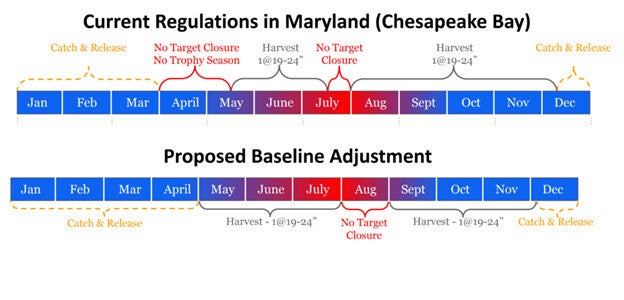 Charts above courtesy of Maryland Department of Natural Resources
To learn more, we recently sat down with Dr. Allison Colden, CBF’s Maryland Executive Director and fisheries expert, to discuss Maryland’s potential new striped bass regulations and what they might mean for fish and fishermen.
Changing the Striped Bass Fishing Season
What changes is DNR proposing to the striped bass fishing season?
As you can see in the charts above, Maryland DNR is proposing to reopen a few days of catch-and-release fishing in April and enforce a no-target closure for the entire month of August. The red sections of the timeline represent when water temperatures are highest and striped bass are most at risk of dying when caught.
What do anglers and the public think about the proposed changes?
Maryland DNR has solicited public feedback on the baseline reset proposal through several venues. First, to develop the proposal, DNR convened a workgroup of fishing stakeholders that provided input on how best to balance access to fishing opportunities with the need to conserve striped bass.
The proposal was then included in an update of the Atlantic States Marine Fisheries Commission (ASMFC) coastwide striped bass management plan, which went through public hearings and an open public comment period last year. Through that process, the majority of public comments supported the baseline reset versus maintaining existing seasons.
What is the point of these adjustments if they likely won’t result in any more or fewer fish deaths?
From a technical standpoint, the baseline reset is considered “equivalent” to the current fishing seasons. Using the current models we have for striped bass, there’s no functional difference between the current season and the new proposed season, which begs the question—why make a change at all?
Our understanding about the health of the striped bass population is based on the assumption that anglers are fishing according to regulations, so ensuring the rules are clear and easy to follow is key.
Dr. Allison Colden, CBF Maryland Executive Director
Well, we need to consider what we know is true for Chesapeake Bay versus the entire Atlantic coast. For example, managers assume that nine percent of striped bass die after being caught and released across all seasons, based on estimates developed for the full Atlantic coast. However, studies conducted in Maryland show that, in the summer, the mortality rate is closer to 30 to 40 percent due to the additional stress of low oxygen and high water temperatures. These hot conditions are most prevalent from mid-July to August, which is why a longer closure in August, as proposed in the reset, will likely have significant conservation benefits for the striped bass population, even if they aren’t captured by the coastwide model.
Additionally, the current fishing calendar looks like a confusing checkerboard—some days open for harvest, some catch-and-release, and some closed entirely for a few weeks at a time. DNR’s proposal would simplify that schedule immensely. This leaves less margin for error and can help improve angler compliance with fishing regulations. Our understanding about the health of the striped bass population is based on the assumption that anglers are fishing according to regulations, so ensuring the rules are clear and easy to follow is key.
Seasonal Concerns
Why are striped bass so vulnerable in the summer?
High water temperatures put a lot of stress on striped bass, and when they’re in this stressed state, additional exertion from being hooked and reeled in can just be too much to bear. Even if handled properly, striped bass are much less likely to survive being caught under hot conditions.
As mentioned above, studies indicate that 30 to 40 percent of striped bass can die when caught and released in Maryland in the summer. More specifically, according to a Maryland Department of Natural Resources study, when air temperatures are above 95 degrees Fahrenheit, about 17 percent of shallow-hooked striped bass died after being caught and released. A full August closure would help mitigate those high risks.
Are there concerns about expanding fishing in the spring during spawning season?
The Chesapeake Bay is where up to 90 percent of all striped bass along the Atlantic coast are spawned. Therefore, protecting spawning striped bass in Maryland waters is critical.
Some have expressed concern with the baseline reset’s allowance for additional catch-and-release fishing in April and early May when spawning fish are traveling up the Bay. In terms of catch-and-release, striped bass are much less likely to die from stress during this time, when air and water temperatures are significantly cooler, and estimates of catch-and-release mortality are less than one percent.
Fortunately, large adult spawning fish have actually seen a rebound in recent years due to conservative management, unlike the small young fish which have seen multiple consecutive years of low numbers. The baseline reset maintains closure of the striped bass “trophy” fishery, which traditionally targeted the largest spawning fish. Instead, it limits fish harvested to 19 to 24 inches in length, consistent with size limits throughout the rest of the season.
Other Considerations
Why not put a moratorium on striped bass fishing until they can recover?
Many remember the historic moratorium Maryland put on striped bass fishing in the 1980s. That action is broadly considered a conservation success story.
We can and should learn from that success, but it’s also important to consider the circumstances of what we’re seeing today and the real underlying issues striped bass face. In the 1980s, we saw a low number of spawning adult fish, with overfishing as the primary culprit. Striped bass’s severe downturn led to the moratorium, which explains why when fishing stopped, the population rebounded quickly.
 Steve Droter/Chesapeake Bay Program
The major trends we’re seeing right now are high rates of summer mortality and low recruitment of young fish. In fact, the number of spawning adult fish is on the rise, thanks to conservative actions taken in recent years. But young striped bass are not surviving the challenges of early life, due to habitat loss, pollution, and invasive predators like blue catfish. These impacts are driven by the environment, not by overfishing. The proposed baseline reset is intended to try to mitigate these environmental impacts by reducing fishing pressure on resident fish when they are most stressed.
What else can anglers do to help the striped bass population?
Anglers are the first line of defense in protecting striped bass. In addition to ensuring compliance with fishing regulations, anglers can:
- Avoid fishing for striped bass when air temperatures exceed 90 degrees Fahrenheit. Even during the fishing season, anglers can and should reference Maryland DNR’s Striped Bass Advisory Forecast to determine if air and water temperatures are safe to catch and release striped bass.
- Practice ‘Careful Catch’ fish handling techniques to minimize stress and increase survival of fish that are caught and released.
- Utilize circle hooks, barbless hooks, and other tackle that minimizes gut hooking and damage to fish.
- Target other species, like invasive blue catfish, instead of striped bass. Think of it as a challenge!
What’s Next?
This month, DNR submitted their proposed regulatory change to Maryland’s Joint Committee on Administrative, Executive, and Legislative Review (AELR) to begin the administrative process. AELR Committee members are currently reviewing the proposal, which Maryland DNR shared in the Maryland Register on January 23. Members of the public were invited to provide input through February 23. More details can be found here: dsd.maryland.gov/MDRIssues/5302/Assembled.aspx#_Toc219797696
Related Stories
-
 Blog Story
To Save the Chesapeake Bay, Save This Fish
Saving menhaden helps save the bay. Now, evidence of a crisis is impossible to ignore.
-
 Blog Story
Field Notes: Building an Oyster Reef
Over the course of the summer, CBF built an oyster reef as part of a larger project to restore and protect an eroding shoreline along Maryland's South River.
