Eastern Oysters
The iconic Chesapeake Bay mollusk plays an important role in the Bay ecosystem, as well as the local seafood industry.
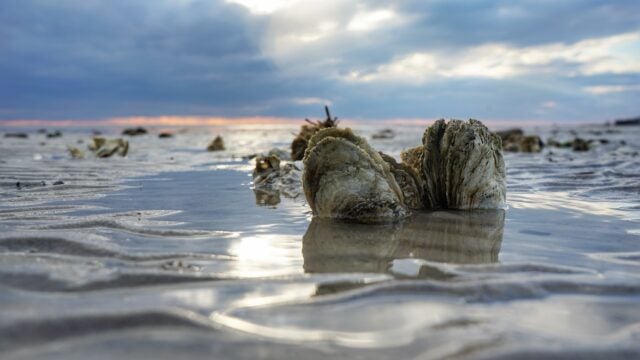
About the Eastern Oyster
Oysters and their reefs not only provide critical habitat for a variety of Bay critters, they also help improve water quality and drive local economies.
These shellfish are also prolific filter feeders. They remove light-blocking algae from Bay waters and help remove excess nutrients like nitrogen and phosphorus. And healthy reefs are home to other filter feeders, as well, including barnacles, encrusting bryozoans, sea anemones, and hooked mussels.
Without oysters, the quality of the Bay ecosystem suffers. Without their filtration clearing the water for light to penetrate, Bay grasses can struggle to grow. Without healthy grass beds and reef habitat that provide refuge from predators and ample prey to feed on, juvenile fish and crabs may not survive to adulthood. In other words, more oysters equal better water quality, more fish and crabs, and healthier underwater grass beds.
A thriving population affects humans, too. Without it, the Bay’s traditional seafood industry will continue to struggle. The good news is that when we bring back oysters, all of their benefits come back with them.
Currently, oyster populations in the Bay are at a small fraction of their historical population size. The storied shellfish and their vertical reefs once posed navigational hazards to early Europeans sailing in the Bay. Their abundance created a Chesapeake oyster-harvesting industry that became the largest in the world by the late 19th century.
But decades of overharvesting, pollution, and disease have contributed to the decline of populations in the Bay. Destructive harvesting techniques led to the loss of roughly three-quarters of the Bay’s reefs between 1860 and 1920. As the population of the watershed continued to grow, so did pollutants. Due to an overabundance of nutrients like nitrogen and phosphorus, Bay waters began to grow too much algae, which led to large dead zones—areas without enough oxygen to sustain life. Loss of forest land and inadequate erosion control left oyster beds silted over and oyster larvae with no place to set. Beginning in the 1950s, the Bay was hit with two diseases—MSX and Dermo—that are caused by parasites that attack and frequently kill the mollusks, though they are harmless to people. Together, continued overharvesting, pollution, and disease devastated the Bay’s populations.
In Maryland, the oyster population has tripled in the last 20 years, according to the 2024 Benchmark Oyster Stock Assessment by the Maryland Department of Natural Resources. Experts attribute this success to multiple factors, including significant large-scale oyster restoration efforts, several years of strong natural reproduction thanks to favorable environmental conditions, and harvest restrictions implemented since 2018.
In February 2023, Virginia’s evaluation found that oyster stock was at its best condition in a generation, and even extended the season for the first time since 1987-88. Virginia’s total wild oyster harvests has remained stable at around 600,000 bushels for the past several years, partly due to a rotational harvest system. This system reduces pressure on certain harvest bars by only opening them to harvest once every three years. In addition, a state supported replenishment program helps to plant shell on harvest areas, increasing habitat for baby oysters (spat) to attach and grow.
In 2014, Maryland and Virginia each committed to restoring oyster populations and reef habitat in 11 rivers by 2025. Areas in which this large-scale oyster restoration has been carried out to bring back reefs and restore their function in the ecosystem are starting to see the benefit of increasing populations and stable or growing reef habitat.
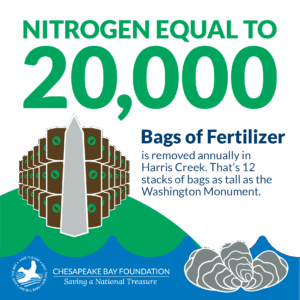
Restored reefs in Harris Creek, on Maryland’s Eastern Shore, can now filter the entire volume of the creek in less than 10 days during the summer. Each year, the reefs are estimated to remove an amount of nitrogen equivalent to 20,000 bags of fertilizer—a service valued at more than $1.7 million.
Pollution, habitat loss, overharvesting, and disease are the main factors limiting oyster recovery in the Chesapeake Bay. Full implementation of the Chesapeake Bay Clean Water Blueprint, the science-based plan to restore the Bay to health, is the primary means by which we can achieve improved water quality and reduce the threats to this crucial shellfish’s survival.
Until populations improve enough to replenish reefs on their own, we will need to continue restoration efforts by placing shell and juvenile oysters on the bottom to kickstart the process.
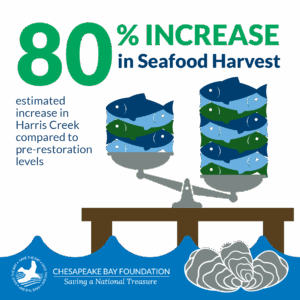
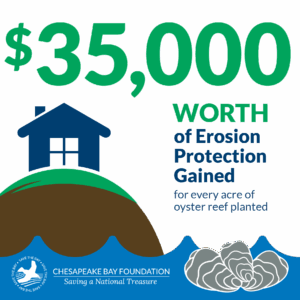
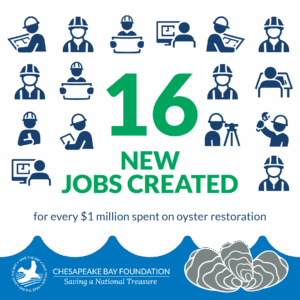
How can I help oysters recover in the Chesapeake Bay?
There are many ways you can help us restore oyster populations and improve water quality in the Bay.
Tell your neighbors and friends about how important oysters are to the health of the waters and wildlife of the Bay.
Shell availability is one of the biggest limiting factors in oyster restoration. Through recycling your oyster shells through CBF’s shell recycling program and supporting restaurants that participate in shell recycling programs, you can help ensure shells are available for plantings.
Support local oyster farmers by buying from local farms or at farmers’ markets.
Writing a letter in your local paper or to state officials responsible for oyster restoration, tell them about your support for oyster recovery—and especially the unique value of vertical oyster reefs.
Help restore oyster populations by building reef balls, cleaning shells, or becoming an oyster gardener.
Related Programs
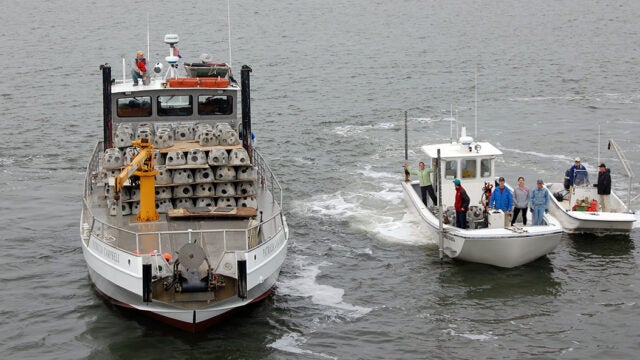
In support of re-establishing this keystone species, CBF has established facilities and programs in Maryland and Virginia devoted to restoration of the Eastern oyster, Crassostrea virginica.
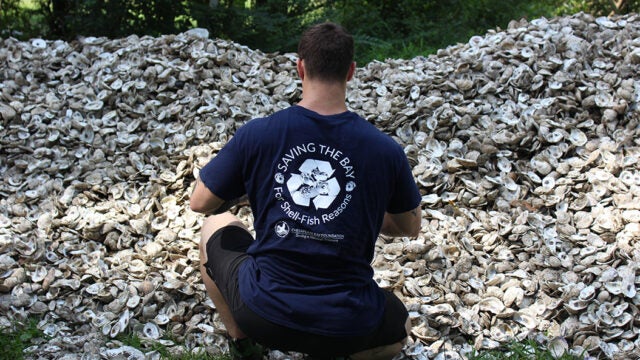
Find out about oyster shell recycling then get involved. Drop off your empty oyster shells, volunteer to pickup shells and deliver them to CBF, host a recycling pickup, or encourage your local seafood restaurant to participate.

Do you enjoy working with others to help restore the Chesapeake Bay and its rivers and streams? Whether growing oysters, planting trees, or helping in our offices, there are plenty of ways you can contribute.
Related Resources
Related Stories
-
 Blog Story
For the Love of Oysters 2.0
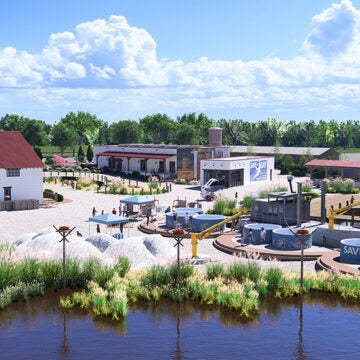
This fall, CBF will start a journey to revamp oyster restoration and innovation at our new Truman Oyster Center on the site of the former Woodfield's Fish & Oyster Company in Galesville, Maryland.
-
 Blog Story
Baltimore Harbor Oyster Sanctuary Now Accepting New Tenants
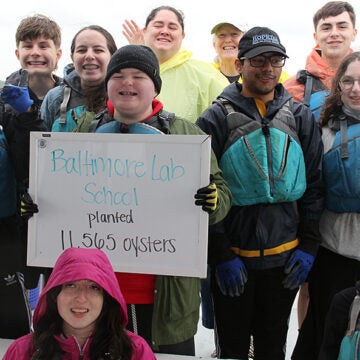
Throughout the decade, students from the Baltimore Lab School have grown approximately 70,295 oysters in the Baltimore Harbor. That number includes over 11,500 oysters the kids planted one day in May.
How to Get Involved
From signing up for an event to shopping our CBF Store, there are so many ways you can get involved in the Save the Bay movement.
