CBF’s Mobile Oyster Restoration Center
Introducing the Prudence H. and Louis F. Ryan Mobile Oyster Restoration Center
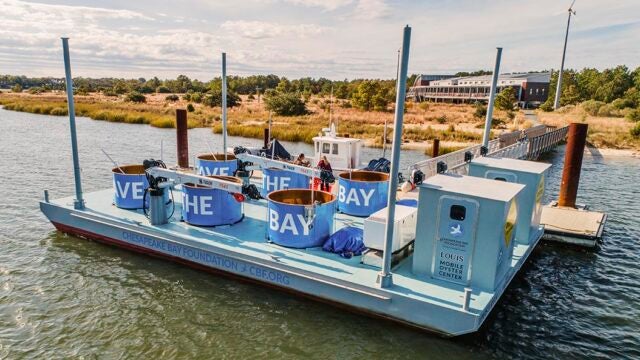
This oyster restoration center floats! The Chesapeake Bay Foundation’s innovative oyster barge travels from one river to the next, allowing CBF to restore local oyster populations more efficiently than ever before.
This uniquely mobile facility sits atop two linked barges that hold six 850-gallon tanks where baby oysters will attach (or “set”) on recycled shells and reef balls. When the oysters have set, these shells and reef balls will be planted on nearby sanctuary reefs.
The oyster barge will
- be located on the same rivers where oyster reefs are being built, increasing efficiency;
- double CBF’s Virginia oyster production capacity to as much as 15 million oysters per year;
- improve oyster restoration success by saving travel time and using local river water tanks, ensuring happy, well-adjusted baby oysters;
- blend into the surrounding environment;
- engage and educate the community by bringing CBF’s oyster restoration work to new places.
Frequently asked Questions
Q: Where can I see the oyster barge in action?
A: The oyster barge travels to Virginia rivers prioritized for oyster restoration, including the Lynnhaven, Elizabeth, and Piankatank rivers and other Virginia tributaries. On each river, CBF will work with the local community to find a location that works well both for neighbors and with the surrounding environment.
Q: How big is it?
A: The two 50-by-13-foot barges are pinned together to form a 50-by-26-foot floating center—large enough to support six 850-gallon setting tanks, two cranes, and room to work.
Q: What are the cranes for?
A: The cranes are used to lift pallets of recycled oyster shells and to load heavy concrete oyster reef balls, which are a great way to quickly build three-dimensional oyster habitat.
Q: Will the oyster barge be open to the public?
A: The oyster barge will be open to volunteers looking to get involved in oyster restoration, and for educational opportunities for students and members of the community.
Special Thanks
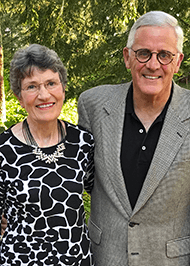
This innovative oyster barge is made possible thanks to generous support from Prudence and Louis Ryan, the Hampton Roads Community Foundation, and the Marietta M. & Samuel T. Morgan Trust.
“My wife and I have lived on the Lafayette and Elizabeth Rivers for the last 40 years. In that time, we have learned how critical oyster restoration is to improving the health of the Bay. We are thrilled to support this amazing oyster barge and CBF’s Making History Campaign with its goal of adding 10 billion new oysters to the Bay.” —Louis Ryan
CBF’s oyster restoration work wouldn’t be possible without the members of the Chesapeake Oyster Alliance and many partners in Virginia, including:
Christopher Newport University
City of Norfolk
City of Virginia Beach
Elizabeth River Project
Friends of the Rappahannock
Hampton Roads Sanitation District
Hampton University
Lafayette Wetlands Partnership
Lynnhaven River NOW
National Fish and Wildlife Foundation
National Oceanic and Atmospheric Administration
Restore America’s Estuaries
The Rotary Club of Norfolk
U.S. Army Corps of Engineers
Virginia Institute of Marine Science
Virginia Marine Resources Commission
