Press Release
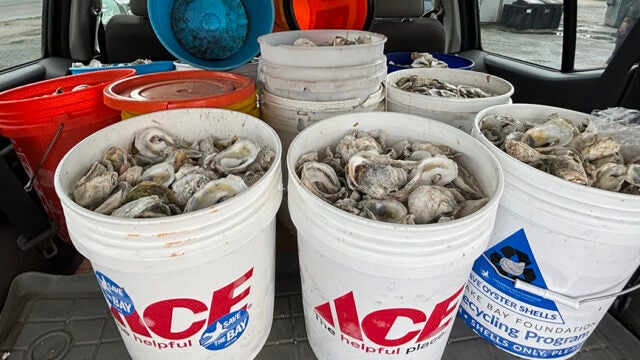
Chesapeake Bay Foundation’s volunteer-based program celebrates success of top-performing year
The Chesapeake Bay Foundation’s oyster shell recycling across the state of Virginia marked a record increase in the number of shells recycled in 2023, a significant gain with benefits for oyster restoration efforts, wild oyster fisheries, and aquaculture operations.
In 2023, CBF’s shell recycling increased by over 1,000 bushels compared to 2022, bringing the total recycled shells to 2,500 bushels, equivalent to 50 tons.
“Oysters can filter up to 50 gallons of water a day, playing a crucial role in improving water quality along with providing benefits to over 300 Bay species. But they also grow Virginia’s economy. The state’s seafood industry heavily relies on oysters, with Virginia oyster sales totaling an estimated $60 million per year. So they are an ecological tool as well as an economic tool,” CBF’s Virginia Oyster Outreach Coordinator Ryan Westpfahl said.
Oyster shells are a limited resource but remain key to increasing the Chesapeake’s oyster population, supporting the wild oyster fishery, and assisting aquaculture operations. The tight supply and cost of oyster shell challenges large-scale oyster restoration work. While a growing number of restaurants recycle oyster shells, far too many shells still end up in landfills.
To help increase the supply of oyster shells, CBF runs one of several volunteer-based shell recycling programs in Virginia. Volunteers pick up empty oyster shells from restaurants, oyster roasts, and other businesses. These shells are then cleaned, cured, and prepared for planting on oyster reefs.
On April 3, CBF volunteers backed up a truck to Fuller’s Raw Bar in Hampton, ready to load blue and white bins with oyster shells from the restaurant. The pickup came a day after Fuller’s Raw Bar $1 Oyster night, which usually produces, according to John Ledbetter with Fuller’s Raw Bar, between 2,200 to 2,400 shells alone.
In total, Fuller’s Raw Bar donates up to 6,000 shells weekly and is among the largest oyster shell contributors in CBF’s program, which includes 60 volunteers and 40 restaurants. Of the 400 bushels of shell recycled from Hampton last year, more than 300 bushels came from Fuller’s Raw Bar.
Ledbetter said providing the recycled shells benefits everyone as well as the environment.
Maggie Vaughan, a CBF volunteer for seven years, and Bonnie Kersta, a CBF volunteer since 2007, heaved bins inside the trunk until it was full, just as they do every week.
“My father was a striped bass fisherman, and he would tell me how the pollution in the Bay was affecting striped bass. I knew I had to do something, and the oyster shell recycling is part of me giving back and paying homage to my dad,” Kersta said.
Baby oysters, called spat, must attach to a hard surface such as empty oyster shells. One shell can become home to 10 or more oysters. In oyster restoration work, these spat-on-shell oysters are planted on sanctuary oyster reefs to increase oyster populations.
Oyster reefs filter water, pollutants such as nitrogen and phosphorus, and provide habitat for fish, crabs, and other species vital to the fishing and seafood industries.
Recycled oyster shell is also extremely important to Virginia’s oyster replenishment program, which supports the wild oyster fishery. Additionally, recycled shells are used by the Commonwealth’s growing oyster aquaculture industry.
Shell recycling bins placed throughout the state also provide public drop-off locations for those with leftover shells.
(ARLINGTON, VA.)—Farmers in Maryland, Virginia, and West Virginia will get new support for conservation practices through two grants awarded to the Chesapeake Bay Foundation (CBF) as part of a historic investment in Bay restoration and community engagement EPA announced today. Information CBF gathers through these grants will also help inform future work on policy improvements to agricultural conservation programs.
CBF’s projects are among 82 new Bay conservation grants worth $35 million awarded by the National Fish and Wildlife Foundation (NFWF), a nonprofit that administers several Chesapeake Bay grant programs. The 82 grants will leverage $32 million in matching contributions for a total conservation impact of $67 million, according to a NFWF release.
Maryland and West Virginia farmers to get help with high-priority conservation projects
A grant to CBF of $476,000, which CBF must raise $259,000 to match, will help Maryland and West Virginia farms in the Upper Potomac River watershed implement conservation practices with the greatest potential to improve water quality and sequester carbon.
Practices will include restoring forested streamside buffers and wetlands, converting cropland to rotationally grazed pasture, and fencing livestock out of streams. The grant will also cover educating other farmers and the larger community about regenerative agriculture practices.
The Upper Potomac watershed is an agricultural area of strategic importance to reducing nitrogen and phosphorus runoff into the Bay and its second-largest tributary, the Potomac River. It also accounts for two-thirds of the 1,600 acres of streamside forested buffers Maryland is trying to plant by 2025 and is prime habitat for native brook trout.
“This grant will allow CBF and our partners to accelerate progress we are already making through extensive investments, including from NFWF, to work directly with farmers and other landowners in the region to improve water quality,” said CBF Maryland Restoration Specialist Rob Schnabel.
“CBF will work with farmers to understand their conservation priorities, including where state and federal cost-share programs can add value and where program deficiencies deter landowners from seeking support,” Schnabel said.
“By providing tailored assistance to interested landowners, our goal is to help them overcome these obstacles. The grant will also allow us to provide farm tours to educate farmers and decision-makers about the benefits of regenerative agriculture, enabling positive long-term change in the region,” he said.
Streamlining installation of conservation practices for Virginia farmers
In Virginia, a grant to CBF will provide $498,000, which CBF must raise $55,000 to match, to make it easier for farmers in Virginia’s Shenandoah River watershed to use public cost-share programs to adopt conservation practices like planting forested buffers near waterways and improving grazing management.
CBF will meet with individual landowners, coordinate site visits with local partners, and leverage partners’ water quality expertise. CBF will also engage with the local community and landowners to communicate the benefits of regenerative agriculture.
“Unlike cost-share programs that require the farmer to lay out the money and wait to be reimbursed, this grant will make it possible for CBF to provide a ‘turn-key’ service where we hire the contractor, ensure everything is installed correctly, and make all the payments. All the landowner needs to do is agree to participate,” said CBF Watershed Restoration Scientist Matt Kowalski.
“We hope this approach, which builds on successful conservation models like the James River Buffer Program, will make it possible for more people to participate in conservation cost-share programs. Through coordination and partnerships, we can have a Shenandoah Valley that continues to produce food and fiber, as well as clean air and water,” Kowalski said.
Cuffs Run proposal would destroy ‘phenomenal natural area’
The Chesapeake Bay Foundation (CBF) has taken legal action to stop a 1,000-acre pumped-storage hydroelectric facility proposed for Cuffs Run, near the Susquehanna River in York County.
CBF filed a motion to intervene in the administrative proceedings with the Federal Energy Regulatory Commission (FERC) as the commission considers granting a preliminary permit to York Energy Storage LLC, for plans to build a 1.8-mile-long dam and flood 580 acres in Chanceford Township, to create a hydroelectric facility. CBF will also file a protest and comments on the project.
“This is a phenomenal natural area, and this facility is the wrong project, in the wrong place, at the wrong time,” said Paul Smail, Vice President for Litigation and General Counsel at CBF. “We are going to make every effort to make sure this project does not get a preliminary permit.”
CBF previously joined other groups in signing a letter to FERC, urging it to deny the February 2023 preliminary permit application.
The $2.5 billion project at Cuffs Run is doing irrevocable harm to Cuffs Run and the Susquehanna River and includes projected displacement of 40 families. Water would be pumped from the Susquehanna to fill a reservoir and flood roughly 580 acres and homes. Flooding and clear cutting of habitats will result in increased risk of erosion and destroy vital wildlife habitat along Cuffs Run and the river. The proposal is in direct contradiction to Pennsylvania’s commitments under the 2014 Chesapeake Bay Agreement.
Gone would be carbon sequestering forests, prime farmland, and conservation lands. Cuffs Run, home to naturally reproducing brook trout, would be devastated. Vital habitats for plants and animals classified as of special concern would be obliterated. Obliterated too would be the Mason Dixon Trail, recognized by the National Park Service as a heritage trail.
Opposing the Cuffs Run project is a unique opportunity for CBF to defend water quality, wildlife habitat, natural resources and public access to those resources, and private property rights in a predominantly agricultural community in York County.
If the motion to intervene is granted by FERC, CBF will become a party to the commission’s proceedings. “What that allows us to do is receive service, receive notice of all the filings made in this case,” Smail added. “It also allows us to seek judicial review should the preliminary permit be granted. It also allows us to seek reconsideration before the commission and ultimately seek an appeal before the circuit court for the District of Columbia Circuit.”
CBF will continue to engage with the Lancaster Conservancy, Susquehanna River Heritage Area, Lower Susquehanna Riverkeeper and other partners in opposing the York Energy Storage project to empower local citizens and its membership.
“It’s hard to describe how extraordinary Cuffs Run area is. One has to be amongst it to truly appreciate the uniqueness of the area in our region,” added Harry Campbell, CBF Science Policy & Advocacy Director in Pennsylvania. “If this proposal moves forward, the opportunity for future generations to experience this special place will be gone forever. So will the refuge that a wide array of plants and animals have made among its forests and fields.”
A 60-day public comment period continues through March 31, before FERC rules on the permit application. View a step-by-step guide in how to file public comment, and use the P-15332 docket number to reference Cuffs Run. CBF is also circulating an online petition to stop the Cuffs Run project.
Support from Chesapeake Bay Foundation and ICAR Partnership Led to Grant Award
Flood prevention and protection projects across the state will receive a total of $53.9 million in awards, the Virginia Department of Conservation and Recreation announced March 20.
This fourth round of grants and loans from the Community Flood Preparedness Fund includes $65,000 to the Town of Chincoteague on the Eastern Shore for development of a resilience plan, as well as regional training and education to build climate resiliency capacity.
The partnership between the Chesapeake Bay Foundation and Old Dominion University’s Institute for Coastal Adaptation and Resilience (ICAR) supported the successful grant application. The partnership hopes to expand on this success and offer its free assistance to other Eastern Shore communities that remain particularly at risk to flooding and sea level rise.
According to DCR, the newly funded projects will expand flood prevention and protection projects, capacity building, and planning and studies throughout the Commonwealth.
Jay Ford, the Chesapeake Bay Foundation’s Virginia Policy Manager, said in a statement:
“We are excited to see the Town of Chincoteague’s award to develop its resilience plan and increase training and education. The Eastern Shore remains one of the most vulnerable communities on the East Coast to flooding and sea level rise. But it lacks the resources to tackle this challenge on its own. The Chesapeake Bay Foundation’s partnership with ICAR was honored to help develop this application. The community will now benefit from state funds to help protect the community and the Eastern Shore’s future.
“There are tremendous federal and state funding opportunities available right now for addressing increased flooding. CBF and ODU are happy to help Eastern Shore communities access these funds. We look forward to working with communities around the Eastern Shore in pursuing funding and designing solutions to protect our culture, economy, and natural resources for generations to come.”
Jessica Whitehead, Executive Director of ICAR, issued the following statement:
“The ICAR and CBF partnership came from an investment by state lawmakers, an investment intended to help enable Virginia communities to become more resilient and access essential funding for projects that protect communities from sea level rise and flooding risks. We are excited to build on this success so more communities around the Eastern Shore and Commonwealth benefit from sustainable climate resiliency solutions.”
Flood prevention and protection projects across the state will receive a total of $53.9 million in awards using proceeds from Virginia’s participation in the Regional Greenhouse Gas Initiative, the Virginia Department of Conservation and Recreation (DCR) announced March 20.
This fourth round of grants and loans from the Community Flood Preparedness Fund (CFPF) includes localities from Petersburg to the Town of Chincoteague on the Eastern Shore to Buchanan County in Southwest Virginia and underscores the importance of Virginia’s reentry to RGGI.
RGGI, a multi-state carbon emissions reduction program, served as CFPF’s only consistent funding source. The governor’s budget included $100 million for CFPF, but the state’s withdrawal from RGGI late last year effectively shut off the only steady statewide funding source for community-based climate resiliency projects. State lawmakers have included language in their budget to return Virginia to RGGI. That budget now awaits the governor’s approval.
According to DCR, the newly funded projects will expand flood prevention and protection work, capacity building, and planning and studies throughout the Commonwealth.
Jay Ford, the Chesapeake Bay Foundation’s Virginia Policy Manager, said in a statement:
“This fourth round of awards from the flood preparedness fund underscores the importance of Virginia’s RGGI participation. Communities across the state are urgently ramping up work to protect homes and businesses from flood risk and sea level rise with sustainable nature-based solutions. They deserve support for these projects. RGGI not only funded this work, but lowered the state’s carbon emissions.
“We applaud this statewide support for flood prevention and protection projects. Virginia is taking steps to become a climate-ready Commonwealth, but floods and sea level rise are already on Virginians’ doorsteps. Schools are closing, streets are flooding, and businesses and lives are unnecessarily at risk. The state has a chance to change this reality and maintain essential support for climate change resilience by rejoining RGGI.”
Statewide Coordination and Equity Key Elements of Legislation
The largest and most effective steps Virginia has taken to ready the state for climate change now await the governor’s approval to be signed into law. The Virginia General Assembly has sent two passed bills to Governor Youngkin that would significantly bolster the state’s resiliency to climate change threats.
The legislation enjoyed historic support from state lawmakers when they passed these bills in the final days of the General Assembly session. Sea level rise, flooding, and other climate change threats increasingly harm Virginians’ lives.
The same week of the bills’ passage, parents in the Hampton Roads region dealt with their children’s schools being closed due to flooding, drivers navigated swamped roads, and communities across the Commonwealth prepared to mark Flood Awareness Week by sharing memories of severe storms that damaged their homes and businesses.
“The rural coastal areas of Virginia are among the most at risk and vulnerable to flooding, natural disasters, and hazards that impact resiliency. It is crucial to coordinate statewide resources to proactively protect the businesses, homes, and livelihoods of these residents and the community,” Delegate Hillary Pugh Kent, R- Warsaw, said.
Lawmakers responded in a bipartisan manner this session with legislation that aligns climate resiliency resources statewide through the creation of a new central office, prioritizes equity in flood protection funding, and returns Virginia to the multi-state, carbon emission reduction program known as the Regional Greenhouse Gas Initiative (RGGI) through the budget. Key legislation includes:
Creation of the Office of Commonwealth Resilience: HB 1458 introduced by Delegate Phil Hernandez
- This bill creates a new state office dedicated to coordinating climate adaptation efforts across Virginia’s government, providing leadership and maximizing co-benefits in the state’s climate response. It ensures equity in the implementation of resilience and adaptation strategies, prioritizes the protection of Virginia’s natural resources, executes nature-based designs, and supports the state’s statutory obligations to clean water. The proposed budget also includes $1 million over the biennium to create this Office of Commonwealth Resilience. “This essential legislation shifts the Commonwealth beyond just reacting to these damaging weather events to readying Virginia for climate change. This is a comprehensive approach that better supports critical local projects across the state and maximizes the value of investments,” Hernandez said.
Prioritizing low-income communities in the Virginia Resilient Revolving Loan Fund: HB 673 introduced by Delegate Michael Feggans
- This bill ensures climate change solutions are equitable by prioritizing low-income communities in funding from the Virginia Resilient Revolving Loan Fund. This fund supports resources to help with increased flooding events.
“Virginia has a chance to be a leader on resiliency in the face of climate change, but there’s still more work to do to become a climate-ready Commonwealth. These initiatives reduce carbon emissions, strengthen flood protection, reduce storm damage to homes and businesses, and ensure cleaner air and water for communities,” Chesapeake Bay Foundation Virginia Policy Manager Jay Ford said.
Last night, Chesapeake Bay Foundation (CBF) President and CEO Hilary Harp Falk was pleased to honor Maryland Sen. Ben Cardin with CBF’s Clean Water Legacy Award at its 2024 DC on the Half Shell gala.
CBF was joined by more than 600 top philanthropists, lawmakers, and community leaders on March 18, 2024, at Union Market as the organization honored Sen. Cardin’s extraordinary efforts to restore and protect the Chesapeake Bay. DC on the Half Shell is CBF’s most important event in the nation’s capital.
“Whether advocating for Maryland fisheries, promoting environmental education, or ensuring federal support for Bay research and restoration, Sen. Cardin’s career has been one legislative victory for clean water after another,” Falk said.
“CBF is proud to honor Sen. Cardin’s enduring legacy as a devoted clean water champion, not only for the Bay and its tributaries, but for the entire country. We are deeply grateful for decades of leadership and dedication,” Falk added.
Sen. Cardin has advocated for the Bay since he began his public service career in 1967 in the Maryland House of Delegates. From his work on the original Chesapeake Bay Agreement in the early 1980s to his recent success securing historic funding increases for the federal Chesapeake Bay Program, Sen. Cardin has never wavered in his commitment to saving our region’s greatest natural resource.
“It’s an honor to receive the Chesapeake Bay Foundation’s Clean Water Legacy Award. I’ve dedicated my career to improving the health of our watershed because of its direct and existential impact on the communities and wildlife it serves as home and habitat. For nearly six decades, I’ve proudly supported the Chesapeake Bay Foundation’s efforts to protect our treasured Bay,” Sen. Cardin said.
“The Chesapeake Bay is the heart of Maryland’s identity and economy, and the success of our state, region and nation relies on its sustainability. In the Senate and beyond, I will remain fully committed to continuing the work to improve the health of the Bay and its local rivers and streams so that it remains a national treasure for future generations,” Sen. Cardin said.
DC on the Half Shell guests spent the evening listening to live music, enjoying gourmet cuisine, sampling local oysters, and most importantly, celebrating Sen. Cardin’s decades of achievements in the fight for a cleaner, healthier Bay.
The biennial event spotlighted the Bay’s most critical natural filter, the oyster. Oyster farmers from around the region served an assortment of the finest (and sustainably grown) oysters the Bay and its rivers have to offer. Guests also enjoyed hors d’oeuvres, a full buffet dinner, and dessert.
Milestone Reached Through Federal, State, and Local Efforts, Surpassing Halfway Point to 10 Billion Oysters Goal
Following a banner year for Chesapeake Bay oyster restoration and aquaculture, the Chesapeake Oyster Alliance (COA) this week announced it has recorded a new total of 6 billion oysters directly added to the Bay since 2017.
COA’s count aims to include all oysters directly added to the Bay and its tributaries through restoration and aquaculture. These efforts have now surpassed the halfway mark to the group’s goal to promote adding 10 billion new oysters to the Bay by 2025.
The majority of contributions toward the 10 billion oyster goal come from major restoration initiatives in Maryland and Virginia targeted towards 11 Bay tributaries, which are on track to be completed by 2025.
“We’re seeing an exciting oyster renaissance on the Bay, from massive tributary scale-efforts down to widespread citizen involvement and public awareness. At least six billion oysters have been added to the Chesapeake in recent years thanks to heroic work by Maryland and Virginia, federal partners, and COA aquaculture and restoration partners,” said Tanner Council, COA Senior Manager for the Chesapeake Bay Foundation. “Each year, the Chesapeake Bay is getting closer to an extremely ambitious goal of adding 10 billion new oysters.”
The 2023 oyster count in Maryland was elevated by a record year for oyster restoration thanks to large-scale restoration work by the Maryland Department of Natural Resources (DNR), National Oceanic and Atmospheric Administration, U.S. Army Corps of Engineers, and Oyster Recovery Partnership.
In Virginia, an outstanding year for oyster aquaculture saw a total of about 119 million oysters recorded in the Commonwealth in 2023. Virginia aquaculture numbers in recent years range from a low of 86 million in 2020 to a high of 129 million in 2022. Oyster aquaculture operations raise these oysters to sell to restaurants and consumers, supporting local economies while filtering water and creating habitat.
A significant number of oysters were also added through small-scale restoration work and the efforts of individuals and small businesses through programs like oyster gardening. These efforts are a great example of how the people and partners throughout the region have embraced the many benefits of oyster restoration and aquaculture.
The Chesapeake Bay Foundation (CBF) founded the Chesapeake Oyster Alliance in 2018 to spark momentum and innovation to bring back oysters from historically low levels. COA has grown to include more than 110 nonprofits, academic institutions, businesses, and aquaculture operations. Together, these partners advocate for accelerating oyster restoration, science-based fisheries management and expanding the oyster aquaculture industry throughout the Bay.
To support progress in oyster restoration and aquaculture, COA promotes research and new approaches through oyster innovation grants, restoration funding, facilitating collaborations between partners, and an annual Chesapeake Oyster Science Symposium. Strong coalitions such as COA are key to long-term success in restoring a keystone species like the Bay oyster.
“Having now surpassed the halfway mark, we are more motivated than ever to maintain momentum and accelerate progress by building support, innovation, and partnerships,” Council said.
In January 2024, COA also announced its most recent Oyster Innovation Awards, totaling $140,000 for 15 organizations making progress in oyster-related research, technologies, reproduction, educational opportunities, and more. This is the fourth consecutive year of similar grant distributions under the COA Oyster Innovation Awards
Oysters filter water and form reefs that provide essential habitat for countless other species. They also support the region’s recreational and commercial fisheries, and the Bay’s local economy and culture. Despite oysters’ critical role, their population is just a small fraction of what it once was. Restoration efforts and aquaculture in the Chesapeake Bay are critical to bringing back this keystone species.
General Assembly Session Acknowledges Necessity of Climate Readiness and Ecosystem Restoration
Significant investments in cleaner water, conservation, and climate readiness were proposed by Virginia state lawmakers this week as the General Assembly session heads toward the finish line.
The budget conference report released Thursday afternoon by Virginia state lawmakers proposed support for resilience efforts, flood protection, conserving the state’s disappearing trees, continued investments in beloved species like oysters, and reducing pollution to critical waterways amid a looming 2025 deadline to meet Chesapeake Bay restoration goals. Legislators proposed the following levels of investment over the two-year budget period:
Pollution Reduction
Building off last year’s historic investment in farmers, legislators recommended investing $231 million in the Virginia agricultural cost-share program. Practices like fencing cattle out of streams, and planting streamside trees are among the most cost-effective steps Virginia can take to restore the Chesapeake Bay and improve water quality throughout the state.
Tree Conservation
- Legislators are proposing a $20 million investment for a pilot Pay for Outcomes Program where pollution reduction projects with verified, successful results are compensated.
- Legislators recommended $400 million in bonds to fund upgrades at wastewater treatment plants, which are essential to continuing progress in reducing nitrogen, phosphorus, and sediment pollution.
- With the state losing tree canopy at an alarming rate, the proposed budget included $1.16 million in funding to study the Commonwealth’s forests and conservation opportunities. The conference report also supports funding for a Department of Forestry policy specialist.
Climate Resiliency
- Although the proposed budget removes $25 million from the Resilient Virginia Revolving Loan Fund, it maintains the $100 million in year one that the Governor proposed for the Community Flood Preparedness Fund (CFPF). Communities from Southwest Virginia to Fairfax to the Eastern Shore have used the CFPF for projects that protect homes and businesses from flooding.
- Lawmakers included language to return Virginia to the Regional Greenhouse Gas Initiative (RGGI), a multi-state carbon emission reduction program. RGGI participation is key to Virginia’s climate adaptation and mitigation efforts as well as our clean water goals.
- The budget also includes $1 million over the biennium to create the Office of Commonwealth Resilience, which will help coordinate climate adaptation efforts across Virginia government as we build towards a Climate ready Commonwealth.
Tackling Invasive Species & Rebuilding Keystone Species
- The budget proposal restores $1 million over the biennium for oyster replenishment activities. This funding is vital to thriving waterways and local economies that until recently had long-suffered from overharvesting, pollution, and disease.
- Strengthening the blue catfish industry also received support from lawmakers. The final budget for this initiative included $250,000 in the second year of the biennium. A robust commercial fishery for blue catfish will help reduce their predatory pressure on other commercial and recreationally important fishery species.
The House and Senate compromise on the state budget will head to the governor for approval.
Chesapeake Bay Foundation Virginia Policy Manager Jay Ford issued the following statement:
“Virginia lawmakers heard growing calls from their communities about the detrimental loss of neighborhood trees, flooded streets, and the threat of pollution to beloved waterways and species. They answered these calls with this conservation-focused budget, which invests in cleaner water, agricultural conservation practices, and climate resilience.
“The historic show of bipartisan votes and funding for these solutions demonstrates the increasing urgency to contend with these environmental threats. We applaud these investments and look forward to working with legislators to further protect Virginians and the environment.”
Local photographers are now invited to submit their top photographs from around the Chesapeake Bay watershed for the Chesapeake Bay Foundation (CBF)’s annual Save the Bay Photo Contest.
CBF is seeking photos that illustrate the beauty of the Chesapeake Bay and its tributaries, as well as the plants, animals, and people that rely on it. Images depicting water, wildlife, recreation, farms, and flora within the watershed will be considered.
Photographs captured from across the watershed are eligible, including in Pennsylvania, Virginia, Maryland, and Washington D.C. All skills levels are encouraged to participate.
“The beauty of the Bay is captured best by our everyday interactions with it,” said Jennifer Wallace, CBF’s senior creative project manager and contest organizer. “That is proven to me every year when submissions for the photo contest roll in. I am always amazed by the talent of each contestant and the benefits these photos have for our mission to save the bay.”
“As photographers, it’s wonderful to be able to share our work with other nature lovers in the Chesapeake Bay community,” said Bill Mish, winner of the 2023 Save the Bay Photo Contest, from Annapolis, Maryland.
The deadline for submissions is March 29. Photos will be narrowed down by a CBF panel based on subject matter, composition, focus, lighting, uniqueness, and impact. The public will then vote for their favorite image in the Viewer’s Choice Gallery from April 8 to April 30.
Winners will receive a one-year membership to CBF and can receive cash prizes ranging from $100 to $500. Winning photographs will also be featured on CBF’s website, social media, 2025 calendar, and award-winning Save the Bay magazine.
More information and submission instructions can be found at cbf.org/photocontest.
