Press Release
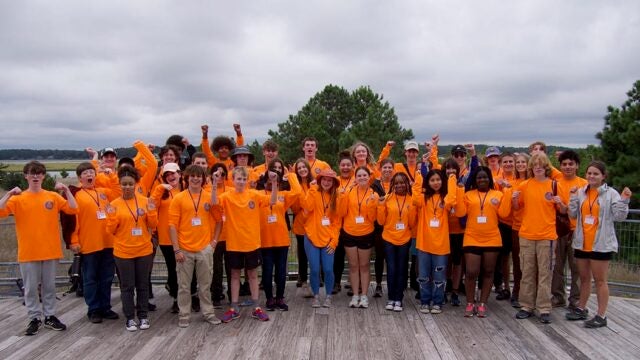
Chesapeake Bay Foundation Student Leaders Hold Summit at CBF’s Brock Environmental Center
Climate change is one of the most important issues we face today and in the future. In Virginia Beach last weekend, 40 high school students from across Virginia, Maryland, and Pennsylvania worked to develop climate change solutions that can be implemented in their communities at the biannual Chesapeake Bay Foundation (CBF) Student Leadership Summit.
Over the course of three days from Sept. 29 to Oct. 1, high schoolers in CBF’s Student Leadership Program discussed pressing issues with environmental leaders and investigated the impacts of climate change on local forests, marshes, and the Chesapeake Bay by collecting water quality data and conducting biological surveys.
They spent the weekend at CBF’s Brock Environmental Center and camped at First Landing State Park, also working on maintenance of native plant gardens and oyster restoration. Each student developed a final action project identifying solutions and recommendations for climate resiliency in their communities and across the region.
Luna Mendoza Castro of Virginia Beach is a junior at An Achievable Dream Academy. Mendoza joined students from across the region to make a difference in addressing climate change and resiliency.
“It affects us every single day, whether we want it to or not. If there’s flooding, I’m going to be affected by it. I can’t get to school sometimes even,” Mendoza said. “I’m still young and I want to make an impact now, rather than waiting too late and wishing I had.”
CBF’s Student Leadership program equips the next generation of environmental stewards to take action through advocacy, restoration projects, and addressing issues in their communities. It is open to all high school students in the Bay watershed, which encompasses parts of Virginia, Maryland, and Pennsylvania.
“Student leaders are making a difference locally by finding solutions that create more resilient communities and healthier rivers and streams,” said CBF Vice President for Education Tom Ackerman. “These students are the next generation of environmental problem-solvers and they set an important example for their peers and all of us.”
Charlotte Kearns of Catonsville was one of the many students who traveled from Maryland to Virginia Beach to tackle climate change issues.
“The Patapsco floods a lot. Increased flooding really hurts our Ellicott City community. We can see firsthand the impacts to our rivers,” Kearns said. “Through working with communities, you can have a better environmental impact.”
Morgan Stellfox of Enola, Pennsylvania, is a junior at East Pennsboro High School.
“It helped build my confidence that climate advocacy can make a difference, and climate resiliency is possible,” Stellfox said. “I found the oyster bagging educational because it covered an area I didn’t know too much about, being from PA, and it was really interesting to see a method of reusing [oyster shells] to recover the [oyster population] in action.”
This is the 50th year of CBF’s award-winning environmental education program, which has led more than 1.5 million people in hands-on environmental investigations.
Research shows that outdoor learning helps students improve resilience, problem solving, critical thinking, leadership, and teamwork, and leads to higher test scores and stronger engagement in school.
CBF offers many different types of environmental education experiences. Schools can sign up to take students on a CBF field experience at www.cbf.org/education. To find out more about CBF’s student leadership program, visit https://www.cbf.org/programs/student-leadership/.
Environmental groups hope for improvements to flawed permit
Between now and Nov. 25, Maryland residents have an opportunity to provide comments to the Maryland Department of the Environment (MDE) concerning a permit that governs how more than 1,400 industrial facilities manage pollution from stormwater runoff that affects communities across the state, as well as local rivers and streams. A public hearing will be held on Sept. 28 at MDE’s offices in Baltimore and written public comments will be accepted until Nov. 25.
The Chesapeake Bay Foundation (CBF), Blue Water Baltimore, the Gunpowder Riverkeeper, as well as the Potomac Riverkeeper Network and Waterkeepers Chesapeake found the permit seriously flawed and filed suit against MDE in December of 2022. The Chesapeake Legal Alliance represents Blue Water Baltimore and the Gunpowder Riverkeeper. The Environmental Integrity Project is representing Potomac Riverkeeper Network and Waterkeepers Chesapeake.
The permit fails to take into account the increased intensity, frequency, and duration of rain events due to climate change; it fails to address environmental justice by conducting cumulative impacts analyses of facilities located in overburdened communities; it allows certain industrial facilities to gain exemption from permitting requirements without third party verification of whether pollutants on their sites will be exposed to stormwater; and it does not provide fence-line communities the opportunity to weigh in on the risks that they face.
“We appreciate MDE taking another look at this permit. The Moore Administration has acknowledged the challenge of climate change as well as the importance of environmental justice,” said CBF Maryland Executive Director Allison Colden. “This permit, as written, favors polluters over the communities they harm. We hope that citizens voice their concerns and that MDE will respond.”
“Industrial stormwater pollution threatens communities as well as water quality. This hearing gives Marylanders a second chance to ensure that environmental justice communities are protected from such pollution,” said Bob Dreher, Legal Director of the Potomac Riverkeeper Network
MDE’s data shows that stormwater running off industrial sites has extremely high levels of pollution, including nitrogen, lead, copper, and aluminum. The previous industrial stormwater permit failed to achieve the state’s primary objective to reduce pollution from stormwater.
“This permit single-handedly regulates pollution from nearly 300 facilities in the Baltimore region, where residents are consistently hardest hit by the compounding factors of climate change, systemic disinvestment, toxic contamination, and so much more,” said Alice Volpitta, Baltimore Harbor Waterkeeper with Blue Water Baltimore. “Now is the time for regulators to hear our voices, protect our waterways, and prioritize the people living on the frontlines of this issue every day.”
“We have well over 100 industrial sites in the Gunpowder, Bush, Bird, and Middle River watersheds. All of these sites cumulatively impact downstream, underserved communities and ultimately the Chesapeake Bay,” said Gunpowder Riverkeeper Theaux Le Gardeur.
MDE reopened the permit for public comment on specific provisions after the environmental organizations pointed out that the MDE failed to allow public comment on those provisions before finalizing the permit.
“Increasing rainfall due to climate change is supercharging the pollution coming off of industrial sites, leading to serious health impacts on nearby communities that are often the most overburdened with pollution. With this hearing, Maryland has a new opportunity to create a permit that protects some of our most vulnerable community members,” said Robin Broder, Acting Executive Director of Waterkeepers Chesapeake.
While the strength of the permit is important, so is enforcement. The Chesapeake Accountability Project, through a public information request, found widespread noncompliance under the previous permit from 2017 to 2020. Only 24 percent of MDE inspections—475 of 1,979—found industrial facilities following permit requirements with about two-thirds being noncompliant. MDE only took six formal enforcement actions in response.
“Swift and efficient permit enforcement is key to ensuring compliance terms are met and state waters are protected, which is why enhanced enforcement is a top priority for the environmental groups involved in the suit. We hope MDE will renew its compliance commitments, provide additional resources for inspections, and prioritize sectors known to pose a high risk to water quality and public health,” said Sheronda Rose, CBF Litigation Staff Attorney.
Black in Marine Science Is Coalition’s 100th Member
The Chesapeake Oyster Alliance (COA) welcomed its 100th partner this month, marking an important milestone for the coalition. COA consists of non-profits, academic institutions, businesses, and aquaculture operations working together to restore the Chesapeake Bay’s oyster population. The efforts by these partners and others are helping achieve COA’s goal of adding 10 billion new oysters to the Bay by 2025.
The 100th partner is Black in Marine Science, a network focused on increasing diversity in marine science while highlighting the many Black scientists already in the field. The connection to COA creates new opportunities for collaboration around oyster restoration, research, and aquaculture.
“We are thrilled to join this partnership and excited to collaborate with other like-minded organizations. I truly believe in the mission of the Chesapeake Oyster Alliance and the impact it has on restoring the health of the Chesapeake Bay,” said Black in Marine Science Community Director Leslie Townsell. “As a member of COA, we have access to valuable resources and support that help us achieve our mission of improving the lives of those we serve through environmental stewardship. I am excited to work alongside other members and see the positive changes we can make together.”
Oysters filter water, form reefs that create habitat for crabs, shrimp, and game fish, and contribute to local economies and the seafood industry. But oyster numbers in the Chesapeake Bay have declined to just a small fraction of historic population levels.
With a goal of sparking momentum and innovation to bring back the Chesapeake oyster around a collective goal, the Chesapeake Bay Foundation founded COA in 2018.
COA’s diverse coalition of partners today range from the Virginia Institute of Marine Science, to the Smithsonian Environmental Research Center, to Solar Oysters, to the Nansemond Indian Nation. A full list and map of COA’s partner organizations can be found at this link.
“We cannot truly restore the oyster population in the Chesapeake Bay unless we work together. That’s why reaching 100 partners is such an important milestone for the Chesapeake Oyster Alliance,” said COA Manager Tanner Council. “We never set a numeric goal for a certain number of partners–we have always just sought out the best from around the Bay’s oyster world to join us. Our door remains open to anyone working for the Bay oyster.”
COA has tackled the challenges facing increasing oyster populations in many ways. That includes distributing more than $280,000 in grants in the last three years to promote innovation in oyster aquaculture, restoration, and public education. COA partners are presently applying for the next $150,000 pool of grants to be awarded in December.
COA has also hosted two Chesapeake Oyster Science Symposiums in the last two years, totaling over 500 attendees in person and online, to foster collaboration and research in oyster restoration and aquaculture. The next symposium will take place on Oct. 26 in Cambridge, MD, and online.
“Being a COA Partner and an Oyster Innovation Grant awardee has made our business more marketable,” said Claire Neubert, co-owner of the Hampton-based ecotourism business Shored Up. “When people hear that we are COA Partners and grant awardees, they have a better understanding of our business, our goals, and what we do for Bay oysters.”
Research, innovation, and the dedication of academic institutions is also key to increasing oyster populations in the Chesapeake Bay.
“COA has been a principal group in bringing scientists, commercial growers, resource managers, and oyster gardeners together to share their ideas and passion for restoring our resource. We are very proud to be part of it,” said University of Maryland Extension Principal Agent Don Webster.
Promoting growing oysters for food is an important part of increasing the number of oysters filtering water in the Bay. Oyster aquaculture has tremendous potential for achieving ecological benefits while providing economic opportunities. Companies contributing to this burgeoning industry include Rogue Oysters, a COA partner based on the Rappahannock River in Virginia.
“Oysters are literally a foundation species that supports a healthy Chesapeake Bay by creating clean habitat for the Bay’s marine life to thrive. Great partners like COA are critical to bringing everyone together to see a thriving oyster population that fuels a thriving Chesapeake Bay and helps restore it to its former glory,” said Rogue Oysters Co-Founder Taryn Brice Rowland.
In Maryland, the St. Mary’s River Watershed Association has engaged students in new oyster-related projects as a COA Partner and an Oyster Innovation Grant awardee.
“Through COA meetings and conferences, we are able to learn more about oysters, their needs, and decisions being made throughout the community that impact oyster restoration,” said St. Mary’s River Watershed Association General Manager Emma Green. “It’s important to bridge communities across the watershed beyond eating oysters. COA connects people across the Bay region and beyond to form diverse partnerships that allow people to combine efforts and resources to support a common goal of restoring oyster populations.”
Council notes that there are many ways to support COA.
“We also welcome and promote businesses, civic groups and schools through our Reef Builder Tier, and accept individuals into our Supporter Level, which keeps members informed on COA highlights and opportunities. There’s room for everyone who loves the oyster,” said Council.
To find out more about COA, visit http://www.chesapeakeoysteralliance.org/.
The Chesapeake Bay Foundation (CBF) is bringing its comprehensive adult education and advocacy course to the Washington, D.C., metro region this fall and encourages area residents who care about clean water to register now.
On six consecutive Thursday nights starting October 5, participants in the D.C. Metro Volunteers as Chesapeake Stewards (VoiCeS) course will learn about local waterways, the challenges to restoring water quality, and how to get involved in protecting them.
Topics include getting to know your local watershed, Anacostia River restoration efforts, environmental justice, urban farming, agriculture and the federal Farm Bill, and how to be an effective advocate.
The D.C. Metro VoiCeS program will feature expert speakers from several of the region’s leading environmental and conservation groups, including the Anacostia Watershed Society, the Potomac Conservancy, the Alliance for the Chesapeake Bay, and the D.C. Commission on Climate Change and Resilience.
“CBF is excited to host this engaging course for the first time ever in the nation’s capital. We look forward to empowering D.C.-area folks to fight for clean water in their neighborhoods, across the Bay watershed, and nationally,” said CBF Federal Policy Coordinator Annabelle Harvey.
Classes are scheduled from 6 pm to 8 pm every Thursday from October 5 to November 9. They will be held at REI Washington’s D.C. flagship store at 201 M St. NE. Registration is free, but you must register to join the class.
Participants who attend all six evening sessions and one Saturday field experience will be certified by CBF as Chesapeake Stewards. Those interested in further advocacy work can also complete a final project. Attendance at a minimum of four classes is expected.
CBF’s Volunteers as Chesapeake Stewards (VoiCes) program was created in 2004 to engage local volunteers and provide in-depth education about the Bay and what is being done to protect and restore it. Already active in Maryland and Virginia, this fall’s course will be the first specifically for D.C. area residents.
For more information or to register, contact Annabelle Harvey at aharvey@cbf.org. There are only a few spaces left, so sign up today!
With fall just around the corner, the Chesapeake Bay Foundation (CBF) invites you to join our celebration of the Bay region’s best local food and drink from noon to 4 pm on Saturday, October 14, at CBF’s Clagett farm in Upper Marlboro, Maryland.
Formerly Burgers & Brews for the Bay, Food & Farm Fest is a “farm-to-table” event where top chefs turn local, sustainably grown produce and grass-fed meats into culinary delights for carnivores, vegans, and everyone in between.
All-inclusive tickets allow you to spend an autumn afternoon sampling delicious local dishes, sipping craft beverages, enjoying live music, and learning how the regenerative agriculture practices used at Clagett Farm help restore the Bay and fight climate change.
The farm is centrally located approximately 30 minutes from downtown Washington, D.C., and 40 minutes from Annapolis. Fun activities for children of all ages include hayrides, meeting CBF’s cows and sheep, painting pumpkins, and free professional family portraits.
Check out our growing list of restaurant partners, who will be showcasing delectable delights from their creative kitchens! Swizzler will serve grass-fed sliders and their famous Chesapeake Fries. Chef Rasheed of Food & Friends will whip up quesadillas, Harvest Thyme Tavern will serve brick-oven pizzas, and Mise En Place Farm will prepare their famous farm tacos!
Swizzler, located across the street from Nationals Park in D.C., takes your classic burger-joint favorites to the next level with the freshest ingredients from farms around the area. Don’t miss their famous smash burgers and hand-cut fries.
Food & Friends is a Washington, D.C., nonprofit that provides home-delivered, medically tailored meals and nutrition to people living with cancer, HIV/AIDS, and other serious illnesses.
Mise En Place is a small compost-driven, no-till farm in Davidsonville that proudly uses regenerative and sustainable practices to grow produce and spices, raise chickens, and make honey.
Rik and Pam Squillari, co-owners and executive chef and pastry chef, respectively, of Harvest Thyme Tavern in Davidsonville, blend the robust flavors of Italy that inspire Rik with breads and pastries that reflect Pam’s Eastern European heritage to create unique, seasonal offerings from sustainably-sourced ingredients.
Local brewers and beverage providers can help you find the perfect craft beers and non-alcoholic drinks to complement whatever you’re sampling. Serving up refreshing beverages of all kinds will be Forward Brewing of Annapolis; Baltimore brewers Heavy Seas Beer and Union Craft Brewing; Devils Backbone Brewing Company located in Lexington, Va.; and Upper Marlboro-based distributor Bob Hall, LLC.
On hand to get toes tapping and feet stomping will be the “electric newgrass” band Swamp Donkey. The five-man group puts on a high-energy show with an eclectic mix of original songs and creative covers, all in its signature big sound.
At Clagett Farm, CBF uses regenerative farming methods such as planting cover crops, practicing no-till, and rotating pastures where livestock graze to improve water quality, build healthy soil, sequester carbon, and boost the farm’s resiliency to climate change. It is located on 283 acres at 11904 Old Marlboro Pike.
Each year, Clagett Farm produces tens of thousands of pounds of fresh produce to supply the community-supported agriculture (CSA) program. The Clagett Farm CSA serves roughly 250 shareholders who invest in the farm before the growing season begins. In return, CSA members receive an abundant share of local produce over the 26-week CSA season.
Clagett Farm also donates more than 30 percent of its weekly harvest to the Capital Area Food Bank and Prince George’s County Food Rescue. Last year CBF donated a total of 23,000 pounds of farm-fresh produce to these critical community partners.
Clagett Farm also operates a nursery that supplies many of the native trees that CBF helps farmers and other landowners plant near waterways to trap and filter polluted runoff before it can reach creeks, streams, and rivers that feed into the Bay. Food & Farm Fest guests will have the opportunity to sample the bounty of the farm, learn how to join our CSA, and purchase native trees and grass-fed beef and lamb on site during the event.
Sponsorship opportunities for Farm & Food Fest are still available and tickets are on sale now. For more information, please contact Jessica Rubino at jrubino@cbf.org.
Mussel Models Produced in Joint Effort by Chesapeake Bay Foundation, Florida Museum of Natural History, Smithsonian Institution, and U.S. Fish and Wildlife Service
Scientists and imaging specialists will help save freshwater mussels, one of the most endangered classes of organisms, using 3D imaging technology. With funding provided by the U.S. Fish and Wildlife Service’s National Conservation Training Center (NCTC), imaging experts are now creating 3D-models based on specimens from the Florida Museum of Natural History and the Smithsonian Institution.
Once complete, the models will be freely available online to educate the public about these amazing yet little-known creatures that dwell in rivers and streams across the United States. The models will also be used to train conservation biologists to identify all 300 species of North American freshwater mussels.
The Chesapeake Bay Foundation (CBF) will use 3D-printed mussel shell replicas in its nationally recognized education program, as well as other public outreach opportunities, to help inform the public about how mussels improve water quality. The 3D models of mussels native to the Chesapeake Bay watershed and CBF’s mussel outreach work are supported by Chesapeake WILD funding administered by the National Fish and Wildlife Foundation. This is one of the first projects supported by the Chesapeake WILD program, established by Congress in 2020 to aid restoration efforts in the Chesapeake watershed.
Joe Wood, Senior Scientist for CBF, said:
“Freshwater mussels provide incredible benefits for water quality and habitat, yet many people know very little about these hidden heroes of rivers and streams. Raising awareness is key. Giving someone the opportunity to hold a lifelike mussel shell in their hand is an important step towards protecting and restoring freshwater mussel populations.”
John Pfieffer, curator of bivalves at the Smithsonian Institution, said:
“The U.S. is a globally important hotspot of freshwater mussel biodiversity. Many of the country’s freshwater mussels are at risk of extinction. Roughly one out of every three species are protected under the Endangered Species Act, and another 30 species are thought to have recently gone extinct.”
Matthew Patterson, Course Leader, U.S. Fish and Wildlife Service, National Conservation Training Center, said:
“This project is very exciting because it provides opportunities to teach field biologists and the public how to identify all of the freshwater mussel species native to the United States, including the nearly 100 species listed as threatened or endangered. And all of this is happening in 2023 as the Endangered Species Act is turning 50 years old.”
Zachary Randall, biological scientist and manager of the Florida Museum’s digital imaging division, said:
“The use of photogrammetry has been prominent in cultural heritage studies for a long time, and the biological sciences have recently hopped on the bandwagon, realizing the power it has to visualize a specimen’s external features and color in 3D. That’s what this method really excels at.”
Chesapeake Bay Foundation (CBF) President and CEO Hilary Harp Falk is pleased to announce that CBF has a new top watchdog protecting clean water and the communities that depend on it in Paul Smail, who has been promoted to Vice President for Litigation and General Counsel, Richard T. Pelham Chair.
“Paul has amassed an impressive record of protecting our land and forests, holding industrial polluters accountable, and amplifying the voices of citizens whose neighborhoods are overburdened by pollution,” Falk said. “His nine years on the front lines of the fight for clean water for all watershed residents made him the natural choice to lead the charge for CBF.”
Smail joined CBF in 2014 as Staff Litigation Attorney and became Director of Litigation in 2019. His successes include winning a landmark case affirming citizens’ right to challenge developers’ tree-clearing plans on the merits in court. He also represented CBF in litigation that forced important upgrades to reduce sediment pollution discharged into the Potomac River by the massive water treatment plant that serves Montgomery and Prince Georges counties.
Smail’s current work includes partnering with residents of under-represented communities in Baltimore City and Baltimore County to fight municipal stormwater discharge permits that fail to protect their health and their homes from repeatedly being flooded by polluted stormwater [and untreated sewage] when it rains.
“Environmental litigation is not simply about enforcing the laws meant to ensure clean air, clean water, and a healthy environment,” Smail said. “Especially when you go up against big corporations or government agencies, it’s about connecting the legal issues with how they impact people and the Chesapeake Bay’s delicate ecosystem.
“Every success the litigation team has had, and will have in the future, comes from telling the court how pollution and health hazards affect real people in their everyday lives,” Smail added. “Empowering people in the watershed to tell their stories and seek justice is a privilege and a responsibility I embrace.”
Before joining CBF, Smail worked in private practice representing clients in regulatory compliance litigation, transactions involving land and asset purchases, and resolving environmental enforcement actions. Smail also served as assistant general counsel and litigation associate for a consumer law practice in Towson, Maryland.
After graduating with an English major from Washington College in 1997, Paul began his varied career working for the Maryland Conservation Corps, an Americorps program administered by the Maryland Department of Natural Resources.
He spent a year doing botany work at protecting rare and endangered plants Shenandoah National Park before landing at the University of Maryland Center for Environmental Science’s Chesapeake Biological Laboratory.
There he worked as a research assistant for Dr. Walter Boynton, a longtime professor and estuarine ecology expert, and studied estuarine ecology and seagrasses in estuarine systems. Smail’s work with Boynton also inspired him to go back to school to study [environmental] law and policy.
Smail is the Immediate Past Chair of the Maryland State Bar Association’s Environment and Energy Law Section, and currently serves on the Board of the Friends of the Jones Falls.
Continuing its efforts to aid the comeback of striped bass, the Atlantic States Marine Fisheries Commission (ASMFC) voted yesterday to extend the emergency regulation it adopted in May to reduce striped bass mortality. The ASMFC also continued work on a draft Addendum II to the striped bass management plan outlining additional options for the long-term recovery of striped bass populations.
At its May meeting, ASMFC’s Atlantic Striped Bass Management Board took emergency actions to protect striped bass spawned in 2015 by instituting a maximum recreational harvest size of 31 inches. Atlantic Coast states had until early July to implement the emergency action.
At the same time, the Board initiated work on a draft Addendum II to develop options to bring striped bass fishing mortality back down to levels needed to rebuild the population following 2022 estimates that indicated a nearly 40 percent increase in striped bass removals.
The Chesapeake Bay serves as a critical nursery area for striped bass, contributing significantly to the coastwide stock and the regional economy. But the current stock is in poor condition due to excessive mortality from fishing, low reproduction, water quality challenges, and climate change.
Yesterday the ASMFC voted to extend the previously adopted emergency measure that set a 31-inch maximum size limit in the recreational fishery for an additional year, effective October 28. Further action on Addendum II was delayed pending additional input from ASMFC’s technical committee. The committee is tasked with evaluating the updated management options that were modified at yesterday’s meeting. Managers will meet in the Fall to review input and finalize the Addendum for release for public comment.
Chesapeake Bay Foundation (CBF) Senior Regional Ecosystem Scientist Chris Moore issued the following statement:
“As fishing continues to put pressure on striped bass populations, extending the emergency size limits another year is the right call while the Board considers additional measures.
“Striped bass are in trouble. This addendum is ASMFC’s best chance to turn the tide. Unfortunately, by removing certain Chesapeake Bay-specific management options, the Board missed an important opportunity to consider longer seasonal closures, which protect striped bass during critical life stages and during periods of low oxygen and high-water temperatures that increase striped bass mortality. It now falls to the states to take further actions to address striped bass mortality during these challenging times of the year.
“As development of Addendum II continues, CBF urges the Board to retain management options that consider commercial quota reductions needed to maintain the stock’s reproductive potential. These management options must be retained if we are to achieve the necessary reductions in fishing mortality that can ensure striped bass populations get back on track by 2029. Without strong conservation measures across all fishery sectors, the hope of bringing back this iconic species will be lost.
“We encourage anyone who cares about the future of striped bass to follow this management action and weigh in.”
The Keystone 10 Million Trees Partnership is accepting nominations for the Annual Mira Lloyd Dock Partnership Diversity Award, given in recognition of conservation work in environmental justice communities in Pennsylvania.
Environmental justice refers to the effort to ensure that people with lower incomes and Black, Indigenous, and communities of color aren’t disproportionately harmed by pollution and other environmental threats. In Pennsylvania, the Department of Environmental Protection considers any census block group where 20 percent or more individuals live in poverty, or 30 percent or more of the population identifies as a minority, to be in an environmental justice area.
The Keystone 10 Million Trees Partnership, coordinated by the Chesapeake Bay Foundation, welcomes nominations of anyone in Pennsylvania who has shown exemplary leadership in their community through environmental restoration, awareness, education, and/or conservation work. This includes community tree plantings, rain garden and/or native pollinator garden installation or plantings, regenerative agriculture or urban farming/permaculture, or community beautification in an environmental justice community.
Nominees are ranked on their community engagement, collaboration, and environmental conservation work with environmental justice communities in support of planting 10 million trees for Pennsylvania. Nominees are given credit for using science, research, innovative, and creative approaches to conservation. A volunteer committee of environmental leaders, past Dock Award winners, and others will determine the winners.
To submit a nomination, visit https://tenmilliontrees.org/contact/mld/. Forms are also available by emailing keystonetrees@cbf.org, or calling (717) 200-4543. The deadline for nominations is Sept. 29. The award winners will receive $5,000 worth of native trees and supplies from the partnership, to be used for a 2024 tree project.
Now in its fourth year, the award was created to honor the spirit of Mira Lloyd Dock, who pursued urban beautification and forest conservation at a time when women and people of color were not welcomed at the decision-making table.
Mira Lloyd Dock is recognized as the first Pennsylvania woman to lead the way in forest conservation. She was an advocate for Penn’s Woods and in 1901 was appointed to the State Forest Reservation Commission by Pennsylvania Governor William Stone.
The Keystone 10 Million Trees Partnership will present the award during the Pennsylvania Forestry Association’s Annual Symposium on Saturday, Nov. 4, at Toftrees resort in State College.
To learn more about the Keystone 10 Million Trees Partnership, visit TenMillionTrees.org.
The Chesapeake Bay Foundation (CBF) is partnering with Montgomery County Public Schools (MCPS) to launch a new oyster gardening program for sixth graders at YMCA Camp Letts in Edgewater this fall.
The new program will enable students who attend the county’s outdoor education program at Camp Letts to participate in hands-on lessons about oysters and their importance to the Chesapeake Bay ecosystem. An adult oyster can filter up to 50 gallons of water per day. Oysters also naturally build reefs that serve as habitat for fish, crabs, and other important Bay species.
To create and maintain the oyster garden at Camp Letts, CBF will contribute about 2,500 spat-on-shell oysters each year that students will take care of in 16 cages. Spat are very small, nearly microscopic, juvenile oysters that attach to recycled oyster shells and grow over time into adult oysters. Students will assist with cleaning algae and other organisms from oyster cages that will be suspended from the camp’s floating dock on the Rhode River. The first oyster garden at the location will be ready before the start of the school year in September.
As students clean the cages, they’ll also be able to view and learn about benthic organisms such as worms, shrimp, and other small creatures that find homes on oyster reefs.
“At CBF we want to connect students with the Chesapeake Bay and its ecology and one of the best ways to do that is to learn about oysters,” said Kellie Fiala, CBF’s Maryland Oyster Restoration Coordinator. “Oysters are a keystone species that improve water quality, build habitat for other species, and serve as a food source.
“However, due to a combination of pollution, diseases, and overharvesting, the Bay’s oyster population is at historic low levels. We’re hoping that as students learn about the importance of oysters to the Bay, they’ll support ongoing efforts to protect and restore the Chesapeake’s oyster population,” Fiala added.
Each year about 3,000 students and 300 adults will interact with the oyster garden at Camp Letts through MCPS’ outdoor education program, which includes lessons on how to evaluate the health of watersheds and ecosystems.
The oysters raised by students at Camp Letts will be added to sanctuary reefs in the South and Rhode Rivers each year so they can continue to grow. The camp in Edgewater is one of the closest areas to Montgomery County that enables students to interact with brackish Bay waters, which are a mix of salty ocean water and freshwater. Students will be tasked with comparing the organisms found in the brackish water with those they can typically find in the freshwater ecosystems that exist in Montgomery County.
CBF’s oyster restoration staff will train MCPS outdoor educators on how to run oyster gardening sessions for the students and provide learning materials.
“We are excited to give students an opportunity to learn about the importance of oysters and what we can do as citizens who live upstream to protect the bay,” said MCPS Outdoor Education Center teacher Antonio Carrillo.
CBF runs several oyster gardening programs in Maryland and Virginia that enable organizations and individuals to raise oysters on private docks or at public waterfront locations. All the oysters raised through CBF’s oyster gardening programs are later added to sanctuary reefs in the Bay where they are protected from harvest.
If you would like to get involved with our oyster gardening program, please email our oyster restoration staff.
