Pennsylvania Watershed Renewal Projects
Renewal projects affecting three watersheds represent an evolution in CBF’s work to reduce pollution to Pennsylvania’s rivers and streams.
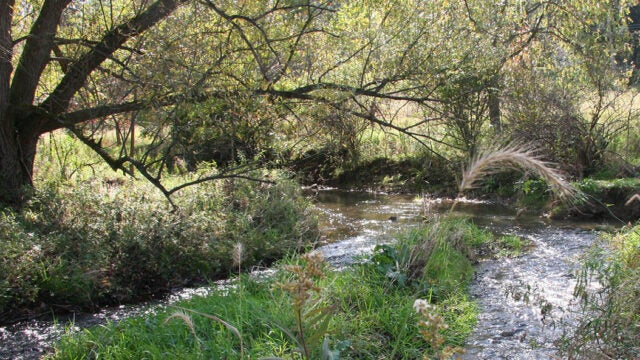
Renewal projects in the Pequea Creek, Halfmoon Creek, and Marsh Creek watersheds accelerate the implementation of key practices to bring streams back to health, improve wildlife habitat critical to critters like the brook trout, and enhance local appreciation of local waters. They use a multi-pronged approach to help restore the health of streams impaired by nonpoint source runoff resulting from certain agricultural activities.
The plans were approved by the Pennsylvania Department of Environmental Protection and the U.S. Environmental Protection Agency in 2021/22 and selected by Senators Bob Casey (D-Pa.) and Ben Cardin (D-Md.) for inclusion in the fiscal year 2022 federal Omnibus Appropriations Bill. The senators requested $2.18 million for the Pequea Creek Watershed renewal plan in Pennsylvania’s Lancaster and Chester counties and $1.06 million for the Halfmoon Creek watershed restoration plan in Centre and Huntingdon counties. Since the original funding was awarded, the Halfmoon Creek project has expanded to include Marsh Creek in Centre County. The program runs from June 2023 to June 2028.
Senators Casey and Cardin collaborated closely to both support Pennsylvania farmers’ efforts and reduce upstream sources of pollution, restoring the quality of the Chesapeake Bay for all those who rely on it.
“In addition to cleaning up our waterways and reducing further pollution, this funding brings us one step closer to a more sustainable economy,” said Sen. Casey.
“This federal investment will help us work more cooperatively with farmers and expand the use of best-available technologies to identify the most effective conservation strategies to reduce pollution that enters the Susquehanna River Basin,” said Sen. Cardin.
What Are the Watershed Management Plans?
The plans to restore these critical watersheds is based on CBF’s 4Ps—advanced Plans in Priority Places that focus on high impact Practices in close collaboration with Partners. The plans use emerging high-resolution watershed data and modeling to identify optimal locations. While heavily guided by this analysis, plans are also balanced with community knowledge, values, and interests. Partners developing and implementing the plans with CBF are wide-ranging, and include county conservation districts, local watershed and conservation organizations, academic institutions, state and local government agencies, local businesses, planning agencies, landowners, farmers, and residents. Funding vital for the plans was made possible by the Richard King Mellon Foundation.
The plans focus on three priorities in the watersheds:
- Direct engagement with agricultural producers—CBF has dedicated staff in each watershed to actively cultivate a culture of stewardship and help connect farmers with local partners for planning, design, and implementation assistance.
- Delivery of planning and design services—CBF has forward contracts with local engineering firms to provide farm planning and design of conservation practice services in the priority watersheds.
- Cultivating a culture of stewardship—We are supporting a series of hands-on farmer-to-farmer conservation field days and meaningful watershed experiences to further educate and engage farmers.
Why Halfmoon Creek?
The 24-square-mile Halfmoon Creek watershed encompasses over 32 miles of streams. It is classified as a high-quality, cold-water fishery that supports naturally reproducing wild brown trout. In 1998, the Pennsylvania Department of Environmental Protection designated Halfmoon Creek as impaired because of sedimentation largely due to agriculture. In 2008, the U.S. Environmental Protection Agency designated the entire watershed as impaired.
The focus on the Halfmoon Creek watershed is to reduce sediment pollution, preserve critical landscapes, restore degraded landscapes, and foster stewardship of the watershed. The restoration plan calls for implementing riparian buffers, stream restoration, streambank fencing, cover crops, and no-till agriculture.
Download the Halfmoon Creek plan.
Why Marsh Creek?
The 44-square-mile Marsh Creek Watershed is a tributary of Bald Eagle Creek and the West Branch Susquehanna River. It supports cold-water and migratory fishes, including stretches with naturally reproducing populations of wild brown trout. Following an assessment in 2000, Marsh Creek was recognized as impaired due to organic enrichment and sedimentation. Today, approximately 18 miles of streams are impaired for aquatic life, while 41 are impaired for recreational use.
The focus of the Marsh Creek watershed management plan is to reduce nonpoint source pollution, conserve the watershed’s cold-water fishery, improve flood resiliency, and foster long-term stewardship. Restoration strategies include streambank stabilization, streambank exclusion fencing, grass waterways, riparian buffers, and agricultural best management practices to improve water quality and habitat. The watershed plan is being reviewed as an Advanced Restoration Plan and undergoing final state and federal agency review but currently being used to guide on-going implementation.
Why Pequea Creek?
Portions of the 153-square-mile Pequea Creek watershed began appearing on the state’s list of impaired waters in 1996, 1998, and 2000 due to excessive nutrients and sediment. Approximately 86 percent of the stream miles in the watershed have aquatic life impairments resulting from agricultural practices and changes to habitat, and of those, over 70 percent are affected by four or more sources.
The priority of the Pequea Creek watershed plan is the restoration of 41.1 miles of streams with aquatic life impairments that have high potential to once again be healthy. The project will be used to keep soils and nutrients on the land with such practices as cover crops, no-till agriculture, riparian buffers, streambank fencing, streambank stabilization, and other practices.
