Resource
CBF’s Policy Recommendations on Data Centers
Data centers are rapidly expanding across the Chesapeake region. CBF has identified the following 15 principles to guide its evaluation of proposed facilities and related policies.
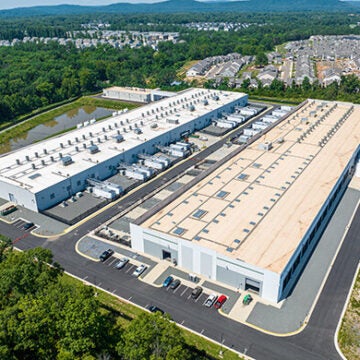
Hugh Kenny/The Piedmont Environmental Council
Topline Recommendations:
- Data centers must be transparent from the start to the end of the project.
- Data centers must achieve net zero clean water consumption for cooling.
- Data centers must attain net zero use of fossil fuels.
Full Menu of Recommendations:
- Data center projects must comply with all existing disclosure and public process requirements associated with the land development.
Disallow nondisclosure agreements (NDAs) and any conditions that hide information that is typically public or restrict public notice and engagement processes applicable to other local development projects. - Data centers must be sited on lands that are zoned industrial in the approved local zoning map and/or comprehensive plan.
Prevent siting data centers in any non-industrial zoning districts, such as agricultural, mixed use, residential, or any overlay districts designed to protect natural or historic resources. - Data centers must not be sited on land with important natural resources.
Centers must avoid, minimize, or mitigate impacts to prime agricultural soils, high value forest corridors, streams and wetlands, or other priority natural resources. Mitigation rates must be high enough to disincentivize taking of resources becoming a cost of doing business. - Municipalities must have authority to pursue community agreements that assure net benefits for the community.
Enable municipalities to enter agreements with data centers that include wide-spectrum noise and air quality monitoring, lighting limitations, extended setbacks from residential or recreational property, use of local contractors or services, site closeout plans, and/or other commitments that benefit the community. - Data centers must fully comply with all environmental permit requirements.
Projects must adhere to all federal, state, and local environmental permits, such as for surface water or groundwater withdrawal, wastewater discharge, air pollution, and species protection. Protections that go beyond requirements could be included in community benefit agreements. - Require cumulative impacts assessment for all new data center projects.
States must require data centers to complete an assessment of cumulative impacts prior to approval of other state permits. - Proposed and existing data centers must be transparent by disclosing their water and energy use and other factors that may impact natural resources.
Enable state and/or municipalities to require disclosure of the proposed and actual sources and amount of energy and water consumed for cooling and energy generation. Reporting of the name of tenants, companies supported, and types of activities undertaken are also options. - Data centers must be required to pay for their own energy.
These facilities cannot be allowed to externalize their energy costs to ratepayers. Appropriate steps include requiring that they secure and maintain 30-days of backup power and pay for the entirety of their energy costs to prevent blackouts, avert residential power bill increases, or deplete local funding or support for public infrastructure investment. - Data centers must meet environmental standards to receive tax incentives.
Condition receipt of state tax incentives, such as exemptions to sales taxes for equipment purchases, on certifying to achievement of specific environmental performance measures (e.g., LEED certification). - Data centers must achieve net zero clean water consumption for cooling.
For cooling, disallow use of potable water, minimize use of surface water and groundwater, and favor use of reclaimed water, non-toxic closed-loop, or other state-of-the-art approaches. Any water “consumption” (i.e., evaporated or otherwise lost) above zero could be offset by funding water replenishment projects (e.g., treatment of wastewater or stormwater that exceeds standards) in the watershed where water is sourced. Require net zero for new data centers at install and existing data centers by a future date certain. Long-term preference for achievement “water-positive” operations. - Data centers must achieve net zero use of energy from fossil fuels.
Power for data centers must come from renewable energy, likely via power purchase agreements based on the amount available today exceeding the amount needed, to preclude use of fossil fuel and reduce offsite water consumption at thermoelectric power plants. Any fossil fuel use could be offset by investing in renewables, residential heat pumps, energy efficiency, or related projects. Development of new natural gas or other fossil fuel plants on site at data centers “behind the meter” must not be allowed, especially those that are sited close to residential areas. Long-term preference for “carbon-negative” operations. - Data centers must not discharge water pollution.
Data centers must ensure proper treatment of runoff from their property during and following construction, toxic wastewater from operations (e.g., metals, PFAS), and thermal pollution from offsite thermoelectric energy production. - Clean generators must be used to provide back-up power.
All data centers must use Tier IV generators or equivalent technology for providing back up power. Use of Tier II generators with add-ons is not sufficient. - Data centers must properly dispose of any hazardous materials.
Data centers regularly replace equipment. This generates hazardous waste, such as e-waste (e.g., servers, circuit boards), batteries, coolants, fire suppression agents, and other chemicals that can contain hazardous waste. Under RCRA, facilities are accountable from generation to disposal of these wastes. - Decommissioning plans must be required to manage the facilities and community impacts at closure.
Like all structures and businesses, data centers can have a life cycle. Data center footprints can be substantial, including land, buildings, and infrastructure. These operations can eventually close. The pace of change in tech is rapid, so it is unclear how long data centers will be needed (e.g., they may shrink, or stop being built on land). Decommissioning plan must be in place to address “stranded assets,” mange disposal and remediation on the site, and other community impacts when a center ceases operation.
