Feelers for Peelers: On the Trail of the Bay’s Soft-Shell Crabs
Long live the Bay’s crabbers and connoisseurs, whose celebration of the blue crab’s summer transformation is nothing short of art.
It’s hard to forget the first time you encounter a soft-shell crab. For me, it was fried, its jaunty legs splayed on either side of a brioche bun, looking for all the world like it had crawled in there for a quick nap. I watched in fascination as a friend devoured it. I listened politely as she waxed poetic about Maryland’s culinary delights. Then I promptly swore off soft-shells forever.
But that’s the thing about this magical swamp we call the Chesapeake. It’s visceral. It has character. It has stories. Soft-shell crabs—plucked at that ephemeral stage of a blue crab’s life when it sheds its hard armor and becomes tender enough to savor whole—are perhaps as close a connection as many of us will get to the Bay’s raw drama.
That crab, perched on its bun, lived life. It survived the vastness of the ocean, strummed through meadows of underwater grass, picked along the soft edge of marshes. It was cared for, cultivated, crafted. If its hard-shell brethren are celebrated, the soft-shell is clearly revered. You can’t look at it without a nagging wonder: By what force of man and nature did it end up here?
Crab Heaven: Where Do Soft-Shell Crabs Come From?
Jessie Marsh, Captain of the CBF education vessel Susquehanna and an educator for CBF’s Smith Island Environmental Education Program, thought for a minute when I wondered aloud what first prompted people to catch and eat a soft-shell crab. “I suppose it was like oysters,” he said with a grin. “They were hungry.”
We were en route to his native Smith Island, and the boat grumbled against gray waves whipped by an early May wind. About an hour after leaving Maryland’s Eastern Shore, we eased into one of the creeks that pulses through the island’s green marsh heart. The neat houses of Tylerton, one of three small towns, rose on the horizon.
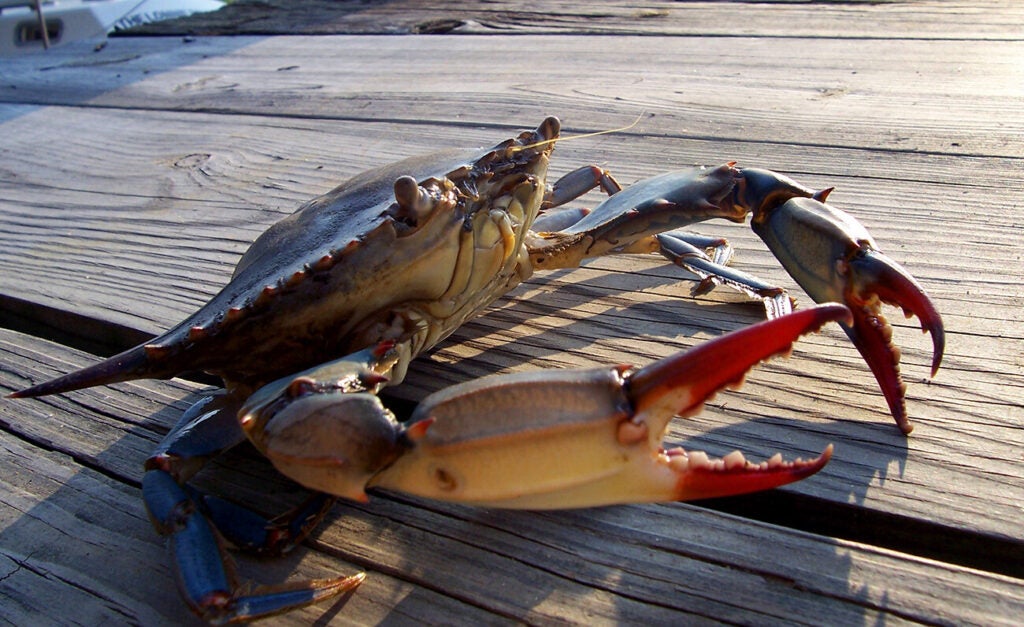 Damon Fodge
If you want to understand blue crabs, soft-shell or otherwise, Smith Island is a pretty good place to start. From above, it looks as if it was formed by a giant bird stepping into soft mud, the creeks flooding the impressions and the soft green marshes pushing up between the toes. In summer, underwater grasses fan out in the surrounding shallow waters.
It’s crab heaven.
Marshes and grasses provide plentiful food for rapidly growing crabs. They’re a buffet of clams, worms, and other small creatures, which live in and on the bottom among the plants.
But crabs seek out places like Smith Island for another reason, too.
How a Blue Crab Loses Its Shell (And Grows a New One)
In order to grow, a crab first has to shed its too-small shell, then grow an entirely new, bigger one over its delicate body. The scientific name for this is ecdysis—from a Greek word meaning ‘to escape’ or ‘take off’—and the process, described in detail in the 2007 Maryland Sea Grant book The Blue Crab, is downright mythical.
It starts when the close connection between the crab’s skin and its shell breaks down. The outermost layer of skin then begins generating the new shell, layer by layer, underneath the old one. As the crab gets ready to shed its old shell, it essentially pumps itself full of water. The growing pressure eventually breaks open the old shell and keeps the newly soft crab rigid enough to wriggle out the back.
For the next hour or two, the crab continues to take on water, expanding to its new, larger size. Only at this point does the new shell begin to harden by drawing calcium and carbon out of the surrounding seawater.
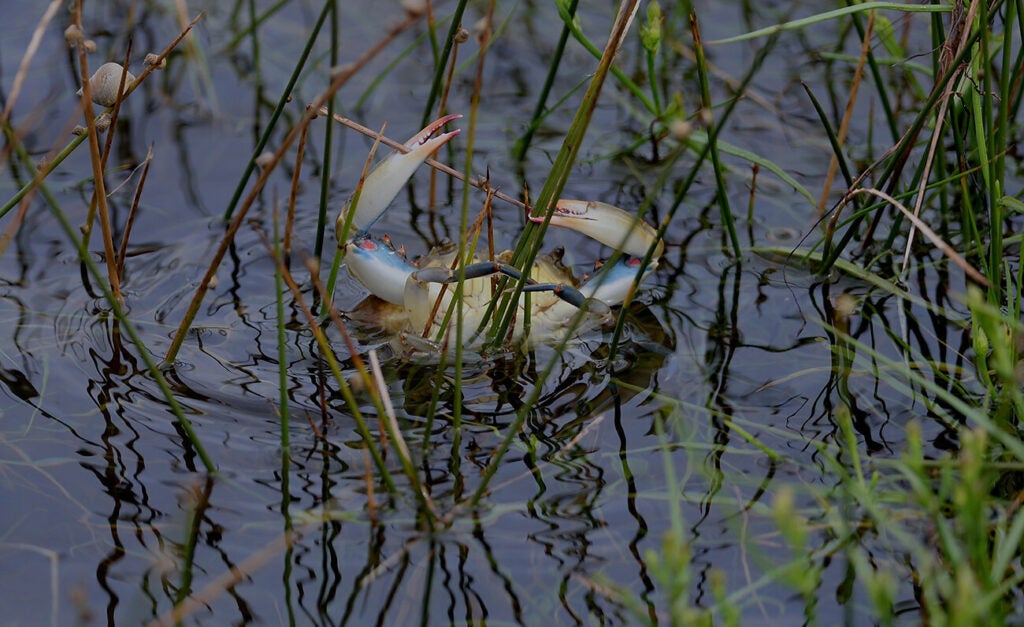 Pamela Monahan
The whole process understandably takes a lot of energy, and for much of the time the crab cannot eat or move. In the hours immediately after it sheds its shell and waits for the new one to harden, the soft crab is especially vulnerable. It needs a place to hide. Thick meadows of underwater grass and salt marshes, like those around Smith Island, are an ideal shelter from predators. Unless, of course, those predators are human.
The Art of Catching a Soft-Shell Crab
As we climb into his golf cart for a whistle-stop tour of the island, Marsh is matter-of-fact about the nonexistent chance of seeing any soft-shell activity during my visit. We’re both bundled in jackets, and our breath is visible in the damp air.
“This is not peeler weather,” he says, using the name applied to crabs that are preparing to shed their shells.
In a typical year, it’s not crazy to start thinking about soft-shell crabs in May. The peak peeler run usually happens in early summer as water temperatures rise and crabs emerge from where they buried themselves in the bottom over winter. But this winter was cold, and the Bay has been slow to warm up.
Soft-shell crabs—plucked at that ephemeral stage of a blue crab’s life when it sheds its hard armor and becomes tender enough to savor whole—are perhaps as close a connection as many of us will get to the Bay’s raw drama.
Luckily, Marsh has a lifetime of knowledge about soft-shells and a practiced educator’s easy patience with questions. He swings the golf cart along the creek and points out a march of low-slung structures perched over the water, connected to the shore by long, narrow docks. These are the island’s crab shanties, he explains.
Most blue crabs only live two or three years, and in that span they might shed their shells nearly two dozen times. But of the whole cycle, they’ll spend only a fraction—less than one percent—as a soft-shell. Needless to say, it’s a short window.
The islanders and watermen out of Crisfield, Maryland, the closest mainland town, designed a clever way to snag the crabs at the exact right moment. It comes down to a basic principle: watch them. Closely.
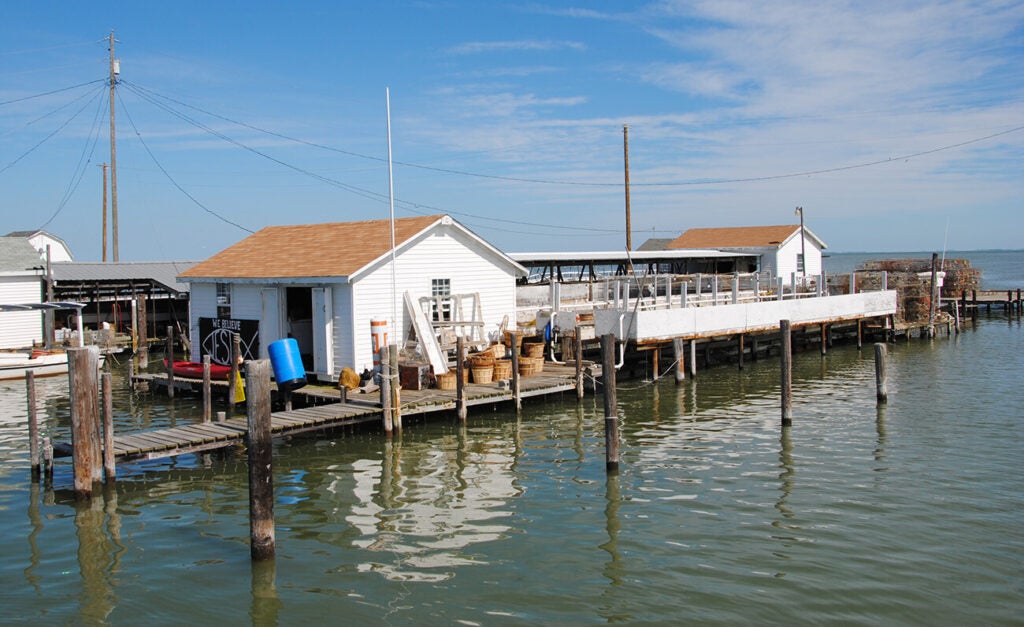 CBF Staff
After rustling up the crabs by running a ‘scrape’ through the grass beds—basically a large mesh bag attached to a metal frame pulled from a boat—watermen take the crabs that are big enough back to their shanties. There, they place them in long, shallow tanks called ‘floats,’ filled continuously with circulating water from the creek below.
At this point, most of the crabs are not yet soft. Instead, they are sorted based on how close they are to shedding their shells—something an experienced waterman can tell by looking at a thin line that appears along the edge of the crab’s swim paddles (its rear-most legs). The line starts white, turns pink, then finally red as the crab approaches shedding.
Marsh remembers as a kid checking on the crabs in the floats, watching for the ‘busters’ to shed their shells at last. Close observation was essential. Soft crabs stop hardening when they’re removed from the water; but wait too long and the shells quickly become papery and unpalatable.
The next step was to pack them in trays and put them in boxes, Marsh says. Tucked between layers of seagrass, paper, and ice, the crabs—still alive—were then ready to ship to restaurants in cities like Philadelphia and New York.
Unable to fully envision it, I ask Marsh what they’re like, those delicate animals caught mid-transformation.
“All the colors—blues, greens, reds—they’re so much brighter,” he says. “They look like candy.”
The Art of Eating a Soft-Shell Crab
It’s a fitting description. All of this painstaking effort, on the part of both crabs and watermen, ultimately orients to one goal: a mighty good meal.
Come early summer, you can find soft-shell crab on many a seafood menu along the East Coast. But it’s hard to argue that soft-shells are beloved anywhere more than right here, in the Chesapeake.
Baltimore’s acclaimed Ekiben is a good place to see the enthusiasm for soft-shells in action.
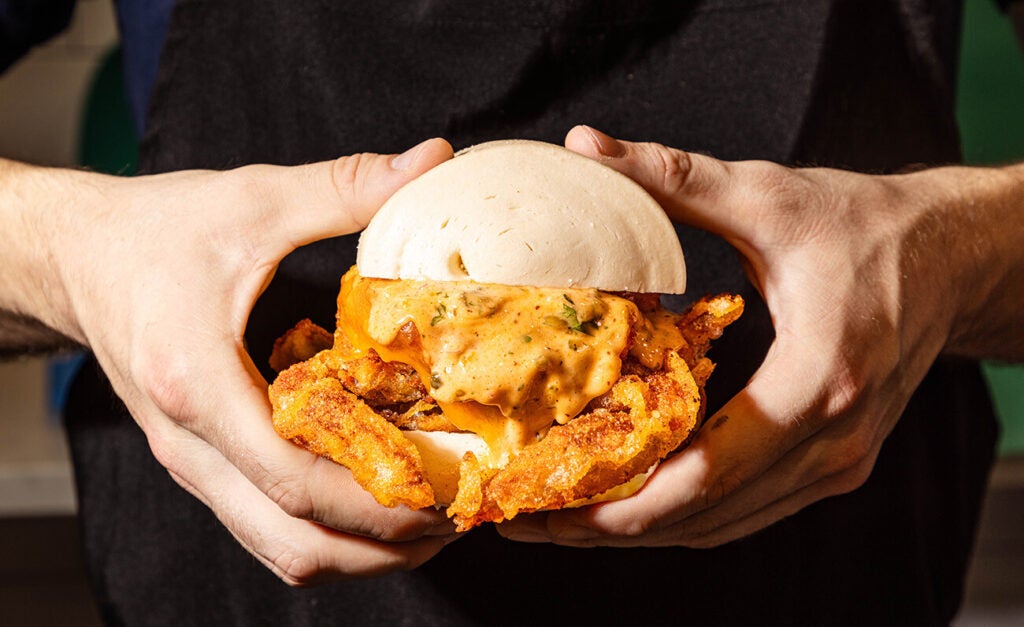 Farrah Skeiky
When the peelers are running, the restaurant’s Locust Point location in South Baltimore adds a towering soft-shell crab sandwich to their popular menu of Asian-Ethiopian cuisine. Called the Maryland Softie, it showcases a crispy soft-shell crab balancing a jumbo lump crab cake atop its back.
“It’s fire. It’s crab on crab on Old Bay on a bao bun,” says Chef Steve Chu, co-owner/founder of Ekiben.
The seasonal delicacy has gone viral, but Chu credits the excitement around soft-shell crabs to the many talented hands around the city that make the most of this unusual ingredient.
“Local chefs have done an incredible job of highlighting what can be for this product,” he says. But he also noted the quality of the crabs available in this region.
“The soft-shells themselves are truly meaty and sweet and briny and juicy and crispy, so I mean, it’s an incredible product and all we try to do is not do too much to it and let the ingredient speak for itself.”
When the crabs come into Ekiben, they’re still alive, Chu explains. They look for crabs that are heavy and still “kicking and screaming” fresh (though the crabs, kept cold, act like they’re almost asleep). For those who have only had frozen soft-shells, it’s a totally different experience, he says. And while he understands the enormous effort that goes into catching and preparing them, and why some people might be hesitant to give them a try, the payoff is arguably worth it.
“People often say that soft-shell crabs are the crown jewel of the Chesapeake Bay. I tend to agree. It’s a product that is hard to get, hard to deal with, it’s a massive pain in the butt. But when you’re able to get your hands on a really amazing soft-shell crab, it’s game-changing,” he says. “They are expensive, but one thing that Marylanders do no matter what your income level is, we will drop some coin for crabs.”
Rightly so.
