Scenes From the 60th U.S. Oyster Festival
What is it about oysters that make them so irresistible, even when many of us would rather look at them than slurp them down our gullet? We bear witness to the undying love for the Bay’s famous bivalve at the recent U.S. Oyster Festival.
The floorboards spring underfoot with the steps of hundreds of spectators filing onto the fairground’s low wooden risers. People clutch beers and cones of sugar-coated cashews, balance funnel cakes in paper trays, lean in close to hear their neighbors over the rumble of the crowd. It’s ball cap and flannel jacket weather, the kind that sets the geese headed south for good. No one minds. It’s perfect for oysters. Perfect for what we’ve all come to see.
 Codi Yeager/CBF Staff
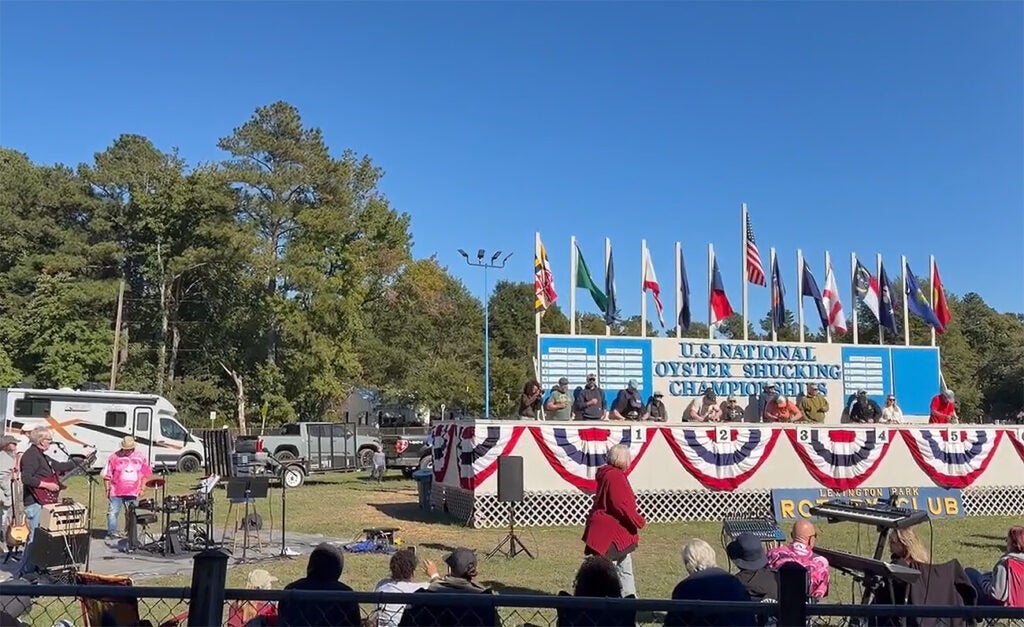
In front of us, five contestants file onto a stage strung with red, white, and blue bunting. Some wave or pump fists at the crowd as the announcer calls their names. They take their positions; in front of each is a large wooden tray and a small basket containing 30 oysters, from which they choose 24 to showcase their skills. When all is ready, the timers are primed. The contestants raise both hands above their shoulders, oyster knives flashing in the sun. Some bounce on the balls of their feet like a batter awaiting the pitch. The announcer turns to the crowd for the countdown: “Five, four, three, two, one,” we shout in unison. “Shuck!”
In the annals of the weird and wonderful ways the Chesapeake Bay region celebrates oysters, the National Oyster Shucking Championship is among the most eye-catching. It’s all the excitement of watching Top Chef combined with the quirkiness of a county fair. At the end, the crowd gets to rush the fence to grab a freshly -shucked half-shell straight from the contestants themselves.
The competition has been held since 1969 at the U.S. Oyster Festival in Leonardtown, Maryland, an annual tradition organized by the Rotary Club of Lexington Park that raises more than $100,000 for local charities and scholarships each year.
We speak so often of the benefits that oysters provide the Chesapeake Bay in terms of fish habitat and water quality, shoreline protection and economics. And those reasons certainly justify restoring and protecting their numbers, which have plummeted in the past several hundred years since European colonization. But if you want to know why oysters matter here, the U.S. Oyster Festival is probably one of the truest answers you’ll get.
Whether out of a good-natured sense of duty, curiosity, or genuine enthusiasm, it was clear that there was something about oysters (or the fanfare around them) that people found irresistible.
Thousands of people show up to wander the St. Mary’s County fairgrounds, sample oysters from dozens of farms and watermen from across the Chesapeake Bay region, and take in the music, historical displays, copious food, and—of course—shucking contest.
But in my estimation, of any five people you ask at random, maybe one or two actually like eating oysters.
One woman came out of one of the fairground’s barns holding a bowl overbrimming with oysters steamed in their shells. She seemed happy, if a bit bemused with her haul. “I felt like I had to have some,” she said, eyeing the pile of rock-like bivalves. “Steamed seemed like a good choice.”
Another group gathered at a low picnic table in the sun. A few oyster shells were visible, but they seemed less focused on the food than the conversation.
“It’s a beautiful Sunday, my football team doesn’t play until tomorrow, everything came together,” said Rob Ragano of Calvert County, Maryland. He loves oysters on the half shell, the big ones, with horseradish, he added.
His companions, Patty Ragano and Gina Blorstad, agreed on the festival’s allure—the oysters’ not so much.
“We all love seafood,” they assured me, as if I might doubt their Maryland bona fides. But when given a choice between oysters and crabs . . .… “Blue crabs. Definitely blue crabs,” they said. Even Rob agreed.
Another couple, Austin and Reagan, were enjoying grilled oysters after a morning volunteering in the beer tent.
“I’d never had an oyster before coming to this festival five years ago,” said Austin.
As nonnative Marylanders, they said the grilled version was a happy compromise. Raw oysters are still a bit much, resembling, as they admitted with an apologetic chuckle, “snot.”
“People are pretty serious about their oysters,” said Reagan. “It can be a little intimidating—I probably wouldn’t go into the raw oyster tent unless you have someone with you who knows what they’re doing.”
 Codi Yeager/CBF Staff
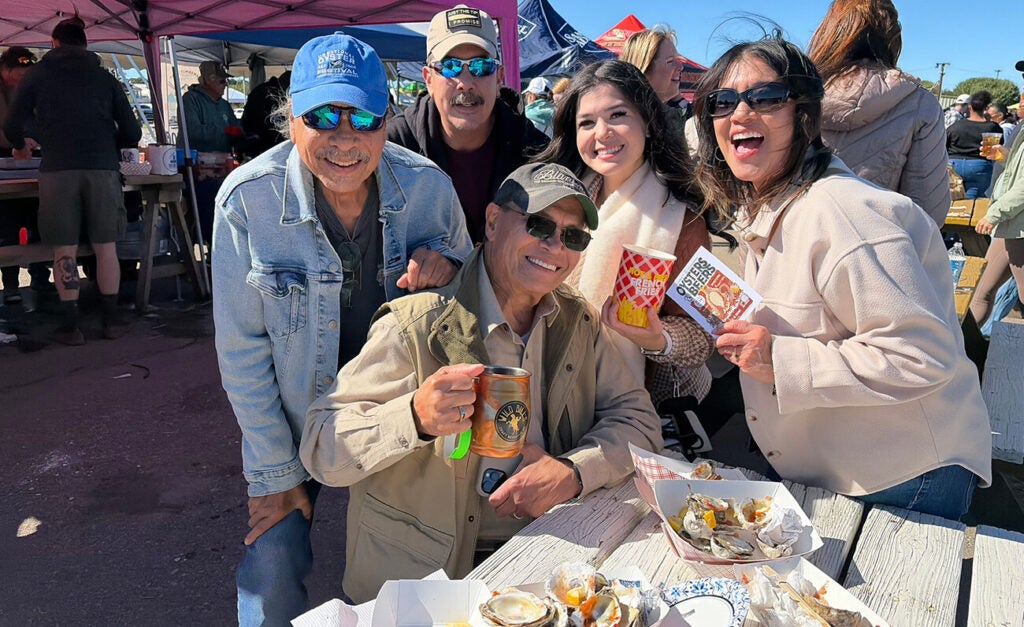
Fred Pagayoya is someone who knows what he’s doing. He and his family were installed firmly at a picnic table in the heart of the bustling oyster tasting row, where oyster farms from across the region shucked thousands of their product for festival-goers over the weekend. Plates of oysters on the half-shell—or the remnants of them—spread along the table’s length.
“We come every year,” he said. The two-hour drive from Ellicott City, Maryland, is well worth it. “We’ve always loved oysters, but this is the only place you can sample oysters from all of the different rivers. Each of the vendors and regions is a little different. Some are sweet or salty or briny. It depends on where they’re coming from.”
Whether out of a good-natured sense of duty, curiosity, or genuine enthusiasm, it was clear that there was something about oysters (or the fanfare around them) that people found irresistible. Like moths drawn to their mollusk-y flame, we’re fascinated by these strange, rock-like creatures. They speak undeniably of a sense of place, a distillation of all the rivers, brine, muck, marsh, and life that make up the Chesapeake. And we love them.
