Six Steps to Create Your Living Shoreline in Maryland
Use these guidelines to design and install your living shoreline.
Living shorelines are the preferred approach to shoreline stabilization, but there is no one-size-fits-all method for designing, installing, and maintaining a living shoreline. This can be frustrating and sometimes hard to navigate. The list below breaks the process down into six steps and allows homeowners to make an informed decision on the best management practice for erosion prevention on their property.
If you would like a visual reminder of these six steps as you work on your project, print out our single-page PDF.
Note: many of the links on this web page will take you off of CBF’s site.
 Terry Coker Peterson
Step 1: Getting the Lay of the Land
Maryland Shoreline Stabilizer Mapper
Site evaluation is an important first step toward creating your living shoreline. Luckily, Maryland Department of the Environment (MDE) put together the Maryland Shoreline Stabilization Mapper based on remote site evaluation and has a suggested shoreline protection measure based on conditions on your site. Each site has the following information listed:
- Existing Shoreline Practice
- Exposure/Fetch
- Tidal Marsh Present
- Beach Present
- Bank Height
- Nearshore Water Depth
- SAV Present (5 year range)
- Road or Permanent Structure Close to Shoreline
If your shoreline is listed as a “Living Shoreline,” you can go ahead to Step 2! If your shoreline is listed as a “Structural Shoreline Stabilization Measure,” that means you are not required by law to implement a living shoreline and can instead utilize a structural approach. Even though a revetment or bulkhead may be permissible, there are still ways to incorporate habitat into a hardened shoreline, so be sure to chat with your contractor about what that might look like.
Because there are some aspects of a shoreline that can’t be assessed remotely, some shorelines are marked as “Undetermined” in the Maryland Shoreline Stabilization Mapper. If this is the case for your shoreline, we recommend gathering some more information that will help you decide what the best erosion management practice will be. Use our Site Evaluation Guide to help guide you through the initial process. The information you are able to find/have on hand from the site evaluation will facilitate later conversations with permitting agencies and contractors.
Step 2: Get Help
A. Ask for additional advice from government entities
Maryland Department of Natural Resources
The link above will take you to their website where you can navigate to the living shoreline technical assistance form.
Maryland Department of the Environment
The link above will take you to MDE’s Wetlands and Waterways Program Directory, where you can find the permit agent who will be working with you based on where the project site is.
B. Ask for additional advice from environmental organizations
Arundel Rivers Federation
If you are located on the South, West, or Rhode rivers.
info@arundelrivers.org
Severn River Association
If you are located on the Severn River
Ben Fertig: ben@severnriver.org
ShoreRivers
If you live on the Sassafras, Chester, Miles, Wye, or Choptank rivers.
Individual Riverkeeper contact information is linked above.
Chesapeake Bay Foundation
Julie Luecke: jluecke@cbf.org or 443-482-2035
Alliance for the Chesapeake Bay
Laura Todd: ltodd@allianceforthebay.org
Chesapeake Bay Landscape Professionals
There are professionals for hire who can assist you with living shoreline projects, including a contractor (to help you build), an agent (to help you through the process and permitting), and others who can help you design your living shoreline. The Chesapeake Bay Landscape Professional (CBLP) Certification program directory lists over 175 CBLP-certified professionals who bring a wealth of experience to sustainable landscaping projects. You can filter the directory by “living shorelines” to find qualified professionals.
Step 3: Funding Opportunities and Budgeting
These programs can help homeowners pay for a living shoreline:
Anne Arundel County – Marsh Grasses Program
Residents of Anne Arundel County with qualifying living shoreline projects can get free marsh grasses (Spartina alterniflora and Spartina patens) for planting.
Anne Arundel County – Stormwater Management Property Tax Credit Program
Residential and commercial property owners can receive a property tax credit of 10% of the cost of materials and installation of a recent living shoreline project. The credit is not to exceed a total of $10,000 over the five-year life of the credit.
Dorchester County – Shoreline Erosion Control Structure Tax Credit
Once approved, residents who have installed qualified shoreline erosion control structures will receive 30% of the cost of the structure as a tax credit against their real property taxes over the course of 15 years.
Maryland Department of Natural Resources (MDNR) – Shoreline Erosion Loan Program
Individuals/groups of homeowners, nonprofit organizations, community organizations, and counties can apply for a 0% interest, 5–20-year loan for a living shoreline project; they can also receive technical and financial support for shoreline erosion issues through site visit evaluations and problem assessments.
MDNR – Resiliency Through Restoration Program
The Resiliency through Restoration Initiative supports implementation of living shorelines and other restoration projects that help protect communities from erosion, flooding and storm impacts. This program provides financial and technical assistance for projects that provide benefits to a community, municipality or county.
MDNR – Roots for Resilience Program
The program supports the construction, design/build, and design proposals for living shoreline projects located in parts of Wicomico, Somerset, or Dorchester Counties that protect substantial areas of adjacent wetland. The goal of this RFP is to award large-scale living shoreline restoration projects that will collectively protect a total of 400 acres of adjacent high quality tidal marsh habitat.
The Chesapeake Bay Trust – Watershed Assistance Grant Program
These tend to be pretty large scale, so this option is probably better for a whole community or for a business.
National Fish and Wildlife Foundation (NFWF) – National Coastal Resilience Fund
NFWF offers a host of grants for various restoration projects. These tend to be pretty large scale, so this option is probably better for a whole community or for a business.
National Wildlife Federation (NWF) – Nature-Based Solutions Funding Database
The National Wildlife Federation’s interactive database of programs for communities interested in federal funding and/or technical assistance.
Step 4: Permit Application and Submission
We highly recommend getting in touch with your local MDNR and MDE representatives for a pre-application site visit to discuss your site and preliminary plans. Look up your contacts for your locality:
Maryland Department of Natural Resources
Maryland Department of the Environment
Critical Area Commission
It is important to understand that permit applications and permit approvals take time, no matter what type of shoreline stabilization you are implementing.
Timelines you should keep in mind:
- Filling out the permit should not take long, but gathering the information needed for the permit may delay the process. On average, you should estimate three to five weeks before the permit is ready for submission.
- Once the permit has been submitted, you should estimate 90 days for a Living Shoreline General License to be approved and 240-325 days for a Living Shoreline Wetlands License. More information on both permits below.
A marine agent or contractor can help you develop a plan and navigate the permitting process. But if you want to do it yourself, there are some important things to know.
There are two types of living shoreline permits that you might be issued, both of which are processed through MDE.
- Living Shoreline General License. This is for projects proposing to construct a living shoreline that extends no more than 35 feet channelward of the mean high water line and/or no more than 500 LF. Additional activities proposed in the application may require application to be reviewed as a Wetlands License.
- Living Shoreline Wetlands License. This is for projects proposing to construct a living shoreline that extends more than 35 feet channelward of the mean high water line and/or more than 500 LF. Additional activities proposed in the application may require application to be reviewed as a Wetlands License. Note that these projects require that you notify adjacent property owners of the project as part of the permit application. More information about what that notification looks like can be found here.
More information, including a flowchart of what happens to your permit after it is submitted, can be found here.
To encourage living shorelines as the preferred method of coastline management, MDE has no application fee if all you are applying for is the construction of a living shoreline.
The permit application process can be tricky and overwhelming. We highly recommend requesting a pre-application meeting with the permitting agencies. Their meeting schedule and request form can be found here.
For these permits, all applicants are required to fill out a Joint Permit Application (JPA). The short form is recommended for all tidal projects. See Maryland Department of the Environment’s Instruction Booklet for step-by-step instructions for filling out the permit application. If you have any issues or need additional assistance with the application process, feel free to contact your local MDE or MDNR staff person.
Make sure your permit application is complete when you submit it, including all required drawings and other forms! Instructions for permit drawings and other helpful information about filling out the permit application can be found here. If your application is not clear or complete, it will delay the process considerably.
Keep in mind that work along the coast and intertidal waterways involves multiple state and federal agencies. Once your permit has been submitted, MDE then routes your permit application through all the other necessary agencies for approval. Although MDE often coordinates with local governments on specific applications, it is the applicant’s responsibility to obtain all local approvals for the project.
MDE will communicate with the applicant within a 45-day period after receiving the application if additional information is required in the application. If MDE fails to notify the applicant within the 45-day period, the application is considered complete for State review.
Step 5: Build
If you have a contractor, they will most likely be the one purchasing the materials needed for your project.
Like most outdoor projects, how soon the project gets completed is based on weather conditions. However, tide also needs to be considered when installing a living shoreline. Ideally living shorelines are constructed at low tides to allow for ample access to the site.
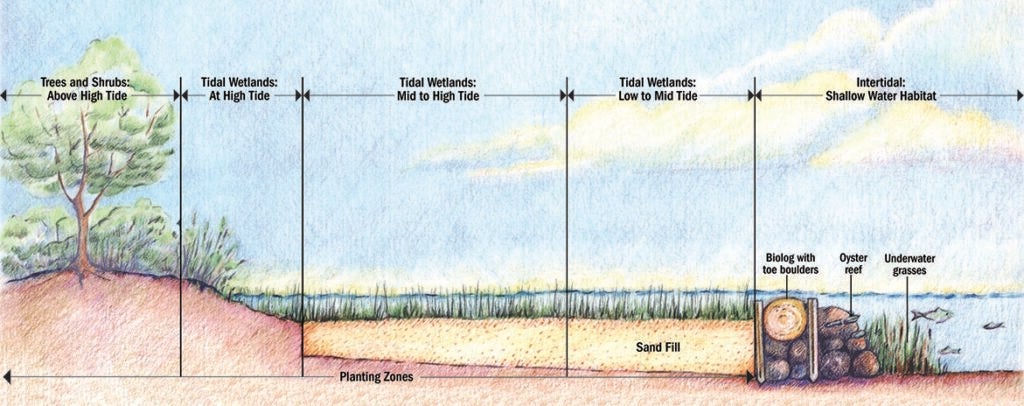
The Center for Coastal Resourcs Management website has these design guidelines for planting.
Hint: Keep a narrow unplanted path to the water for beach access.
To ensure your living shoreline does not become an all-you-can-eat buffet for ducks and geese, goose netting, a three- to four-foot tall mesh enclosure, needs to be installed immediately after grass planting. This is just for the first year to allow for grasses to fully develop. Fencing should be removed after plant establishment to prevent entanglements and debris issues.
Don’t forget to take before, during, and after pictures to document the progress.
Step 6: Living With Your Shoreline
An annual maintenance report to MDE is required for each of the first five years your living shoreline is installed.
The first growing season is a critical time for plant development. Here are some things to keep an eye out for during this time:
- Ensure goose netting is still properly covering all of your grass planting area.
- Remove large debris such as logs, algae mats, and trash, periodically to protect wetland plants from smothering.
- Keep an eye out for non-native invasive plants such as phragmites, english ivy, and other invasive species to ensure that they don’t take over your planting areas. Control or treat as needed and replace them with native wetland plants and shrubs.
- Do a site inspection, particularly after storm events, to ensure that damage and repair doesn’t need to be done to plants or materials. Replacing some planting may be necessary.
- Be aware of potential shading as your plants are getting established; full sun is needed for some marsh grasses.
Educate your neighbors about living shorelines.
Educate your neighbors and community about why you constructed a living shoreline and what the benefits are to your local watershed and the Bay. The more connected these shorelines are, the better they function.
Enjoy your beautiful shoreline and the wildlife it will attract!
For more information or if you see something that needs to be added to our website, contact Julie Luecke at jluecke@cbf.org.
