Critical Questions About a Critical Fish
Atlantic menhaden are the fish that “run the East Coast food web.” So why are they so threatened? Commentary on the recent Washington Post op-ed, “This little fish anchors the East Coast food web. A fight over it is brewing.”
“Conservationists, birders, lobstermen and sportfishermen keep asking: Does it make sense to pull hundreds of millions of pounds of a cornerstone baitfish a year, grind them into meal and oil, and ship some of them to Indonesia, Vietnam and elsewhere? Virginia is the only state left on the East Coast that allows this “reduction” seining of menhaden. Every other Atlantic state restricts menhaden fishing to bait only.”
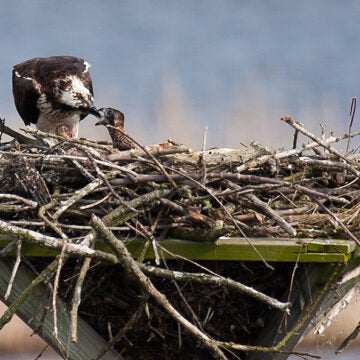
That is something journalist, fisherman, and author Mark Robichaux asks in an op-ed to the Washington Post yesterday. It is an important question considering the current state of the Chesapeake Bay ecosystem, which so fundamentally depends on the health of this fish. “Something is going wrong along the U.S. Atlantic coast,” he says, “and it is visible from the air, from the water and at the docks. In the Chesapeake Bay, osprey chicks are dying in their nests at rates not seen since the DDT era. Scientists say a key reason for their deaths could be that there are not enough fish for the birds to eat.”
Robichaux keenly describes Atlantic menhaden as “the engine of the East Coast food web. Stripers, bluefish, bluefin tuna, humpback whales and osprey eat them. They underpin billions of dollars in fishing economies from the Carolinas to Canada. When menhaden disappear from an area, everything above them in the food chain feels it.” Starving osprey chicks, reduced bait supplies up and down the East Coast, and substantial fish and bycatch deaths are just some of the warning signs we’ve seen over the last few years.
But despite scientific models calling for more than a 50 percent catch reduction, fishery regulators approved only a 20 percent cut, while Virginia continues to allow large-scale industrial menhaden fishing for fish meal and oil. What’s more, it is only one company, foreign-owned Omega Protein and its fishing counterpart Ocean Harvesters, that suck up roughly 70 percent of the entire coast-wide harvest year after year using spotter airplanes, enormous purse seine nets, and vacuum hoses.
“Fixing the problem doesn’t require new science,” says Robichaux. “It requires the will to act on the science that already exists. Cut the coast-wide catch limit to match the ecological targets. On Aug. 5, the [Atlantic States Marine Fisheries Commission] voted to open the Chesapeake Bay cap to public comment. Ocean Harvesters denies the fishery is hurting Bay menhaden and opposes cuts.”
Now is the—and perhaps our final—moment for menhaden. We can’t lose it. The health of the entire Bay ecosystem is at stake. As Robichaux starkly reminds us: “The warnings are no longer subtle. The only question left is whether the people who manage this fishery will act on them — or wait until there’s nothing left to manage.”
Related Stories
-
 Blog Story
How Many More Osprey Chicks Must Starve to Death?
Some of the Chesapeake Bay’s best fishermen—osprey—are sending a loud warning: There aren’t enough fish in the Bay. It’s time to act.
-
 Blog Story
Coming Up Empty: Commercial Watermen in Maryland are Finding Fewer Menhaden
Commercial bait fishermen, who supply menhaden to other fisheries like blue crabs, are stretched thin as it gets harder to find fish.
