How Many More Osprey Chicks Must Starve to Death?
Some of the Chesapeake Bay’s best fishermen—osprey—are sending a loud warning: There aren’t enough fish in the Bay. It’s time to act.
Colonial Beach, Virginia has long celebrated its remarkable osprey population. The small town on the shores of the Potomac River is home to the annual Virginia Osprey Festival.
Joanie Milward, president of the Virginia Osprey Foundation, remembers what it was like when she first moved there in 2017.
“Osprey filled the skies every spring and summer,” she says. “They were everywhere—perched high in the trees, tending their nests, and fishing in the Potomac River and Monroe Bay.”
But since then, it has changed dramatically. Driving around town with Milward this summer, we observed dozens of nests. But when we looked inside, nest after nest was empty. The numbers back up the story those nests tell. In 2022, Milward and her husband began monitoring the local osprey population through Osprey Watch. In 2023, they recorded 55 chicks fledging from 33 nests. Then the numbers collapsed:
- 2024: 5 chicks fledged from 36 nests
- 2025: 8 chicks fledged from 34 nests
- 2026: 14 chicks documented among 37 nests, so far
Milward remains hopeful that every chick observed this year will survive to fledge, but the past several years offer little reassurance.
“The contrast between what we witnessed when we first arrived at Colonial Beach and what we are seeing today is heartbreaking. The decline has been swift and dramatic, and it serves as a stark reminder that our osprey need our attention and action now.”
Nearly 70 years ago, the widely used pesticide DDT nearly wiped out osprey populations across the country. Strong conservation efforts, including banning DDT, helped save them and fueled an extraordinary recovery. Today, the Chesapeake Bay is home to the largest breeding population of ospreys in the world.
But the species now faces another crisis, and leading osprey researchers point to declining availability of menhaden—a small, nutrient-packed fish—as one important driver.
Since around 2020, concerned citizens and researchers have observed fewer osprey chicks surviving their first summer. The declining productivity (measured in chicks per nest) is especially pronounced in the saltier portions of the Chesapeake Bay, while osprey populations in the freshwater reaches of Bay tributaries continue to do relatively well.
The difference comes down to food.
These apex predators, known in many areas as “fish hawks,” depend almost entirely on fish. In freshwater tributaries, ospreys rely on fish such as gizzard shad and catfish. In the saltier portions of the Bay, ospreys have historically relied heavily on menhaden—a small forage fish sometimes called “the most important fish in the sea” because of its abundance and nutritional value.
Menhaden are also a critical food source for countless fish, birds, and other predators along the Atlantic coast.
When researchers compare where osprey nesting failures are occurring with the habitats where ospreys depend most heavily on menhaden, a troubling pattern emerges: poor menhaden availability appears to be driving poor osprey nesting success.
What Happens in an Osprey Nest Without Enough Food?
Roberta Kellam has monitored osprey nests on Virginia’s Eastern Shore for years. A lifelong birder and environmental advocate, Kellam serves as president of Birding Eastern Shore and participates in annual research led by Dr. Bryan Watts, a professor at William & Mary who has studied osprey for decades.
Her observations are deeply concerning:
“Osprey reproductive success is worsening on both the bayside and seaside of the Eastern Shore of Virginia. Their behavior has changed—males are failing to provision the incubating female and nests with young chicks.”
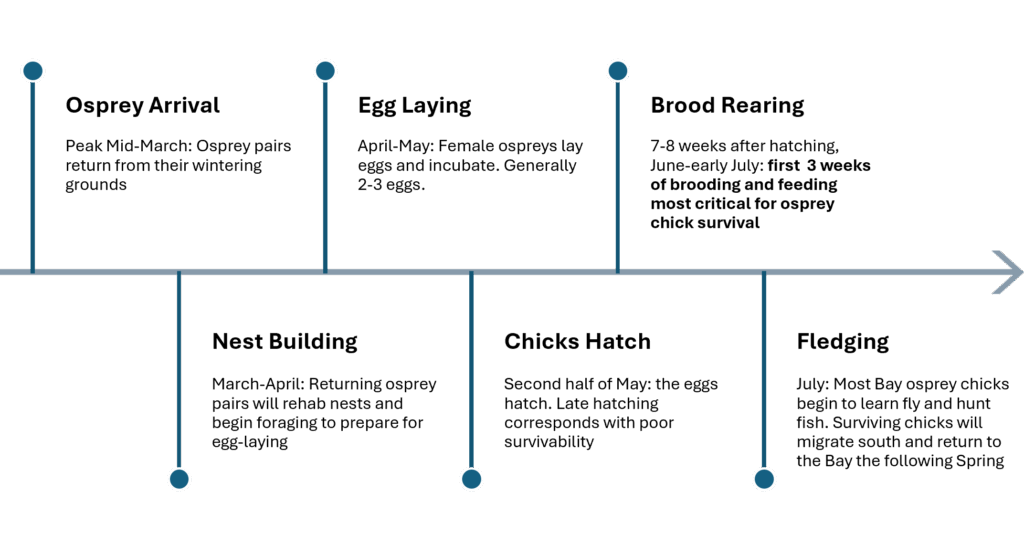
When males do not bring enough food to incubating females, Kellam explained, females may be forced to leave the nest to find food themselves, abandoning their eggs.
“Abandonment of eggs seems to account for about 50% of the nest failures in my estimation. Sometimes the males are gone for days at a time when there are chicks already hatched. The females are forced to leave the nest to find fish to feed the young, leaving the young birds vulnerable to predators and high heat.”
Even when chicks hatch, food shortages can force osprey parents to prioritize some chicks over others—the lesser-fed chicks inevitable wither and die.
“A nest might start with three chicks but only one will be fed and raised to fledge. Last year, in Cape Charles, I watched a 6-week-old fledgling starve to death in favor of the two other chicks.”
The same nest, which had regularly fledged three chicks in previous years, has only one chick this year. One egg was abandoned, and another chick starved to death.
A Widespread Crisis
Dr. Watts, Director of William & Mary’s Center for Conservation Biology, released 2026 Chesapeake Bay osprey nesting data on September 14th, and the findings are “worst ever recorded for the Chesapeake Bay”.
Across the saltier portions of the Bay, reports are coming in this year of dead or emaciated chicks and failed nests. While many nesting pairs laid eggs right on schedule this spring, a concerning number of pairs also failed to even lay eggs.
“It might be the worst year on record, and we’ve never monitored more nests in the Bay,” Watts said. Nest failures can be caused by numerous factors, including extreme weather events, heat stress, predation by other animals, or human disturbances. However, Watts’ research ruled out those factors as the primary cause of this crisis, instead identifying food stress, specifically a lack of menhaden, as the driving factor of the now worst-recorded osprey nesting rates the Bay has ever seen.
In 2026, Watts and his partners monitored 937 osprey nests across 23 study areas that spanned different salinity regions in the Chesapeake Bay watershed. Across the saltier portions of the Bay, where osprey have traditionally relied on menhaden for food, the productivity rate was 0.25 young/pair; the rate needed to maintain a stable population of osprey is 0.8-1.3 young/pair. Watts added, these estimates should be considered “conservative.” Without a reversal in their breeding performance (how many chicks are surviving), Watts expects the breeding population of Chesapeake Bay Osprey to decline by 50% over the next decade.
Chicks are starving to death and the evidence is amassing. “A constellation of quantified metrics of food stress including high rates of females not laying clutches, low provisioning rates, emaciated chicks with stunted development, asymmetric broods, sequential brood reduction, shifts in mean brood size, pairs abandoning viable clutches or broods, pairs abandoning breeding areas en masse and high failure rates support this conclusion,” Watts said. “Beyond these quantified metrics, we are observing young starve in nests.”
Watts further explained, “The extreme food stress documented in recent years appears to be caused by changes in the availability of Atlantic menhaden to nesting ospreys in the Chesapeake Bay…In some parts of the Chesapeake, the rate of delivery of menhaden to nests has declined by more than 80 percent since the 1980s.”
Peter McGowan, a wildlife biologist who recently retired from the U.S. Fish and Wildlife Service, spent years studying wildlife on Poplar Island, Maryland, a remote, uninhabited island in the middle Chesapeake Bay.
McGowan’s long-term observations provide another troubling perspective. [His analysis represents his past work and does not necessarily represent the views of the U.S. Fish and Wildlife Service.]
Osprey productivity at Poplar Island—measured as fledged chicks per active nest—has steadily declined from 1.82 in 2019 to zero in both 2025 and 2026.
That is far below the threshold established for maintaining a stable population.
“A total of only 4 chicks successfully fledged over the past 4 years,” McGowan says. “This metric is a good indicator of food stress, with smaller broods typically produced when prey species are limited.”
Where Do We Go From Here?
What is happening to ospreys throughout the Chesapeake Bay is alarming. It is intensifying, and it demands action.
As a sentinel Chesapeake Bay species and apex predator, ospreys provide an important window into the health of the Bay ecosystem. Their declining productivity is a warning sign at a time when the Bay is changing rapidly before our eyes, facing increasing pressure from climate change, pollution, and development.
Limited food availability, as well as other factors, is clearly part of the picture—and deserves immediate attention. In the saltier portions of the Bay, where ospreys are known to depend heavily on menhaden, poor menhaden availability can have devastating consequences.
We may not yet have every answer about why menhaden availability is changing. But when data are incomplete and the consequences of inaction could be severe, managers should favor risk-averse, conservation-minded decisions. While there is finally federal and state funding for Chesapeake Bay menhaden research, the results from that works are years away and must not delay management action to address this unfolding crisis in the nation’s largest estuary. The response to the warning signs should be clear: we need to ensure that more menhaden remain available to the Chesapeake Bay ecosystem.
Increasing the availability of this critical forage fish would give ospreys and other predators a better chance to survive and reproduce—and would provide greater resilience to an ecosystem already under enormous stress.
The widespread osprey nesting failures and starving chicks are sending a loud message. It is up to politicians, regulators, managers, and all of us who care about the Chesapeake Bay to listen—and act—before it is too late.
The photos below contain images of dead osprey chicks resulting from a lack of food which some viewers may find disturbing. [click the blur to show/hide the photos]
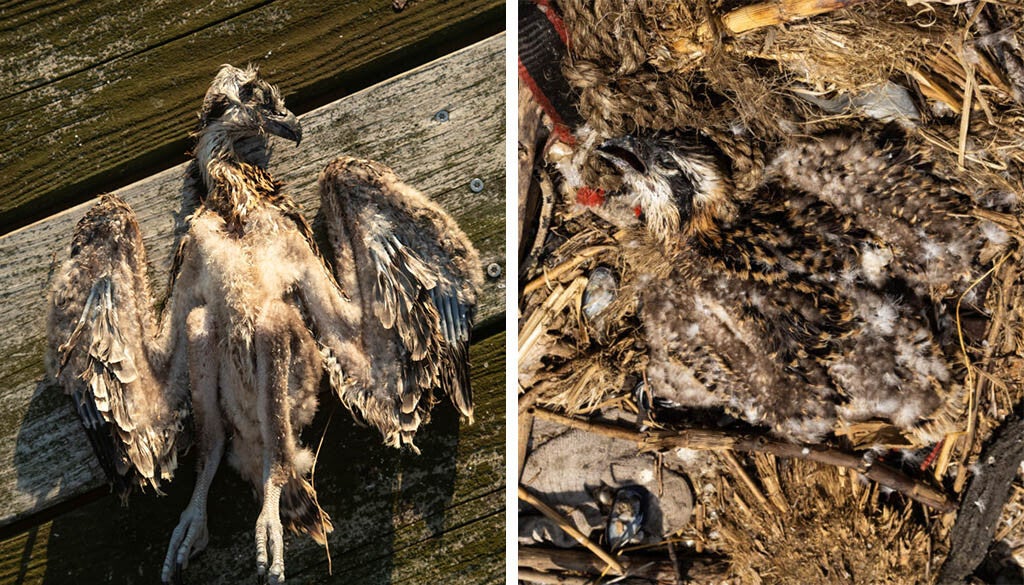 Bryan Watts
Related Stories
-
 Blog Story
Coming Up Empty: Commercial Watermen in Maryland are Finding Fewer Menhaden
Commercial bait fishermen, who supply menhaden to other fisheries like blue crabs, are stretched thin as it gets harder to find fish.
-
 Blog Story
To Save the Chesapeake Bay, Save This Fish
Saving menhaden helps save the bay. Now, evidence of a crisis is impossible to ignore.
