Press Statement
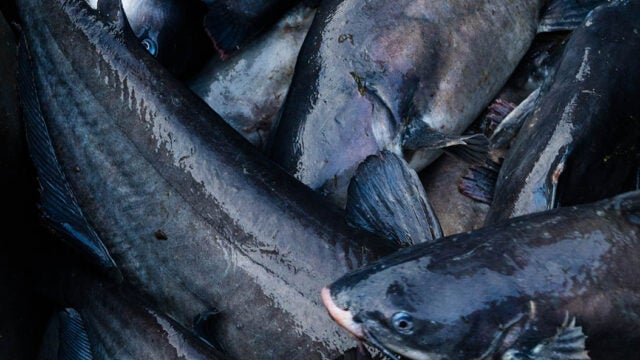
The U.S. Department of Commerce denied a request by Maryland Gov. Wes Moore for the declaration of a federal fisheries disaster due to the harm caused by invasive catfish and snakeheads, the Maryland Department of Natural Resources (DNR) announced in a press release yesterday. The disaster declaration, which Gov. Moore requested in March, would have led to federal funding to address the threat of these invasive species to Maryland’s Chesapeake Bay fisheries, environment, and economy.
Invasive blue catfish are voracious predators that feed on native species, including menhaden, striped bass, eel, shad, river herring, and blue crabs. In some Chesapeake Bay tributaries, they make up approximately 75 percent of the total weight of all fish inhabiting the river.
Maryland DNR has taken additional steps in recent months to control invasive fish species, including hiring a dedicated program manager, increasing blue catfish research and monitoring, and encouraging commercial and recreational anglers to catch and eat blue catfish.
Chesapeake Bay Foundation (CBF) Maryland Executive Director Allison Colden issued the following statement:
“Blue catfish are threatening the Chesapeake Bay’s ecological balance. While the denial of the fisheries disaster declaration is a setback, many other efforts are underway to increase the harvest of blue catfish and mitigate their harm. We applaud the Moore administration for its leadership on invasive species.
“On the federal level, it is absolutely crucial that Congress act to remove burdensome catfish processing requirements that have held back growing the commercial harvest of blue catfish in the Chesapeake Bay.”
Public opinion sought on plan to aid in iconic species’ comeback
The Atlantic States Marine Fisheries Commission (ASMFC) is asking the public to comment on changes to the fisheries management plan intended to help the struggling striped bass population.
The plan to rebuild the striped bass population isn’t likely to meet a 2029 target. The public comment period that closes on December 22 seeks input on new changes to the coastwide management plan that follow an ASMFC emergency action enacted earlier this year. The Chesapeake Bay Foundation (CBF) urges those who care about striped bass and the health of the Chesapeake Bay to make their voices heard.
A variety of factors including low reproduction, water quality challenges, recreational fishing pressure, and climate change have all contributed to the striped bass population decline. While the population has not reached the low point of the 1980s that led to a fishery moratorium, the decline in striped bass numbers continues to spark widespread concern here in the Chesapeake Bay region.
The ASMFC must take strong action to rebuild the striped bass population. Earlier this year, the ASMFC voted to implement an emergency action to decrease the maximum size limit for most striped bass fisheries to 31 inches.
The fisheries management plan up for public comment, known as Draft Addendum II, proposes new recreational bag and size limit options, includes a quota reduction for commercial fisheries, and gives decision makers the ability to respond faster to striped bass assessments. Citizens can send public comments through CBF’s action alert.
Public comments will be accepted until 11:59 PM EST on December 22 and can also be sent to Emilie Franke, FMP Coordinator, at 1050 N. Highland St., Suite 200 A-N, Arlington, Virginia 22201; or at comments@asmfc.org (Subject line: Striped Bass Draft Addendum II).
More information can be found at this ASMFC press release.
CBF Virginia Executive Director Chris Moore issued the following statement.
“The striped bass population continues to struggle, and we can’t ensure its comeback without strong action by the ASMFC. This public comment period is a critical opportunity for anyone with a stake in striped bass to speak out to help protect and rebuild the population.”
“Draft Addendum II includes a number of options that will help reduce fishing pressure and support goals to rebuild the striped bass population. Anyone who cares about the iconic species should weigh in during the ASMFC’s fishery plan public comment period.”
Green 2.0 released its Seventh Annual NGO & Foundation Transparency Report Card today. The organization’s report shows diversity and inclusion data from environmental NGOs and foundations. Green 2.0 is a nonprofit organization working to increase racial and ethnic diversity among environmental organizations.
The Chesapeake Bay Foundation (CBF) is one of the organizations that provided data for the Green 2.0 Survey based on 2022 data.
Carmera Thomas-Wilhite, CBF’s Vice President for Diversity, Equity, Inclusion, and Justice, issued the following statement.
“For too long, CBF and many other environmental organizations have not fully represented our region’s great diversity. Across the Bay watershed, pollution and climate change continue to disproportionately harm our most vulnerable communities.
“We all deserve clean air, clean water, and a healthy environment. For Bay restoration to succeed, people have to be at the center of our work. CBF is committed to working toward diversity, equity, inclusion, and environmental justice.
“There is a continued need for diversity and inclusivity across all levels at environmental organizations to support transformational change and relevancy of organizations for future success.”
Today, the Maryland Department of Natural Resources (DNR) announced new striped bass emergency regulations to help bolster the species’ struggling population. Striped bass are an iconic species in Maryland that support important commercial and recreational fisheries.
However, recent assessments of the striped bass population indicate trouble. This year’s juvenile index was the second lowest on record since 1957. The numbers of spawning fish have been below sustainable levels for several years and are currently under a rebuilding plan at the Atlantic States Marine Fisheries Commission (ASMFC). DNR’s proposed actions, if adopted, would take effect before this year’s recreational fishing season and would close Maryland’s trophy striped bass fishery and extend spring closures intended to protect returning fish as they migrate up the Bay to spawning grounds.
The Chesapeake Bay Foundation (CBF) is hopeful that this emergency action by DNR, in conjunction with changes to ASMFC’s striped bass fisheries management plan currently under consideration, will ensure a better future for watermen, anglers, and the striped bass population.
Allison Colden, CBF’s Maryland Executive Director said in a statement:
“We commend DNR for taking proactive action to protect Maryland’s state fish. As the primary spawning grounds for rockfish along the entire East Coast, what Maryland does to protect spawning striped bass has cascading effects for all states that rely on this coastwide stock. DNR’s emergency actions recognize a need to reduce interactions with spawning fish, which will hopefully help address the alarming trend of continued low juvenile abundance in the Bay.
“While this action is an important step, further changes to protect striped bass, including those currently under consideration at ASMFC, will likely be necessary to help rebuild the population. Addressing high mortality in the hot summer months and reducing fishing mortality from all sectors of the fishery will be critical. Anglers and others interested in the health of the population and current management changes proposed by ASMFC can learn more and take action here.”
The dead zone in the Chesapeake Bay this year is the smallest since monitoring began in 1985, according to data released today by the Maryland Department of Natural Resources, Old Dominion University, and Virginia Institute of Marine Science.
The dead zone appears annually in parts of the Bay and its tidal rivers during warmer months, creating areas where oxygen levels are so low that the water cannot support fish, blue crabs, oysters, and other aquatic life. The dead zone is caused by algal blooms that are fueled by nitrogen and phosphorus pollution. These cloud the water and cause damage, mainly during the warmer months.
The extent of each year’s dead zone is dependent on several factors, including how much nitrogen and phosphorus pollution enters waterways. High precipitation can contribute to the dead zone because it leads to more polluted runoff washing into rivers and streams. Precipitation was below average for most of 2023.
Chesapeake Bay Foundation Virginia Senior Scientist Joe Wood issued the following statement.
“While the smaller dead zone this year is a promising sign, we must remember the major challenges that lie ahead. The mere existence of a dead zone in the Bay is cause for alarm, and a sign that we must still dramatically reduce pollution flowing into the Bay.
“Most of the pollution-reduction progress so far has come from wastewater treatment plants. States in the Bay watershed are still lagging far behind in reducing polluted runoff from agriculture as well as urban and suburban areas. In fact, urban and suburban pollution is increasing.
“Climate change is also making saving the Bay more challenging. The fact that 2023 is on track to be the hottest year on record globally is a red flag, since warmer water holds less oxygen. Polluted runoff from hot pavement increases water temperatures, underscoring the need to reduce runoff from both urban areas and agriculture.
“As climate change also brings heavier and more frequent rainstorms that wash more pollution into our waterways, we can’t count on drier-than-average years to temper the Chesapeake Bay’s dead zone.
“To continue the progress largely made by wastewater treatment plant upgrades, leaders must seek new solutions and invest in efforts that address climate change while reducing pollution from agriculture and stormwater.”
Today, Baltimore City’s Public Works Department agreed to a $4.75 million settlement payment to address pollution from the city-owned Back River and Patapsco wastewater treatment plants. This is a victory for the Bay that will ensure oversight and transparency of treatment plant operations moving forward. The historic failure of these two plants has caused millions of pounds of contamination to enter the Chesapeake Bay and damage water quality for surrounding communities. The settlement is a crucial first step towards righting that wrong.
Chesapeake Bay Foundation’s Maryland Executive Director, Allison Colden said in a statement:
“Today’s settlement is an encouraging step forward but is the first step of many needed to rectify the harm these plants have done to the Bay. Much of Maryland’s progress in Bay cleanup has been achieved by reducing pollution from wastewater and we cannot backslide on that progress.
“Transparency and accountability will be crucial. We are hopeful that sufficient staffing, improved operations, and enhanced public communications will significantly benefit local waterways and communities that have been damaged by previous failures of these facilities.”
Editor’s note: This wastewater violation lawsuit against Baltimore City is led by Blue Water Baltimore represented by the Chesapeake Legal Alliance. More information is available here: Environmental Groups Announce Landmark Agreement To Resolve Wastewater Treatment Plant Violations.
The announcement by U.S. Rep. John Sarbanes that he will not seek another term in the House of Representatives will leave large shoes to fill, according to the Chesapeake Bay Foundation. As a co-chair of the Chesapeake Bay Watershed Task Force, Congressman Sarbanes worked tirelessly to secure federal resources and policy changes that support conservation and cleanup efforts across the Chesapeake Bay watershed. He also worked to ensure that all who call the watershed home have access to, and connect with, nature. Perhaps most of all, Congressman Sarbanes has been a leader in promoting hands-on environmental education for students in Maryland and across the country.
Following his announcement, Chesapeake Bay Foundation President and CEO Hilary Harp Falk issued this statement:
“Along with his work on ethics and campaign finance reform, Congressman Sarbanes is an environmental access and education hero. He recognized that protecting our natural resources begins with ensuring the wonder and majesty of those resources are available to all, especially students.
By advocating for environmental literacy and outdoor education, Congressman Sarbanes gave the next generation the gift of outdoor experiences that lead to a deep appreciation for the need to protect our planet. We thank Congressman Sarbanes for his leadership and tireless efforts to develop tomorrow’s environmental leaders.”
On Saturday, the Pennsylvania Department of Environmental Protection (DEP) will open for public comment its Draft 2024 Integrated Water Quality Monitoring Report that identifies 28,820 miles of waterways in the Commonwealth that have been damaged by pollution. That is an increase of 930 miles since its last report in 2022. To put that in perspective, 34 percent of Pennsylvania’s 85,568 miles of rivers and streams do not meet water quality standards for water supply, aquatic life, recreation, or fish consumption.
Agricultural activities were cited as the leading source of water quality impairment with 8,212 miles, an increase from 6,432 miles in the 2022 report. The legacy of coal mining in the form of acid mine drainage was the second major source with 5,607 miles, down from 5,536 in 2022; and impacts of polluted urban and suburban stormwater runoff from cities, subdivisions and strip malls are third at 3,828 miles, compared to 3,507 in 2022.
Nearly 48 miles of streams were identified as being restored back to health since 2022.
While it is disappointing that impaired stream miles are increasing, the Chesapeake Bay Foundation (CBF) in Pennsylvania notes the increasing momentum in the Commonwealth to get back on track to meeting its commitment to cleaner rivers and streams.
In response to DEP’s report, Harry Campbell, CBF Science Policy and Advocacy Director in Pennsylvania said:
“This latest report indicates that the Commonwealth still has a long way to go toward restoring and protecting our lakes, rivers, and streams. With the passage of key legislation, coupled with recent state and federal government investments, the state is poised to accelerate momentum toward clean and healthy waters.
“The Clean Streams Fund is designed to help address the state’s leading sources of impairment. The hallmark of the Fund is the Agricultural Conservation Assistance Program (ACAP), which directs investments locally to support Pennsylvania’s farmers to leave a legacy of healthy soils and clean water for future generations through conservation practices like streamside forests.
“Sustained, long-term investments in ACAP and the other Clean Streams Fund programs are vital to restoring and protecting the health of lakes, rivers and streams across the state.
“Just as the Fund and ACAP provide critical support for cleaner waters in Pennsylvania, so do recent investments at the federal and other state levels add momentum, and those should not go unnoticed.
“These investments will be more cost-effective and successful when applied in priority places, focus in on high-impact practices, and leverage the knowledge and expertise and support of partners on the ground.”
The Chesapeake Bay Foundation (CBF) applauded the House Natural Resources Committee’s approval today of bipartisan legislation to reauthorize and boost funding for the National Oceanic and Atmospheric Administration’s (NOAA) Chesapeake Bay Office and expand environmental education about the Bay.
Introduced by Reps. John Sarbanes (D-Md.), Bobby Scott (D-Va.), Rob Wittman (R-Va.), and Jen Kiggans (R-Va.), the Chesapeake Bay Science, Education and Ecosystem Enhancement (SEEE) Act would ensure that NOAA continues as an essential member of the federal-state partnership to restore habitat, enhance ecosystem functions, and reduce water pollution in the Bay watershed. The bill number is H.R. 4770.
The NOAA Bay Office is one of the key agencies implementing large-scale oyster restoration projects at the heart of the Bay restoration effort. Its hands-on Chesapeake Bay Watershed Education and Training (B-WET) program teaches the next generation of Bay stewards about the scientific value and wonders of the Bay ecosystem.
CBF Maryland Executive Director Allison Colden testified in support of the SEEE Act and its importance in restoring the fisheries and ecosystems of the Bay watershed at an October 18 hearing of the House Natural Resource Subcommittee on Waters, Oceans, and Wildlife.
A companion bill was introduced in the Senate in July by Sens. Mark Warner (D-Va.), Chris Van Hollen (D-Md.), Ben Cardin (D-Md.), Tim Kaine (D-Va.), Bob Casey (D-Pa.), John Fetterman (D-Pa.), and Joe Manchin (D-WV.). The bill number is S. 2534.
CBF Federal Director Keisha Sedlacek issued the following statement after the markup:
“NOAA’s Chesapeake Bay Office is an integral partner in efforts to restore the Bay and its waterways, fisheries, and wildlife habitats. Its oyster restoration expertise, climate change research, and education programs are essential to ensuring the economic and ecological future of this priceless resource.
“The SEEE Act will ensure the Office can continue its vital role in the restoration effort. This is critical as we approach deadlines and define what the next chapter in Bay restoration looks like.
“CBF congratulates Reps. Sarbanes, Scott, Wittman, and Kiggans for their bipartisan work advancing this important bill through the House Natural Resources Committee. We urge the House of Representatives to make passing it a priority.”
The Chesapeake Bay Foundation (CBF) joins the Chesapeake Legal Alliance and many others mourning the loss of Ridge Hall, a long-time environmental lawyer and mentor. CBF’s Vice President of Litigation, Paul Smail, worked with Mr. Hall for more than a decade.
Starting in 2015, CBF, Blue Water Baltimore, and Mr. Hall worked together to stem the pollution from the former Sparrows Point steel mill, pressing MDE and EPA to address the legacy groundwater pollution flowing off the site. Ultimately EPA listed the toxic sediments in Bear Creek a Superfund site, which we expect will result in significant improvements to the water quality and living resources around the former steel plant.
After his passing, CBF’s Vice President of Litigation and General Counsel Paul Smail issued this statement.
“Ridge was a friend and mentor. He had incredible patience as well as an easy charm that belied a razor-sharp intellect and incisively inquisitive mind. He was a tenacious advocate who never lost sight of what we all fight for—leaving our community and watershed in a better state than we found it.”
