Field Notes: Building an Oyster Reef
Over the course of the summer, CBF built an oyster reef as part of a larger project to restore and protect an eroding shoreline along Maryland’s South River.
Where We’re At: CBF’s 60-foot restoration vessel Patricia Campbell, anchored in a shallow cove on Harness Creek, a tributary of the South River just offshore from Quiet Waters Park in Annapolis. Aboard are nine crew, 108 concrete reef balls, and an industrial-size bottle of sunscreen.
Conditions: The water is smooth and green. It’s mid-morning and the temperature hasn’t climbed. It’s going to be one of those rare, low-humidity summer days. We have a few herons for company.
Why We’re Here: To build an oyster reef. The reef balls, set with millions of baby oysters, will provide the structure for the reef. It’s part of a larger project led by Arundel Rivers Federation to create a living shoreline that will protect the park’s land from erosion. The native marsh plants restored along the shore, together with the underwater oyster reef, will also help create a continuous habitat for fish and wildlife.
Step One: Hook Up the Reef Balls
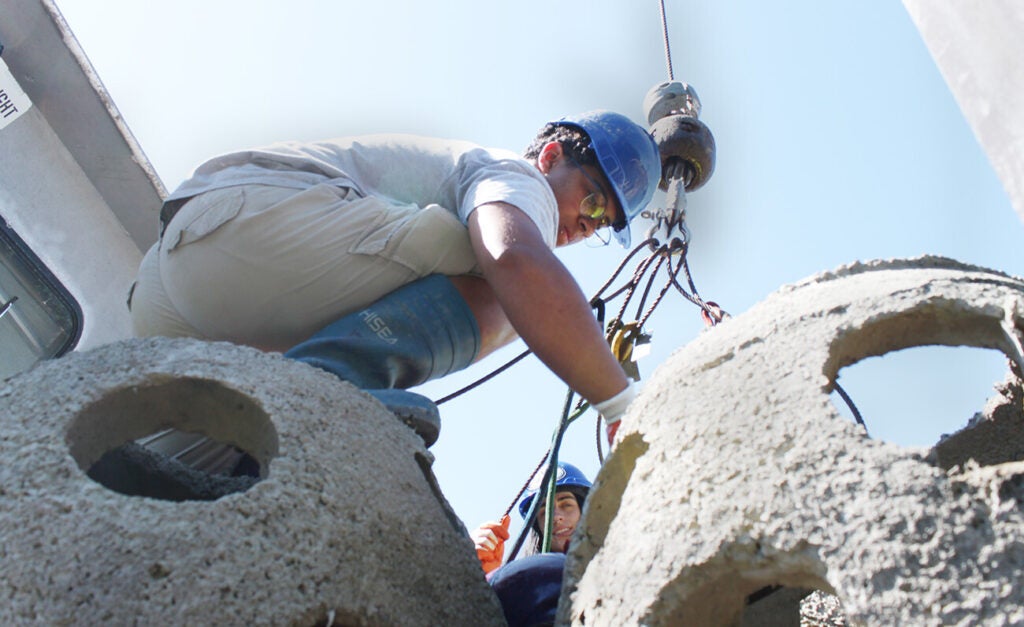
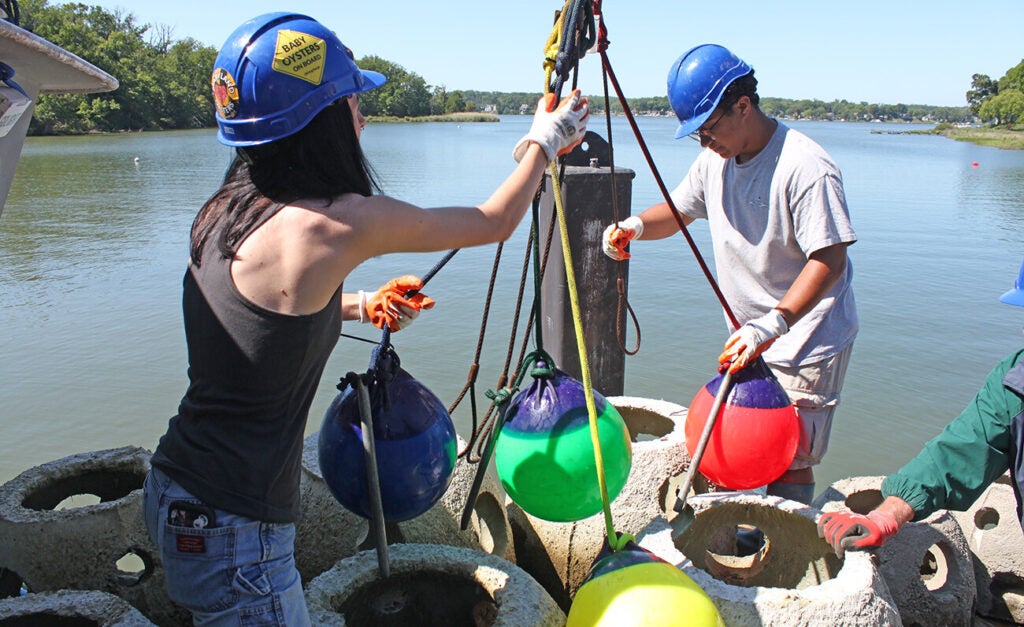
The crew’s first job is to attach the cables that will allow the boat’s crane to lift the reef balls off the deck and into the water. There are four cables, and each one attaches to a single reef ball, creating a clover leaf-shaped cluster. At the top of each cable is a colorful buoy.
The first sets are a little tricky because the reef balls are stacked on the deck, each layer separated by a piece of plywood. The crew has to carefully navigate up to the top layer—rock climbing, Chesapeake Bay style.
 Codi Yeager/CBF Staff
 Codi Yeager/CBF Staff
Step Two: Maneuvering Into Place
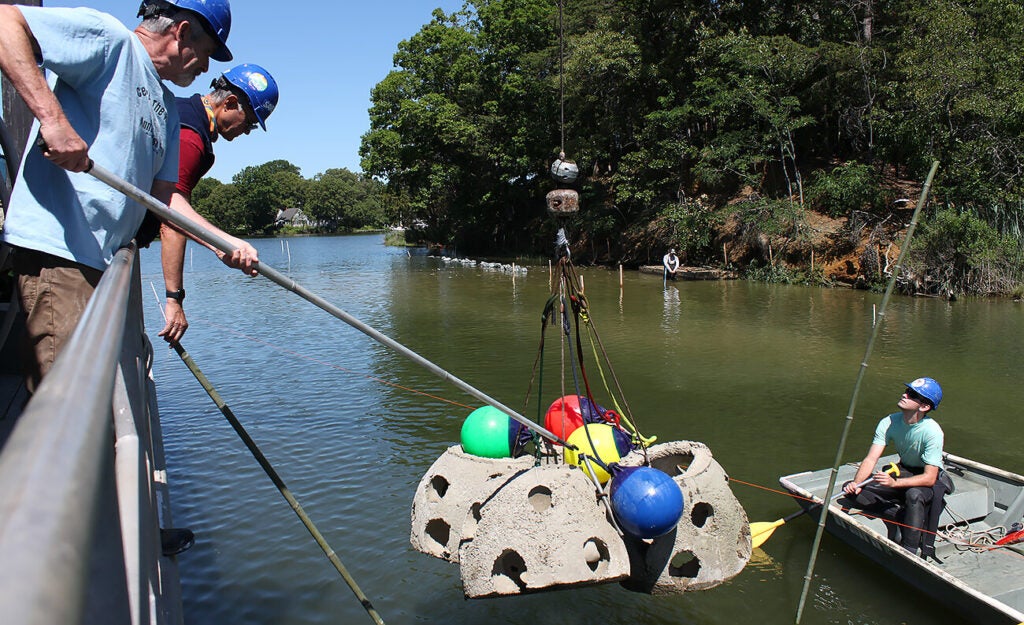
When all are hooked up, the crane pulls the cables tight and lifts the reef balls into the air. The cluster spins slowly as it sweeps across the deck and over the side. Getting the reef balls in the right place is an all-hands-on-deck job.
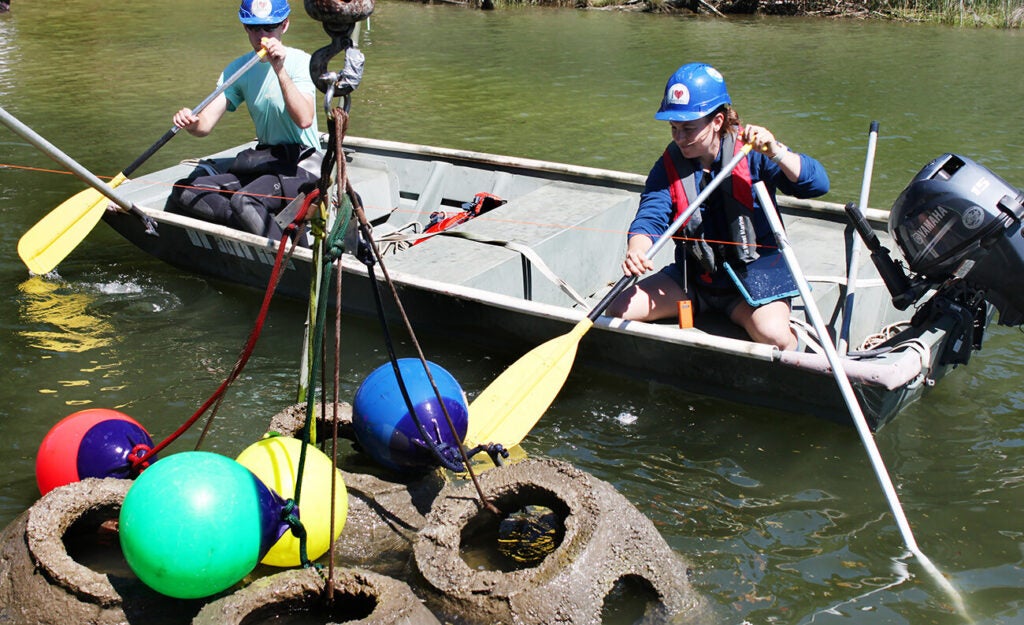
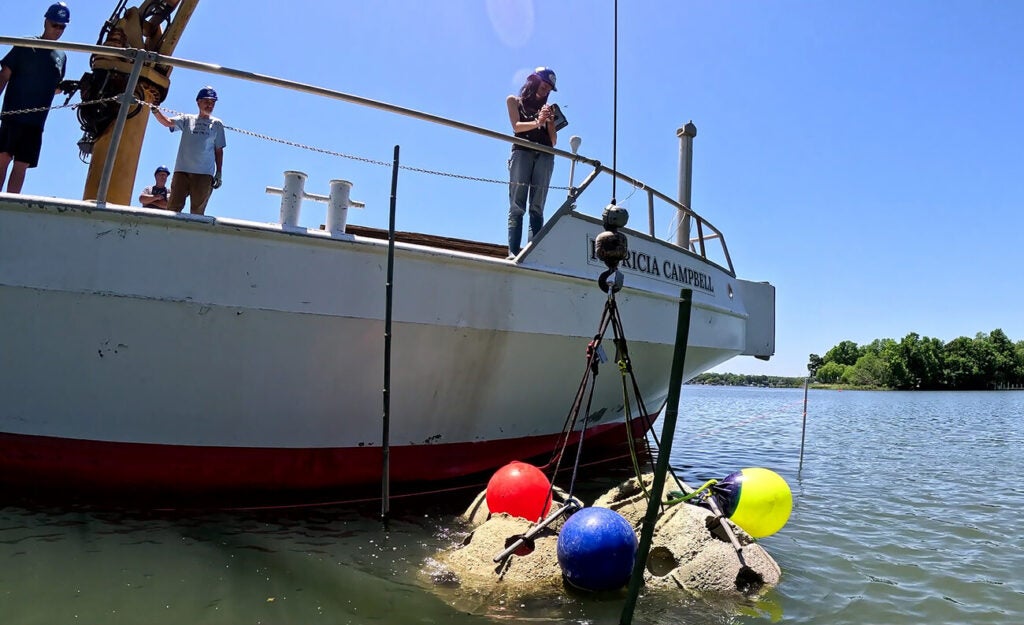
Two crew members wait below in a small dinghy. They’ve already strung a line between two slender white poles, providing a guide for where the reef balls should go. The crane lowers the reef balls until they just touch the water, with crew members on deck spotting how they’re lining up.
The dinghy crew paddles as close as they can safely get. Then they use their paddles to stop the reef balls’ rotation, nudging them into the right orientation and “holding” them in place. This can go on for many minutes, adjusting and readjusting, to make sure all is right. Once they’re deployed in the water, there’s no easy way to move the reef balls. You get one shot.
 Codi Yeager/CBF Staff
 Codi Yeager/CBF Staff
Step Three: Buoys Away!
When everyone is satisfied, the crane slowly lowers the reef balls into the water. This is where the buoys come into play. As the reef balls descend, they pull the buoys underwater. But when the reef balls settle on the bottom, the tension in the cables slackens and they unhook. Newly freed, the buoys rocket back to the surface and pop into the air like a quartet of colorful balloons. Buoys and cables are safely returned to the boat and the process can start again.
Step Four: Collect the Data
The final step is recording the exact location of the reef balls so they can be mapped and tracked with GIS (geographic information system). One crew member in the dinghy holds a monitoring device as close as possible over the newly deployed cluster of reef balls, while the other keeps the dinghy in place with their paddle. On the deck of the Patricia Campbell, another crew member holds an iPad and makes sure the data point is successfully recorded on the map. This process, too, repeats for each new cluster that is set in the water.
 Codi Yeager/CBF Staff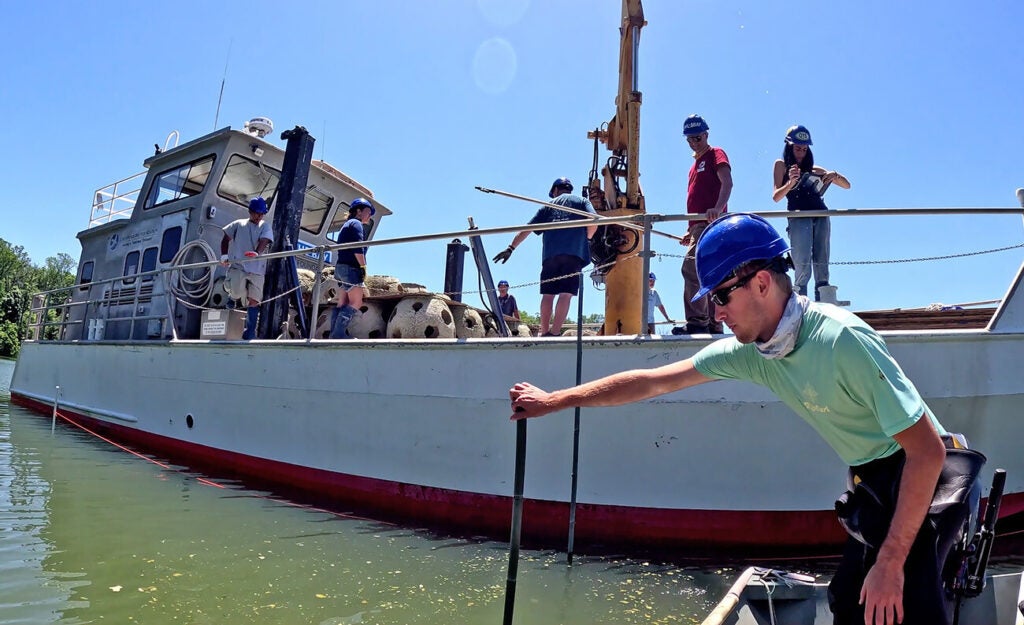
Step Five: Wait for Your Reef to Grow
At first, the reef isn’t much to look at. The baby oysters are too tiny to see with the naked eye, and it just looks like a bunch of reef balls lined up underwater. The nooks and crannies in the reef balls still provide shelter for fish and crabs even now, but given several years of good growth, the reef can transform. As the oysters grow and reproduce, they can cover the reef balls and begin creating new layers of life, one on top of the other. That’s one reason living shorelines that include oyster reefs are seen as a good way to build resilience to climate change—as waters rise, theoretically the reef will, too. We will have to wait and see!
How You Can Help
State, federal, and local organizations are making oyster restoration projects like this happen all over the Chesapeake Bay. In fact, completing large-scale oyster restoration in eleven Bay rivers was one of the biggest successes achieved under the last Chesapeake Bay Agreement. Unfortunately, recent efforts at the state and federal level threaten to open up protected oyster sanctuaries to harvest. These actions would undermine the sanctuaries’ vital purpose to rebuild and revitalize the Bay ecosystem.
To help, CBF is encouraging people to call their state and federal representatives and urge them to keep the Bay’s oyster sanctuaries protected from harvest. At the same time, you can support watermen by buying local oysters! Not only are they good for small businesses, but eating oysters and recycling your shells can aid our future oyster restoration efforts in the Bay.
Related Stories
-
 Blog Story
To Save the Chesapeake Bay, Save This Fish
Saving menhaden helps save the bay. Now, evidence of a crisis is impossible to ignore.
-
 Blog Story
Critical Questions About a Critical Fish
Atlantic menhaden are the fish that “run the East Coast food web.” So why are they so threatened? Commentary on the recent Washington Post op-ed, “This little fish anchors the East Coast food web. A fight over it is brewing.”
