Save Maryland’s Oyster Sanctuaries!
Recent efforts threaten to open up protected oyster sanctuaries to harvest. CBF’s Maryland Coastal Resources Scientist Julie Luecke helps us unpack this challenging issue in the following Q&A.
We know you love oysters as much as we do. That’s why we’re so concerned by recent efforts at the state and federal level to open up Maryland’s protected oyster sanctuaries to harvest. These actions would undermine oyster sanctuaries’ vital purpose to rebuild and revitalize the Bay ecosystem.
Oyster restoration in sanctuaries has contributed to record harvest numbers in recent years. Sanctuaries also support water quality, wildlife, and communities. So why are they under attack?
While local watermen have been struggling to sell their harvest in recent years, it’s not due to a lack of oysters. Icy winters, market challenges, economic downturns, and concerns over Bay water quality took a serious toll on consumer demand, hurting watermen’s businesses in the process. But the solution to these challenges is not opening sanctuaries to increase harvest. Instead, we must find a way to increase the market and help watermen, while recognizing and protecting the unique contributions of oyster sanctuaries.
This complex topic has gotten even more dire in recent months, as Maryland’s Oyster Advisory Commission (OAC) has been asked to consider options for opening rotational harvest in sanctuaries. The OAC is a group of oyster stakeholders, identified by the legislature, that advise Maryland’s Department of Natural Resources (DNR) on oyster resource management.
To help us unpack this challenging issue, and clear up some common misconceptions, we turned to Julie Luecke, CBF’s Maryland coastal resource scientist and representative on the OAC.
 CBF Staff
Q: What are oyster sanctuaries, and why are they important to the Chesapeake Bay?
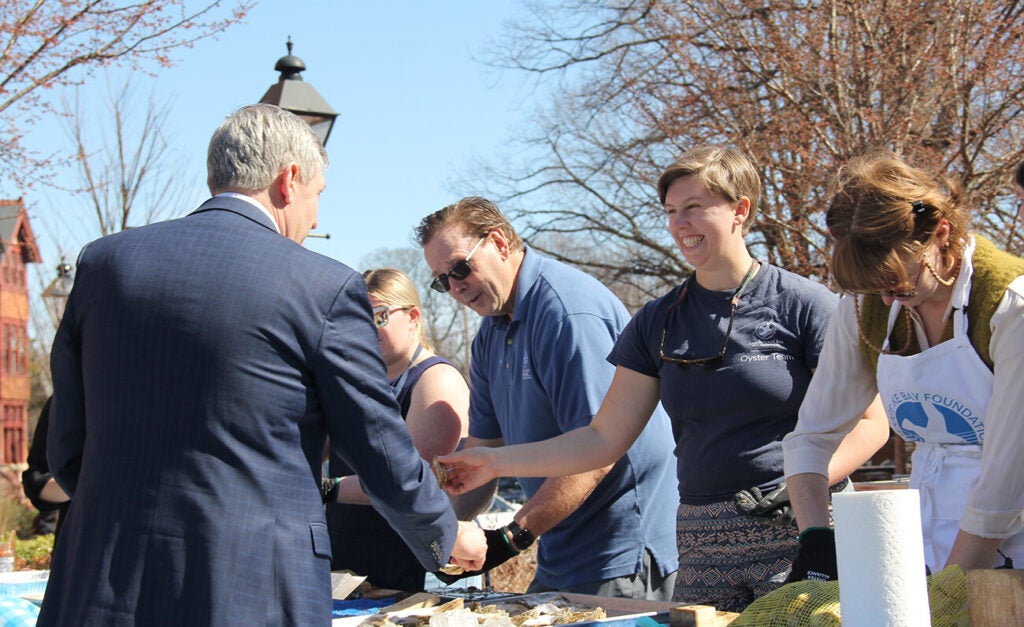
A: Oyster sanctuaries are areas of the Bay where harvesting oysters is prohibited. We keep these reefs protected so they can provide ecosystem services like filtering our waterways, providing habitat for fish and crabs, and supporting recreational and commercial fishing. Protected oyster reefs also produce baby oysters that colonize and build oyster habitat and support harvest outside of sanctuary areas. They are a critical part of our oyster restoration efforts across the Chesapeake Bay.
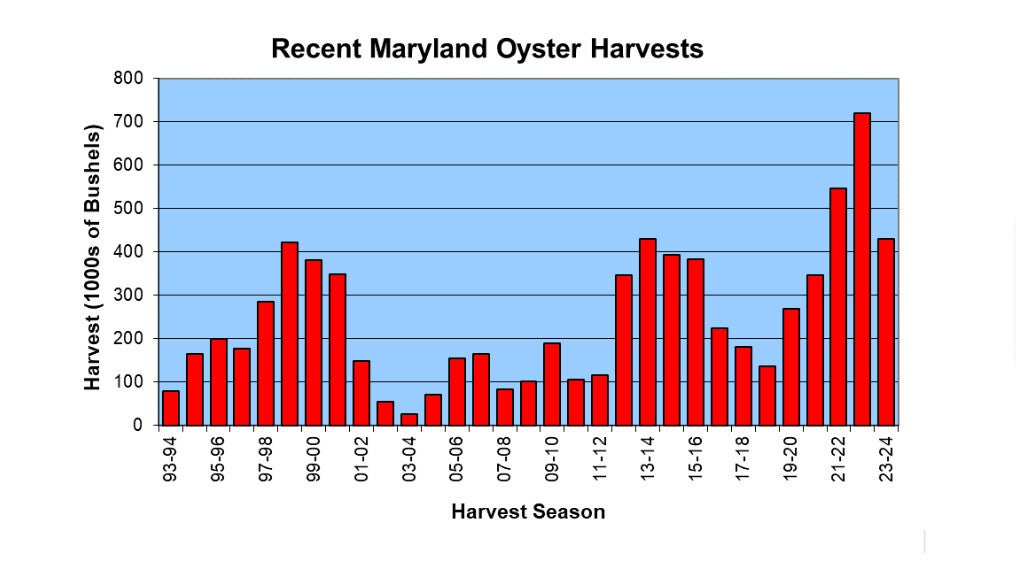
Maryland expanded its oyster sanctuary network in 2010 to help oysters recover from disease, habitat loss, and overfishing. The return on investment has exceeded all expectations. Our state’s oyster population has tripled in the past 20 years, leading to record oyster harvests not seen since the 1980s. But that doesn’t mean restoration is done or that sanctuaries are no longer needed. Oyster populations are still just a fraction of what they were in the 1800s.
 Maryland Department of Natural Resources
Q: What’s the difference between oyster sanctuaries and harvest areas?
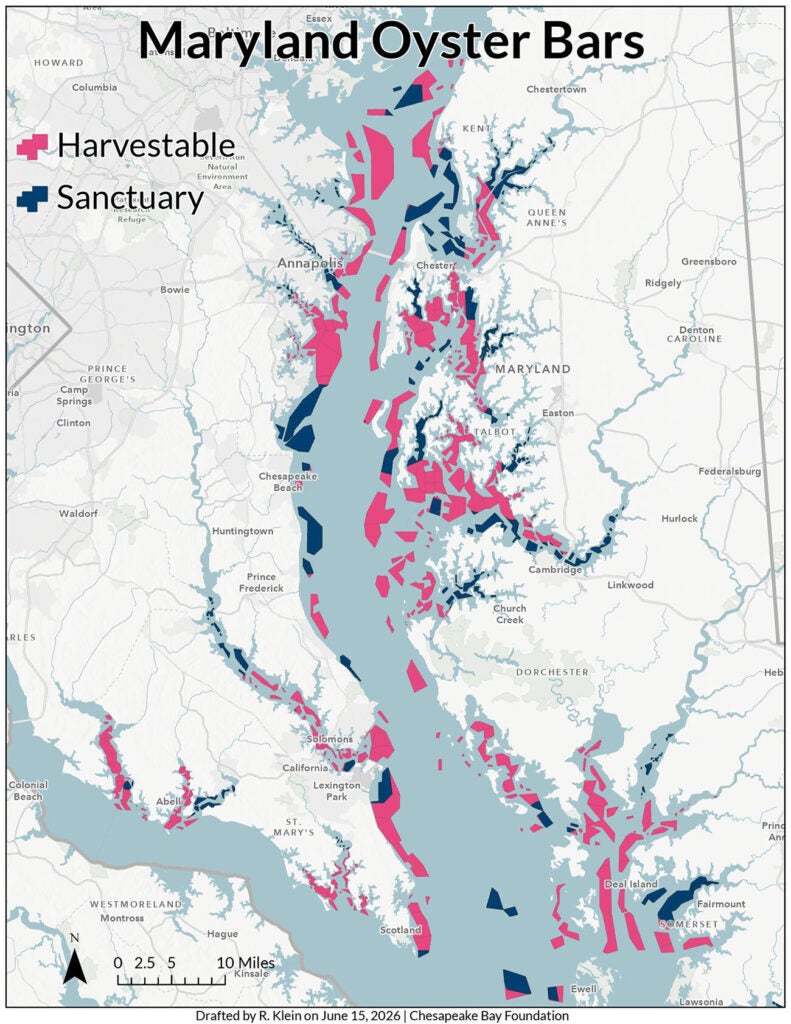
A: Oyster sanctuaries serve a unique purpose in the Bay. Think of them like a protected forest—both conservation areas filter their ecosystem, provide homes for hundreds of wildlife species, and support local communities. Oyster sanctuaries only make up 24 percent of Maryland’s oyster bars. The other 76 percent are open to harvest.
Harvest areas are public oyster bars open for watermen to collect and sell oysters. They do so with dredges, tongs, and other fishing methods. More like a Christmas tree farm, harvest areas still provide ecological benefits, but the trees (and oysters) are removed before these benefits are maximized.
Maryland’s Oyster Management Plan requires 20-30 percent of oyster reefs to remain protected as sanctuaries. This rationale is based on the best available science, which shows that conserving 30 percent of a species’ productive habitat promotes long-term sustainability and resilience. Other global and local conservation efforts, including Maryland’s 30 percent land conservation goal are based on this scientific premise. Protecting a proportion of viable habitat is especially important for species like oysters, who build their own habitat by settling on top of one other.
Harvesting doesn’t just remove the oysters we eat; it also removes critical habitat.
 CBF Staff
Q: Why are oyster sanctuaries currently at risk?
A: In recent months, we’ve seen attacks on oyster sanctuaries across the state and federal levels, including:
- A bill in Maryland’s General Assembly (HB1388) attempted to open five sanctuaries to harvest;
- Maryland’s OAC has been tasked to assess harvest options in underinvested sanctuaries, and;
- the U.S. House’s FY27 Appropriations Bill is attempting to strip National Oceanic and Atmospheric Administration (NOAA) funding for oyster sanctuaries unless they’re opened to harvest.
These efforts are likely in response to recent economic struggles that Bay watermen are facing. While Maryland watermen do need our help, harvesting in oyster sanctuaries is not the answer. We must find other solutions that will both support watermen and protect all the benefits that oyster sanctuaries provide.
Q: Why have watermen been struggling so much?
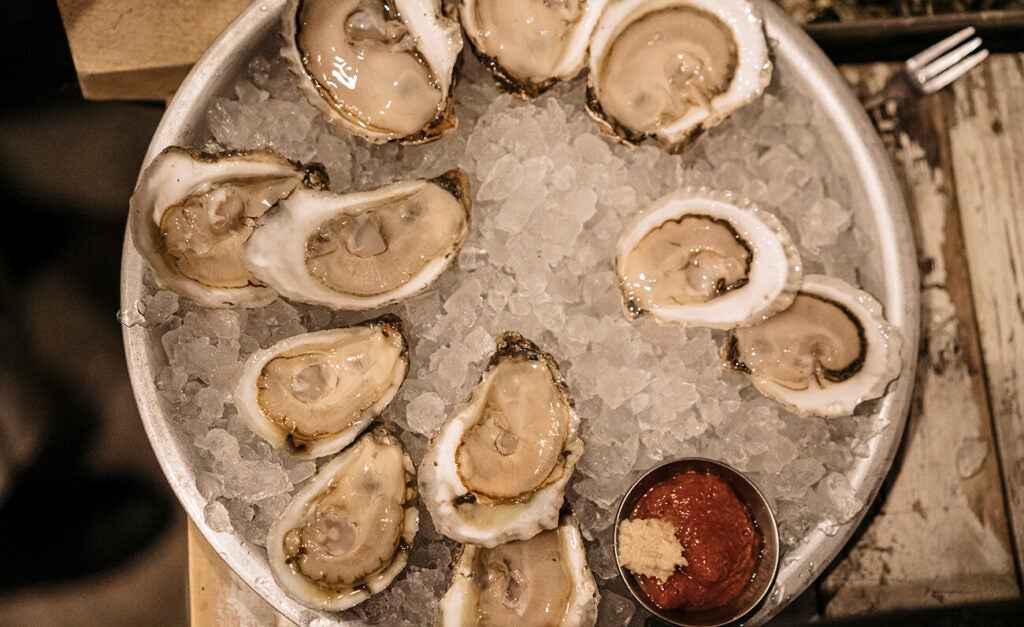
A: Bay watermen have been facing several economic challenges in recent years. We recently saw an influx of oysters from out-of-state fisheries, specifically Gulf states, that have flooded the market. Watermen faced intense winter weather and ice conditions, leading DNR to extend the oyster season by two weeks last year. The industry also suffered from tainted public perception of Bay seafood after the catastrophic Potomac River sewage spill in January. These combined challenges led watermen to request federal disaster relief funding from NOAA, which CBF supported.
 Greg Kahn
Q: Would allowing harvest on sanctuaries help watermen? Would it hurt the sanctuaries?
A: The current challenges that watermen face are not from a lack of oysters in the Bay and will not be solved by increasing supply. Last year, watermen were catching more oysters than they could sell. If we want to help watermen, Maryland should increase marketing and public education to encourage people to buy and eat local seafood.
Multiple studies (most recently, Wade et.al.) show that harvesting oysters, especially via dredging, damages habitat. Harvesting prevents oysters from creating complex reef structures and developing critical disease resistance. Oysters on sanctuary reefs are able to grow extremely large, which means they are able to produce more offspring. They help repopulate not only sanctuaries, but nearby reefs that are open for harvest.
Q: What can people do to help?
A: We want to protect our precious oyster sanctuaries while also helping Maryland watermen who are struggling to sell local oysters.
To meet this goal, we’re encouraging people to call their state and federal representatives and urge them to keep the Bay’s oyster sanctuaries protected from harvest. At the same time, you can support Maryland watermen by buying local oysters! Not only are they good for small businesses and absolutely delicious, but eating oysters and recycling your shells can aid our future oyster restoration efforts in the Bay.
Related Stories
-
 Blog Story
To Save the Chesapeake Bay, Save This Fish
Saving menhaden helps save the bay. Now, evidence of a crisis is impossible to ignore.
-
 Blog Story
Field Notes: Building an Oyster Reef
Over the course of the summer, CBF built an oyster reef as part of a larger project to restore and protect an eroding shoreline along Maryland's South River.
