Menhaden: Better Off, But Still Missing the Mark
Coastal fishery managers just made the outlook for menhaden in the Chesapeake Bay better. But in failing to take stronger conservation action coastwide, did they ultimately fail the fish and the species that depend on them? We make sense of the major decisions made this month.
Menhaden are better off today than they were last week. That’s the simplest way to describe what happened at last week’s Atlantic States Marine Fisheries Commission (ASMFC) 2026 Annual Meeting, where representatives of 15 Atlantic Coast states made big decisions about the future of the small fish that supports much of the coastal food web. But make no mistake: The commission did not go far enough.
On one hand, the commission approved the lowest cap ever on industrial menhaden harvests within the Chesapeake Bay, reducing the current cap by about one-third by 2028. Yet it failed the broader test of protecting enough menhaden coastwide to support other species, deeply undermining its commitment to manage the fish in a way that reflects menhaden’s importance to the larger ecosystem.
It was a complicated meeting with a mixed bag of outcomes, and a lot at stake for both the Chesapeake Bay and the Atlantic Coast (for a refresher, check out this resource on why menhaden are important and our meeting preview blog). Here’s what you should know about how the decisions played out and what they ultimately mean.
Menhaden’s Coastwide Catch Limit Falls Short
The ASMFC began its menhaden deliberations with the thorny issue of setting a catch limit for the entire Atlantic Coast.
Because menhaden are a foundational forage fish—meaning many other species depend on them for food—the ASMFC manages them according to an ecological reference point (ERP). This is designed to scientifically leave enough menhaden in the water to sustain striped bass and other menhaden-dependent predators.
Before the meeting, a technical team of experts determined a 39 percent reduction in the coastwide catch limit was necessary to maintain a reasonable chance of meeting the target for this ecosystem-based management approach.
This was a major test for ASMFC. Last year, when approving the 2026 catch limit, the commission approved just a 20 percent reduction despite science indicating that 54 percent was needed. This decision failed to adequately protect menhaden’s ecological role and undermined the commission’s commitment to ecosystem-based management.
Last week, the ASMFC had an opportunity to correct course and follow the science. Instead, it fell short again.
A majority of the commission’s Menhaden Board balked at serious science-based conservation to support a thriving Atlantic Coast and rejected meaningful catch limit reductions. Instead, they approved 9 percent reductions in each of the next two years that results in a coastwide catch limit of 155,000 metric tons in 2028.
While this is technically a cut, it’s more than what the fishery caught last year. The industry has not been harvesting enough to meet its current limit, which both raises concerns that there is already a serious lack of fish and calls into question whether the new limits will actually keep more fish in the water.
The vote approving the new limits was 11-7. The states of Maryland, Connecticut, New York, Massachusetts, Rhode Island, Florida, and North Carolina stood strong in support of the best available science and the health of the Atlantic Coast ecosystem.
On the other hand, Virginia, Maine, New Jersey, New Hampshire, Delaware, Potomac River Fisheries Commission, South Carolina, Georgia, Pennsylvania, NOAA Fisheries, and the US Fish and Wildlife Service opposed.
But it is shortsighted. Prioritizing short-term economic interests over long-term ecological sustainability is a tale as old as time, with predictable consequences.
Their position disregards a fundamental principle of the ASMFC’s menhaden management framework and one clearly depicted on the Commission’s menhaden webpage: The board will set regulations and catch limits designed to achieve the ERP target, not the threshold level that risks overfishing.
The approved 2027 and 2028 coastwide catch limits have a 99 percent probability of exceeding the level of fishing that would preserve enough menhaden for the ecosystem, according to the ASMFC’s own technical experts. In other words, the ASMFC continues to prioritize harvest over the benchmarks it established to protect the fish and wildlife that depend on menhaden.
This disappointing decision was largely driven by socioeconomic concerns from the industrial reduction fishery—which catches the majority of menhaden coastwide and processes them into products like fish meal and oil—and the need to maintain local bait supplies for New England’s lobster industry.
But it is shortsighted. Prioritizing short-term economic interests over long-term ecological sustainability is a tale as old as time, with predictable consequences. The reason the lobster fishery is increasingly dependent on menhaden for bait, for example, is because Atlantic herring and mackerel populations, their preferred bait species, collapsed—due in large part to shortsighted management decisions that prioritized economics over the health of the resource.
Lowest Harvest Limit Ever Set for Chesapeake Bay
Fortunately, the case for conservation made more progress the next day, when the ASMFC Menhaden Board focused on Chesapeake Bay menhaden management, specifically.
The board was tasked with taking final action on Draft Addendum II, a set of management options that began development a year ago to address concerns stemming from osprey breeding failures and declining harvests among small-scale Bay fishermen who catch menhaden for blue crab bait.
Despite the Virginia Delegation’s best efforts to block stronger protections, there was overwhelming public support for the strongest menhaden conservation options on the table. According to the summary of public comments on Draft Addendum II that ASMFC staff presented, that support included:
- Over 40,000 individual commenters
- Hundreds of conservation organizations
- Dozens of federal and state elected officials, with a phenomenal showing from Maryland officials
The board first considered a motion to set the future Bay Cap—the maximum amount of menhaden the industrial fishery can catch within the Chesapeake Bay—at 13.6 percent of the total coastwide catch. This option would have delivered a more than 50 percent reduction in the industrial menhaden harvest allowed in the Bay and was supported by the overwhelming majority of public comments, as well as CBF.
As expected, Virginia—home of the only remaining industrial fishery on the coast—pushed for a much weaker alternative. Virginia proposed maintaining the status quo proportion of coastwide harvest allocated to the Bay, effectively preserving a high level of industrial fishing pressure in the estuary.
While the Virginia motion was resoundingly rejected by every other state along the Atlantic Coast, the Commonwealth’s opposition to stronger protections continued.
Ultimately, the Board approved a motion setting the Bay Cap at 21.8 percent of the catch allowed coastwide. Combined with the coastwide catch reductions, this will reduce the Bay Cap by roughly one-third by 2028.
The resulting Chesapeake Bay Reduction Fishery Cap limits are:
- 2026 (current): 51,000 metric tons
- 2027: 37,123 metric tons
- 2028: 33,847 metric tons
That vote was 14 yays, 2 nays, and 2 abstentions. Just like their vote to approve Draft Addendum II for public comment back in August, Virginia was the only state to oppose this measure. The Potomac River Fisheries Commission also opposed. Two federal representatives, NOAA Fisheries and the U.S. Fish and Wildlife Service, abstained.
The Board also approved a Bay Cap ceiling of 51,000 metric tons and no floor. So if the coastwide catch limit continues declining, the Bay Cap will also scale smaller, but if the coastwide limit increases, the Bay Cap will not exceed the 51,000-metric-ton ceiling. Unfortunately, the Board did not approve quota period options that would have provided seasonal guardrails to reduce fishing pressure when Chesapeake Bay menhaden-dependent predators need the fish most.
This was undoubtedly a compromise, and not our preferred outcome. But it represents meaningful progress and the lowest limits on industrial menhaden harvests in the Bay since the first Bay Cap was set in 2006. Compared with the disappointing coastwide catch decision the previous day, this was a win.
Making Sense of the Aftermath
Still, it wasn’t enough.
Virginia fundamentally ignored the best available science when it came to arguing against stricter coastwide catch limits. But when it came to setting stricter limits in the Chesapeake Bay, the Commonwealth then urged the Board to wait for more science—asking it to ignore the existing data in favor of a future study whose conclusions are years away.
Virginia’s rationale focused entirely on concerns from the industrial reduction industry that is allowed to harvest 68 percent of all Atlantic menhaden along the coast. For example, we heard the Virginia delegation say that the weather was bad in 2025, which they claimed was why the reduction industry only caught 60 percent of its allotted menhaden and had one of its worst fishing years inside the Chesapeake Bay in recent history. Weather alone does not explain how one of the largest and most efficient fisheries on the Atlantic Coast drastically underperformed. The reduction industry caught 25 percent less menhaden in 2025 than 2024. The weather was not 25 percent worse in 2025.
The simplest explanation is that there were less fish for this highly efficient industrial operation to circle a net around—the same conclusion that declining catches in the small-scale fisheries and failed osprey nests point toward.
CBF believes Virginia has a responsibility to pursue more conservation-minded menhaden management that protects the Chesapeake Bay ecosystem and the communities that depend on this public trust resource.
Stay tuned for CBF’s next steps on Chesapeake Bay menhaden and how you can help.
Related Stories
-
 Blog Story
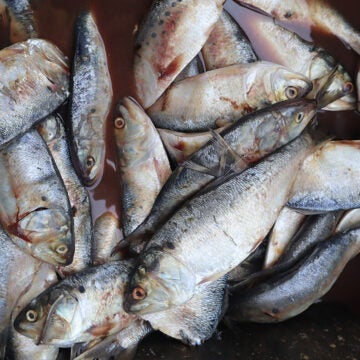
Menhaden Need Maryland’s Help
Anyone who’s been out fishing on the Chesapeake Bay knows that a vital bait fish called menhaden, and their predators, have become harder and harder to find.
-
 Blog Story
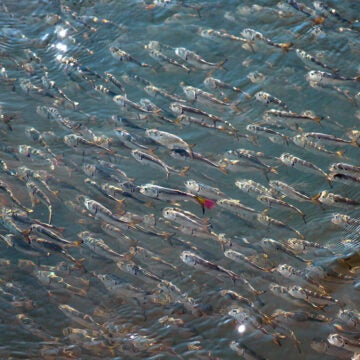
The Big Meeting for a Little Fish: Atlantic States Will Decide on Menhaden
In just a few days, fishery regulators will meet in Newport, Rhode Island, to consider major changes to how they manage menhaden—a critical fish that is foundational to the food web in the Chesapeake Bay and along the entire Atlantic Coast.
