Is the Chesapeake Bay Blue Crab Population Still Crashing?
No, but there is much more to the story. Blue crab numbers are up from last year, but the population still shows a concerning long-term decline.
A year after blue crabs in the Chesapeake Bay seemed headed for a full-on emergency, reassuring news came out this past May. Crabs are up 46 percent!
A month later, some less-reassuring news followed. The population of blue crabs in the Bay is half what it was a decade ago.
So, which is it? Are crabs doing great, or should we still worry? Like most things Bay-related, retired CBF Senior Naturalist John Page Williams was spot-on when he said, “if you want a simple answer, you’ve come to the wrong estuary.”
The simplest might be this: Blue crabs in the Bay are enjoying a moment in the sun, but there are still a lot of clouds in the sky, and no one really knows why. For the less-simple version, read on.
Annual Winter Dredge Survey: What Did It Find?
Maryland and Virginia estimate the number of blue crabs living in the Chesapeake Bay every year through the Winter Dredge Survey, a scientific survey the states have conducted since 1990. This year, the survey estimated 349 million blue crabs are in the Bay—a 46 percent increase over last year.
Specifically, the survey found that the number of young blue crabs more than doubled, while the number of male crabs increased 43 percent. Unfortunately, it found female crabs declined by 25 percent.
There are a few key points to take away from those numbers:
- The increase in young crabs is especially good news because they had been historically low for five years in a row. This year they edged back above the long-term average.
- The increase in the total population (males, females, and young crabs) is also good news. But it’s a little less exciting because this year’s numbers are still below the long-term average, which hovers just around 400 million crabs.
- The decline in female crabs is especially concerning. This is the third year their numbers dropped, getting unnervingly close to a “threshold” fishery managers established to indicate how many females are needed to maintain a healthy population. Falling below that threshold could indicate rougher times ahead for blue crabs overall.
Long-Term Crab Trends: What Do They Tell Us?
The annual dredge survey is a wonderful long-term resource, but it is only a momentary snapshot of the health of the crab population. Crab numbers can swing widely from year to year due to weather and changes in the amount of food, shelter, and predators they encounter in the Bay. Crabs are also short-lived, meaning one bad year can cause big drops in the population, and one good year can do the opposite.
Long-term trends provide a fuller picture.
This year, the Chesapeake Bay Program completed a more comprehensive review of the population overall. This ‘stock assessment’ took into account more than 20 years of data, including from the annual dredge survey as well as other scientific studies, computer models, and harvest data reported by commercial watermen and seafood dealers.
Its main takeaways on population show long-term decline:
- Overall, the population of male and female crabs in 2023 (the latest date it covered) was half what it was in 2011.
- Despite a lot of variability, the number of young blue crabs surviving and joining the population each year declined over time, with the years 1998-2007 and 2017-2023 having especially low numbers.
The trends are particularly disappointing because, for a short time after new fishery regulations began protecting more female crabs in 2008, the population seemed to be on a positive trajectory. The new stock assessment points in another direction, suggesting that a wide variety of factors are still putting immense stress on blue crabs in the Chesapeake Bay.
Why Are Blue Crabs Struggling?
This is the million-dollar question (or, by the dockside value of the Bay’s blue crab fishery, an $80 million question).
When we wrote about the topic last year, we outlined multiple theories scientists have about what’s keeping crab numbers lower. The stock assessment shed more light on many of them, but not all:
More predators
The presence of invasive blue catfish, which can eat young crabs, was one potential culprit for the lower numbers. The assessment concluded that catfish likely do impact blue crab numbers, but only modestly—it estimated just 8 percent fewer crabs reached adulthood due to predation by blue catfish. That being said, it also found the impact has been growing over time, so controlling catfish remains a priority. The study didn’t look at the potential impact of other predators, like warm-water fish that might be moving into the Bay due to climate change.
Pollution
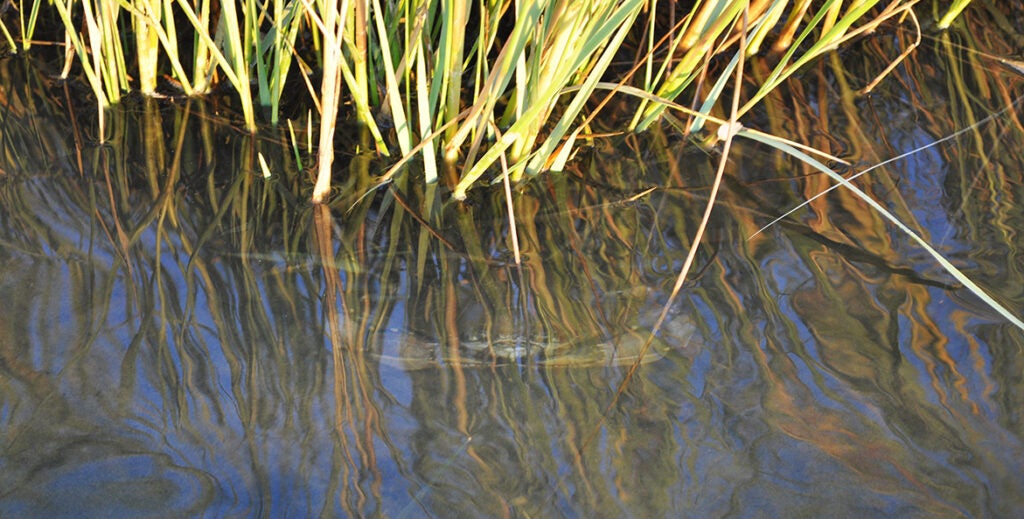
Pollution creates areas of water in the Bay with low—or sometimes no—oxygen. These ‘dead zones’ can affect how crabs move around the Bay, potentially pushing them into areas where they are more vulnerable to predators and fishing. With the data at hand, the assessment could not find a clear connection between the extent of dead zones and the number of crabs in a given year. It doesn’t mean there isn’t one, but it’s not a smoking gun for the population declines, either.
 Lori Rossbach
Changing habitat
Pollution and development could also be affecting the places in the Bay where blue crabs find food and shelter. For example, the extent of underwater grasses varies from year to year, and some types of grasses are vulnerable to rising water temperatures and heat waves. Salt marshes are also at risk as development replaces natural shorelines with hardened barriers. The assessment did not look at changes in habitat over time, so the potential effect of changing habitat on blue crab trends remains an open question.
Changing conditions in the ocean
Similarly, the assessment did not analyze the possible role of changing ocean currents or other conditions that could affect blue crabs during their first month of life, when they’re adrift in the ocean as larvae. The theory is that changes in the ocean could affect how many blue crabs make it back into the Bay. Other studies are still looking into this question.
What’s Needed to Help Blue Crabs
In sum, it’s really not clear why blue crabs are experiencing long-term decline. While it’d be nice to view this year as a turning point (and with blue crabs, never say never), it could just be a breather.
What is clear is that the population is under immense stress.
The assessment called for more research into several key areas, including a better understanding of the dynamics governing how many young blue crabs make it to adulthood, the effects of marine heatwaves and climate change, and the impact of recreational harvest.
In the meantime, blue crabs still need help. CBF is prioritizing three areas of focus:
- Pollution prevention. Reducing sewage pollution and polluted runoff from cities and towns, new development, and farms remains essential for improving the health of the Bay’s water and giving crabs a better chance at survival.
- Habitat restoration. Helping underwater grasses (which also benefit from less pollution), marshes, and oysters will help crabs have abundant food sources and places to shelter from predators. Policies that protect these areas, as well as hands-on restoration projects like building live shorelines and oyster reefs, can all help.
- Controlling blue catfish. Laws and regulations that make it easier for watermen to catch, process, and sell blue catfish can help control their numbers, keeping their impact on crabs from getting worse. Recreational anglers can target blue catfish, and buying Chesapeake blue catfish at restaurants and grocery stores can also help.
Related Stories
-
 Blog Story
To Save the Chesapeake Bay, Save This Fish
Saving menhaden helps save the bay. Now, evidence of a crisis is impossible to ignore.
-
 Blog Story
Field Notes: Building an Oyster Reef
Over the course of the summer, CBF built an oyster reef as part of a larger project to restore and protect an eroding shoreline along Maryland's South River.
