Like Mother, Like Daughter
Montgomery County teacher Karen Earp eagerly signed up for one of CBF’s Chesapeake Classrooms courses this past summer. The immersive professional courses are designed to give teachers the skills, knowledge, and confidence to create meaningful outdoor learning experiences for their students. But although Earp is a longtime CBF education participant, this year was bound to be different.
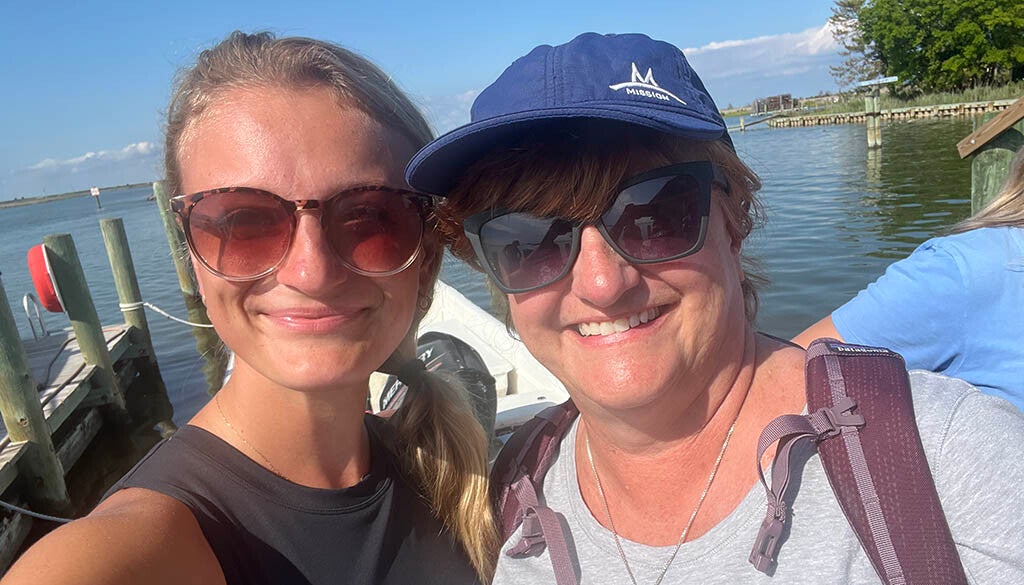
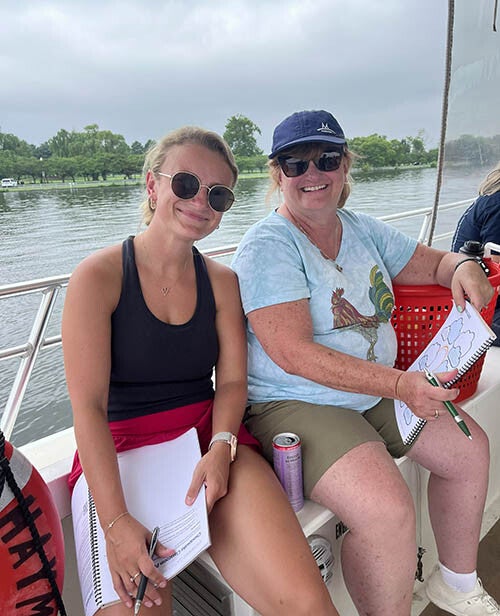
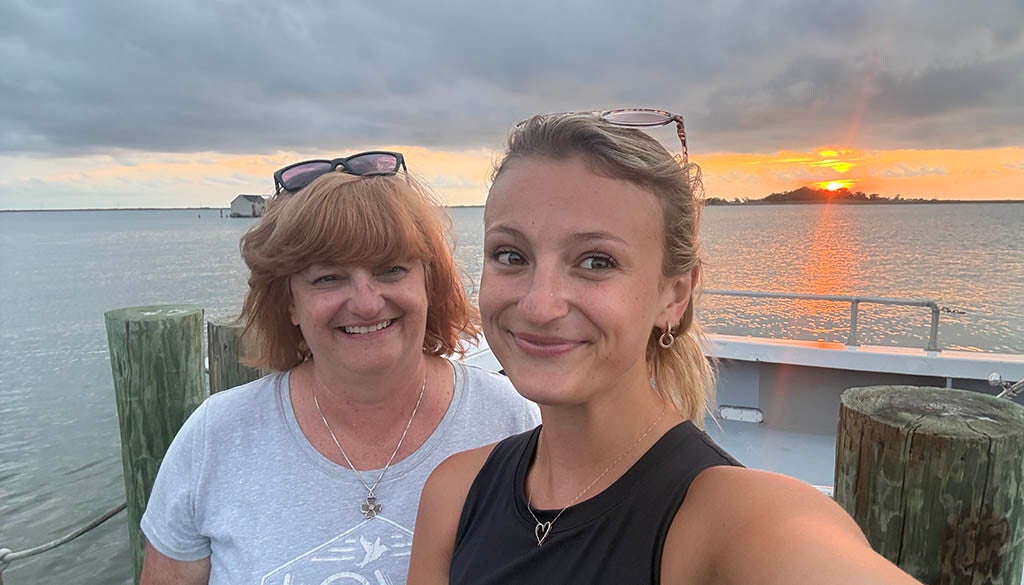
Nearly 30 years earlier, she traveled to Smith Island with a CBF program only weeks after learning she was pregnant. Now her daughter Kailee John, a teacher herself, was joining her mom for her very first teacher training on the Bay. Over five days, the mother-daughter duo performed a stream survey at the Kingsley Environmental Education Center, studied freshwater mussels on the Potomac River, and surveyed biodiversity in the Tangier Sound. After, I talked with them about their experience, what it meant to share it, and what they hope to take back to their classrooms.
 Kailee John
Kathlean Davis: Hello Kailee and Karen! You both signed up for the Chesapeake Classrooms course Montgomery County: Thinking Like a Watershed. What initially interested you in the program?
Karen Earp:
A long time ago I was invited by our science liaison for a weekend retreat to go to Tangier Island. And it was such an amazing experience that when it was offered the next school year for credit, I took it for credit. And then within a couple of years after that, there was a new course offered. So, I took it again and got to go to Smith Island.
When Kailee decided to be a teacher and even did her undergraduate in environmental education, as soon as she was hired with MCPS [Montgomery County Public Schools], I was like, “We have to do one of these CBF classes together!”
When I realized it was Smith, I thought, oh, that’s just full circle because when I did it the original time, I had found out two weeks earlier that I was pregnant with her. So, it was a neat experience to think, “Ah! Coming back with her. And I brought her the first time! She was just this big [holding finger and thumb an inch apart].”
Kailee John:
Obviously [my mom] is very into the environment. So, growing up, I did a lot of stuff with her. She has an environmental club at her school and would teach science for the 4th and 5th graders. So, I did a lot of stream studies and things like that with her and Bay trips to Breezy Point. When I was little, I would go and just kind of participate. And then as I got older, I would kind of help out. And then when I was in high school, I went to school in Carroll County. I was a counselor at outdoor school twice and I loved it.
Like she said, as soon as I was hired by MCPS, she started asking when we could do the [CBF] trips.
 Kris Belessis/CBF Staff
Kailee, did you have an image in your mind of what this course was going to be like?
Kailee John:
[My mom] talked about it even when I was younger—that they went kayaking and seeing the skates in the water, going to the marsh, things like that…Some of the things were a little different. She got to see when they had the co-op of the women that did the crab picking, but they don’t do that anymore.
Karen Earp:
The very first time I went to Tangier, [the CBF staff] got us up at, I don’t know, three or four in the morning to watch “Tangier Rush Hour” and it was just boat after boat after boat going out for crabbing. So then when we were asking at Smith this time, ‘How many people are still working the water?’ it was shocking to me that it was only a few families left on Smith that are still working the water. That was kind of a surprise to me, to see that difference between my first visit there and this visit there.
 Kailee John
What was it like to be there together?
Karen Earp:
Being able to experience that with her—something that I know that she would enjoy, that she would be able to bring back to her classroom—it was an amazing experience to be able to do it together. And just being able to see all of the things that I’ve been able to do before on the trips, and have her experience those through fresh eyes, was a great time.
Kailee John:
It was cool to finally see it after hearing about it so much, and just being able to share that experience with her. Because my environmentalism definitely comes from [my mom].
What was the most memorable moment?
Kailee John:
I really enjoyed getting to do the crab pots. Getting to set them up and hearing about their traditions and how they do it, and then getting to set them and then collect them—I thought it was really cool.
Karen Earp:
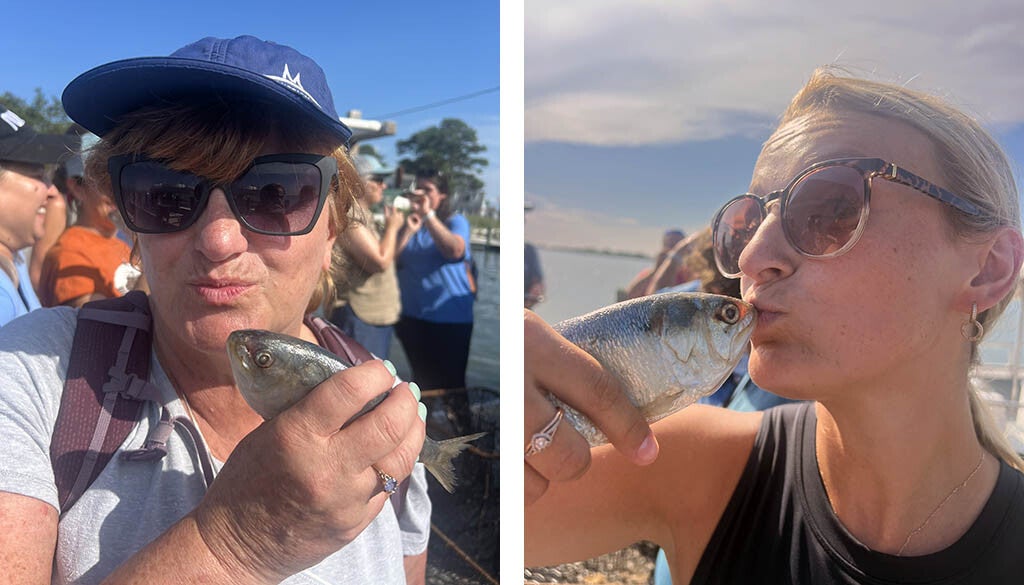
We kissed our menhaden.
Kailee John:
I…
Karen Earp:
Well…[laughing] I got close to the menhaden. She actually made contact. A lot of those experiences I had done, but it was really cool when we did the scraping because we caught a puffer fish. I didn’t know that they lived in the Chesapeake. So that was a really neat find. We caught a terrapin there, as well.
 Kailee John
[Grass] scraping is always the “I spy book” of the experience…seeing things you didn’t expect to see. So, learning outside is important for both of you. What is the takeaway that you want to bring back to students?
Kailee John:
For me, I’m a third grade teacher in Gaithersburg, and a lot of those students don’t spend as much time outside or don’t get some of those experiences. So, my biggest thing with them is just taking them outside, even if it’s not doing environmental education.
My room connects to a courtyard, so a lot of the time I’ll take them out there and we’ll read or play a game or we’ll do our math lesson, just to be outside. We do have a stream behind our school, but it’s behind apartments, so I need to survey it and make sure that it would be okay for me to bring kids back there and make sure there’s a path. If it is, I’m hoping to get it cleaned up and useable to be able to teach out there. That’s the hope.
Karen Earp:
I teach special ed and the last few years, I am pretty much supporting reading and math. So, any opportunity I get to dip my toe into science is exciting for me.
We do have a stream that’s right in my school’s front yard, but through the woods. I took a group of students there, this was pre-Covid, and we were probably three feet into the woods, barely off the street that my school is on, and one of the students said, “I’ve never been in the jungle before.” That was just so telling, how little these kids are getting outside.
So, I would like to be able to access that stream. I’d like to work with our 5th grade teachers and see if we can’t get down there and see that. Particularly, that stream is right across from a gas station. So, it’s not a very pristine stream at all. This one definitely has issues that are very evident right from the start, but that might be eye-opening to them and kind of lead them to be more stewards of the environment if they can see the damage.
The work you do is so important. The fact that CBF can be a small part of the inspiration getting you all outside—giving you a space outside to think and practice and figure out how you want to bring your students outside—It’s really meaningful to hear these stories on the other side of it and to see you in your classroom.
Karen Earp:
I have to say every experience I’ve had with CBF—whether it was through the teacher training or those years doing the [student field program] trips on the Stanley Norman out of Annapolis—every single one is just an incredible opportunity. So, I feel very fortunate that I’ve had those experiences with CBF.
Kathlean Davis: We’re glad to have shared them with you.
CBF’s Student Field Program application for the spring 2027 season opens on Friday, October 16. Learn more and join CBF Education outside this spring with your students. Or join CBF Education for a Chesapeake Classrooms course next summer (2027 courses will be posted early next year).
Related Stories
-
 Blog Story
Our Bay, the Perfect Classroom
As Virginia teacher Tonya Humphrey knows first-hand, environmental education is critically important to her students and their futures
-
 Blog Story
The Karen Noonan Center, 30 Years Strong
A victim of the Pan Am Flight 103 terrorist bombing over Lockerbie, 20-year-old Karen Noonan was a college student devoted to education and the outdoors. For more than 30 years, her legacy has lived on through this CBF education program.
