More Than Rain: A Closer Look at Stormwater Pollution
Pollution from stormwater—the rain and snow that wash off streets, buildings, and lawns—is a stubborn problem in the Chesapeake Bay region. In some places, it is still growing.
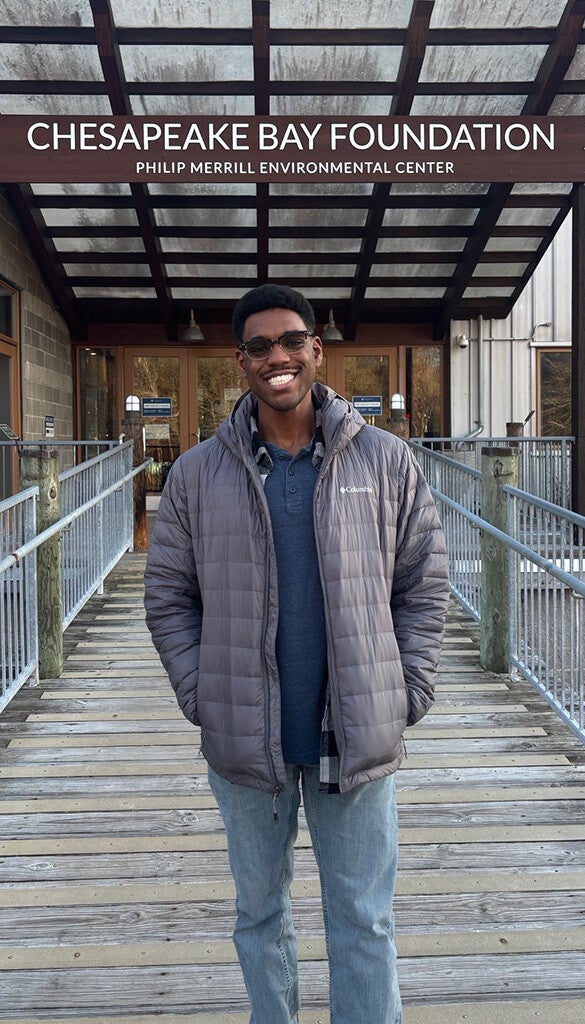
Diandré Richie, the Dr. Beth McGee Science Fellow at CBF in 2025-2026, spent the past nine months researching how stormwater is managed and regulated in the Chesapeake Bay region, and whether or not those approaches are prepared to deal with growing pressures like climate change and more development in the region. We asked him to talk about some of the big takeaways from what he’s learned over his many months of research.
Note: This conversation has been edited for length and clarity.
Q: At a high-level, what were you trying to find out with this research?
A: Stormwater itself is such a big web. There are so many different sections to this issue, from environmental issues with pollution to issues with urban planning to the social aspect of communities facing increased flooding. I was trying to get through the weeds on all of that and find out, between Virginia, Maryland, and Pennsylvania, how do each of the states deal with stormwater? Where are the gaps, particularly when it comes to resiliency? And what are some of the things CBF could do to go farther with stormwater advocacy?
Q: Why stormwater, why now, and why look at it through the lens of resiliency?
A: People think of stormwater as just rainwater that we see every day. But there’s more to it than that. There are communities that are very affected by things like flooding because they are not able to get this water out. And the amount of pollution that goes into the Bay from stormwater is a big problem.
When we’re talking about the future of stormwater, I think resiliency is going to be a big pillar because as the states are implementing these practices [to reduce stormwater pollution] and building new infrastructure, there has to be some way to make sure that years later they are still functioning the way that we want them to function and doing what we want them to do. So even though states are making progress, there are still big gaps when it comes to implementation, maintenance of infrastructure, and then the political landscape that creates nuances between communities.
Q: How are the states currently dealing with stormwater, and how are their approaches different?
A: The main difference is really how they implement best management practices [that are designed to reduce pollution]. Virginia for example is looking a lot at resiliency and dealing with a lot of aging legacy infrastructure where those systems are getting overwhelmed. So, they’re trying more so to update those and make retrofits. In Maryland there is a very high focus on practices that restore impervious area—things like pavements, rooftops, roads, and other surfaces that prevent rainwater from being absorbed. So, a practice that helps restore that might be something like a rain garden that lets the water naturally go back into the ground so it’s not picking up pollution. In Pennsylvania a lot of focus has been on reducing sediment.
If we’re only looking at our current conditions, it’s only a matter of time before what you thought was working isn’t working, or isn’t working at its best.
Diandré Richie, Dr. Beth McGee Science Fellow
Q: Are they making progress?
A: It depends on how you’re looking at it. Yes, there has been progress in that over time there has been more attention on stormwater through [regulatory] sections in the Clean Water Act, and in the Chesapeake Bay area the Total Maximum Daily Load (TMDL) that sets limits on pollution to the Bay. And each of the three states is trying to implement things that reach those. But there is still a lot of progress that can be made, and in some cases pollution from stormwater is actually increasing as more places are developed. None of the three states are completely meeting their goals, and the biggest gap is still on nitrogen pollution. And there are still big gaps between jurisdictions on a smaller scale, down to the county, city level. When it comes to implementation, maintenance of infrastructure, and the capacity and funding to do some of these things, there are all of these little nuances between communities.
Q: Stormwater, as you mentioned, is a tricky problem to begin with. How does climate change play into it, again getting back to the idea of resiliency?
A: The biggest challenge with climate change is that we’re seeing more frequent and harder storms. When communities have legacy infrastructure that is designed for lesser storms or precipitation, and then they get hit with these more major storms, they aren’t able to keep up with the influx of water coming in. And at the same time, we’re having more development that increases these impervious surfaces—like pavement—that don’t allow that water to soak into the ground and collects all this pollution that is then going into the Bay. The system isn’t set up to keep up with all of that.
I spoke with Trisha Salvia [CBF’s Pennsylvania Staff Attorney], about how some of the communities they are working with up in Pennsylvania are doing everything right—they’re putting in best management practices, they are maintaining them, they are doing what they’re supposed to be doing. But they aren’t seeing the outcome they want. So, what’s missing? I think that’s where resiliency comes in. If we’re only looking at our current conditions, it’s only a matter of time before what you thought was working isn’t working, or isn’t working at its best.
Q: So, what needs to shift going forward, if the states could really focus on one thing?
A: I really do think we’re entering a new ‘resiliency’ era of stormwater management. A lot more people are starting to think that way, and there is new data coming out all of the time. How do we better incorporate that into a forward-looking view? Virginia is starting to really focus on this and create a better framework that includes more green infrastructure, things like restoring wetlands. I don’t think the states need to totally reinvent the wheel. A lot of places across the country are doing green infrastructure, so it’s collaborating and learning from each other and really trying to find how do we better implement these, not just check a box.
That’s important for new development, but also for dealing with legacy development and how we upgrade it. Part of that comes down to funding, because there are some big funding gaps. But it’s also a maintenance issue. Many of those legacy practices underperform because there is no maintenance—it’s kind of like check a box, we did it, it’s there. Instead we should be checking back in on the real-world outcome. Is it still doing what we want it to do?
Related Stories
-
 Blog Story
Pennsylvania Should Stand up for Stormwater
Pennsylvania has long rallied communities to protect our rivers and streams, which is why the President’s recent executive order aimed at reversing clean water protections is so hard to understand.
-
 Blog Story
The Higher Stakes of a Summer Storm
It was July 30, 2016, when Howard County, Maryland got hit with over six inches of rain in less than two hours. Intense flash flooding followed, decimating the historic streets of Ellicott City, destroying buildings and businesses, and tragically taking two lives.
