Oyster Advocates Fight for Better Aquaculture Lease Process
Legislative efforts are underway to reduce approval time for oyster aquaculture lease applications and provide incentives to aquaculture businesses that improve Maryland’s environment and economy
It was 8 a.m. in Annapolis and two dozen oyster advocates—some of whom had traveled hours from far-flung parts of Maryland—were just beginning their day in a nondescript conference room in a church a block away from the Maryland State House.
They were there to deal with an issue that had long plagued the state’s oyster aquaculture industry: The arduous process business owners must navigate to get approved for leases to raise oysters in the Bay and elsewhere in Maryland. The leases allow aquaculture operators to plant and raise oysters in areas of the Bay and its tributaries after they’re approved by the Department of Natural Resources (DNR).
“Any aquaculture operator in this room can tell you a horror story about trying to get a lease,” said Allison Colden, CBF’s Maryland Senior Fisheries Scientist, to the group. Colden worked with the Chesapeake Oyster Alliance to convene the delegation of environmental advocates, aquaculture operators, and scientists to support important aquaculture bills being considered in the General Assembly this year. The Chesapeake Oyster Alliance is working toward a goal of adding 10 billion oysters into the Bay by 2025. Expanding oyster aquaculture will help the organization reach that goal.
Why We Need Oyster Aquaculture Bills
One aquaculture bill proposed this legislative session—SB 437/HB 1262—addresses the leasing issue. The bill would require DNR to approve lease applications within six months after review and identify Bay bottom adjacent to state-owned waterfront land with potential for new aquaculture leases.
Another bill—SB 434/HB 1254—would establish a pilot program to evaluate whether aquaculture operators could receive state funds for maintaining their leases in a way that benefits the overall ecosystem. The bill seeks to recognize and incentivize aquaculture practices that bring back habitat and water filtration benefits where wild oyster populations have been lost. The bill complements existing programs to credit oyster growers for the removal of excess nutrients from the Bay.
After the morning meeting, oyster advocates spread out across the State House grounds to discuss the bills and their benefits with legislators.
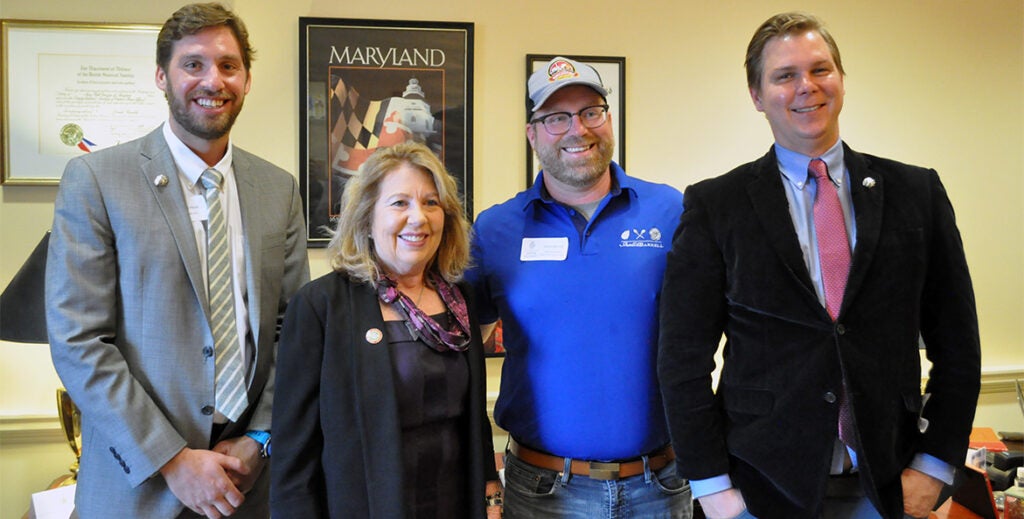 A.J. Metcalf/CBF Staff
Among them were Dan Worrell, owner of Fallen Pine Oyster Co. in Worcester County on Maryland’s Eastern Shore; Matt Pluta, Director of Riverkeeper Programs at ShoreRivers; and Tanner Council, who manages the Chesapeake Oyster Alliance. They met with Sen. Mary Beth Carozza, who represents counties on Maryland’s lower Eastern Shore.
In Sen. Carozza’s district, there were 11 leases waiting for approval that would bring new aquaculture operations to 146 acres of the Bay, Pluta said. Worrell explained how it took him more than six months just to have an already approved lease transferred to him by the previous owner due to agency delays.
“We can’t make quick business decisions due to months of delay for regulatory approvals,” Worrell said. He added that he moved to Worcester County from Baltimore to start his business and is now hiring Salisbury University students to help him with labor. He explained that reducing regulatory red tape around oyster aquaculture would allow new businesses into the market and likely expand the infrastructure for existing ones by bolstering oyster transportation networks, marketing, and industry technology.
Related Stories
-
 Blog Story
“My Voice Was Really Heard”
Advocating for strong environmental legislation is an important part of protecting water quality and saving the Bay. Maryland student leaders took time to talk to their local legislators and encourage them to vote favorably on some of this year’s key environmental bills.
-
 Blog Story
Knocking on Virginia Lawmakers’ Doors
Clean Water Lobby Day in Virginia returns with new faces of a younger generation of Bay stewards fighting for living shorelines, trees, wetlands, and so much more...
