Press Statement
Governor’s Announcement Raises Environmental, Public Health, and Legal Concerns
Virginia Governor Glenn Youngkin today announced his intention to unilaterally withdraw the state from standards requiring a cleaner fleet of vehicles on the Commonwealth’s streets, raising environmental, health, and legal concerns.
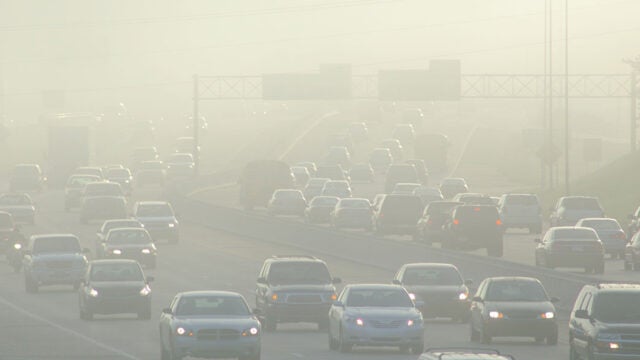
Tailpipe emissions remain a significant driver of water quality pollution, detrimental effects to Virginians’ health, and climate change impacts. Youngkin’s decision undermines Chesapeake Bay restoration efforts, removing a critical tool at a pivotal time in the fight to repair and restore waterways that Virginians depend on for economic, recreational, and health reasons.
Roughly one-third of the nitrogen pollution in the Bay comes from the air, much of it from power plants and vehicle tailpipe exhaust. This airborne nitrogen can fall directly into the water or wash from the land into nearby streams. Pollution from cars is especially damaging to local rivers and streams because it is more likely to deposit in the surrounding area.
Personal vehicles are a major driver of climate change impacts. Tailpipe emissions account for 70 percent of the carbon pollution from the transportation sector, leading to increased flooding and extreme heat, driving up utility bills, and damaging homes and businesses.
This action will also negatively impact Virginians’ health, disproportionately harming low-income communities and communities of color. According to the American Lung Association, widespread transition to electric vehicles could save Virginians $29.7 billion in healthcare costs, prevent 2,700 premature deaths, and avoid 70,900 asthma attacks.
Virginia was one of a number of Bay states that followed or planned to adopt the Clean Cars program, including standards for emissions of greenhouse gases (GHG) and zero-emission vehicle (ZEV) sales. Legislation passed in 2021 directs Virginia’s Air Pollution Control Board to adopt the clean car standards and subsequent updates to the program. The move required a gradual shift to electric vehicles.
Chesapeake Bay Foundation Virginia Staff Attorney Patrick Fanning issued the following statement:
“Virginia chose to adopt more protective vehicle standards because the Commonwealth chose to be a leader in the fight against transportation emissions that damage Virginians’ health, pollute critical waterways, and contribute to climate change. Virginia was one of multiple Bay states that opted into these standards, recognizing their essential benefit in the shared goal of restoring the Chesapeake Bay and building healthier and more sustainable communities. Governor Youngkin’s decision sends the state in the wrong direction when it has never been more urgent to address this major driver of environmental and health problems in the Commonwealth.”
“The impacts of climate change to communities in the Bay watershed are not going away. In just this past year, we’ve seen multiple floods and more frequent, intense storms damage homes and businesses. Families are increasingly burdened by hospital bills. Tailpipe emissions remain a significant contributor to these detrimental impacts. Communities are calling for greater protection, not removal of an important shield in the fight against climate change, environmental degradation, and rising health care costs.”
“The Governor’s action relies on an Attorney General’s Opinion that misinterprets the law and undermines the clear intent of the General Assembly to require the Air Pollution Control Board to not only adopt clean car standards but also to periodically update them to ensure continued progress toward transitioning Virginia to a cleaner vehicle fleet.”
Today, the Chesapeake Bay Foundation (CBF) was honored to be present as Maryland Governor Wes Moore announced a new Executive Order to demonstrate effective implementation of Maryland’s Climate Pollution Reduction Plan through the leadership of state government. The plan aims to reduce the state’s greenhouse gas emissions while also focusing on public health, environmental justice, and local green jobs.
As part of Gov. Moore’s Executive Order, all state agencies will now have to submit a climate action plan and report progress to the Maryland Department of the Environment (MDE) annually. The order will also establish a Climate Sub-Cabinet and roll out new building performance standards.
These actions will be instrumental in improving air and water quality, righting historical injustices, and improving the health of the Chesapeake Bay.
Allison Colden, the Chesapeake Bay Foundation’s Maryland Executive Director, issued the following statement:
“Maryland communities are on the frontlines of the climate crisis. By reducing greenhouse gas emissions, improving green infrastructure, and prioritizing communities, our state agencies can lead by example on how climate change action can be done effectively.
“Prioritizing natural infrastructure like forests and marshes that draw down and store carbon can also improve habitat and water quality, leading to a healthier Chesapeake Bay. We commend Gov. Moore for this Executive Order that will directly benefit public health, environmental justice, and Bay health.”
Chesapeake Bay Foundation Supports Tribe’s Vision for Conservation & Education
The Suffolk City Council voted 7-1 Wednesday to transfer a 71-acre site to the Nansemond Indian Nation, ending a decades-long effort to regain what is considered the Tribe’s cultural heart.
The site known as Mattanock Town never left the spirits of the Nansemond Indian Nation even after centuries of displacement that date back to the arrival of colonists in the 1600s, according to the Tribe. The Tribe’s name means “Fishing Point,” which comes from the Coastal Algonquian language spoken by their ancestors, who lived in settlements along the Nansemond River for thousands of years.
In 2018, after receiving federal recognition, the Tribe presented a renewed vision to Suffolk City Council to restore the land through conservation and education. The Nansemond Indian Nation has focused efforts to heal and deepen their physical connection to their ancestral riverfront land through a variety of projects including oyster gardening, community events, and tree plantings.
Earlier this year, the first tree planting in Mattanock Town took place. On March 1, the Tribe, volunteers, and representatives from the Department of Forestry and the Chesapeake Bay Foundation planted dozens of native trees along the Nansemond River. This kicked off a multi-day project where a total of 450 native trees are expected to be planted.
For more information on the Nansemond Indian Nation and their vision for cultural revitalization through river stewardship, check out the Tribe’s story map, Indigenous Life On The Nansemond River. The public is encouraged to visit the site in August for the Tribe’s annual Powwow.
Chesapeake Bay Foundation Hampton Roads Director Christy Everett issued the following statement:
“This is an incredibly exciting time for the Nansemond Indian Nation, an exceptional steward of Mattanock Town. We applaud the Suffolk City Council’s return of the native land of the Nansemond Indian Nation to the Tribe, a critical member of our community. The Tribe and so many partners have worked hard for years to restore the heavily damaged site, and we look forward to continue to work with the Tribe to make their conservation vision a reality.”
Nansemond Indian Nation Chief Keith Anderson issued the following statement:
“The sacred land where our ancestors once thrived has finally returned back to us. We celebrate this day and look forward to continue conserving and deepening our physical and spiritual connection to the land.”
General Assembly Budget Does Not Reinstate Virginia in Regional Greenhouse Gas Initiative
Virginia state lawmakers proposed investments in key clean water and conservation programs in a budget agreement with Gov. Glenn Youngkin unveiled on Saturday, May. 11.
The budget proposed support for resilience efforts, flood protection, conserving the state’s disappearing trees, continued investments in beloved species like oysters, and reducing pollution to critical waterways.
But the agreement does not include a provision that would have reinstated Virginia’s participation in the Regional Greenhouse Gas Initiative, which ended in 2023 after two years in the program.
The budget announcement comes as Virginia and other states are expected to miss many of the 2025 deadlines for Chesapeake Bay restoration goals. Legislators are expected to vote on the budget agreement during a special session on Monday, May 13. Then it must be signed by Gov. Youngkin to become law.
Lawmakers proposed the following levels of investment over the two-year budget period:
Pollution Reduction
- Building off last year’s historic investment in farmers, legislators recommended fully funding the Virginia agricultural cost-share program at $231 million. Practices like fencing cattle out of streams and planting streamside trees are among the most cost-effective steps Virginia can take to restore the Chesapeake Bay and improve water quality.
- Legislators also supported a $20 million investment for a pilot Pay for Outcomes Program, where pollution reduction projects with verified, successful results are compensated.
- Legislators recommended $400 million in bond funding for upgrades at wastewater treatment plants, which are essential to continuing progress in reducing nitrogen, phosphorus, and sediment pollution.
Tree Conservation
- With the state losing tree canopy at an alarming rate, the budget includes $1.16 million in funding to study the Commonwealth’s loss of trees and ways to expand tree canopy.
Climate Resiliency
- The budget maintains the $100 million that the Governor proposed for the Community Flood Preparedness Fund (CFPF). Communities from Southwest Virginia to Fairfax to the Eastern Shore have used the CFPF for projects that protect homes and businesses from flooding.
- The budget also includes $1 million over the biennium to create the Office of Commonwealth Resilience, which will help coordinate climate adaptation efforts across Virginia government as we build towards a Climate Ready Commonwealth.
Tackling Invasive Species & Rebuilding Keystone Species
- The budget proposes $11 million over the biennium for oyster restoration and replenishment activities. This funding is vital to thriving waterways and local economies that until recently had long suffered from overharvesting, pollution, and disease.
- Strengthening the blue catfish industry also received support from lawmakers. The final budget for this initiative includes $500,000 over the biennium. A robust commercial fishery for blue catfish will help reduce their predatory pressure on other commercial and recreationally important fishery species.
Chesapeake Bay Foundation Virginia Policy Manager Jay Ford issued the following statement:
“This budget is an important step forward in protecting Virginians and the state’s waterways from harmful pollution. Significant funding is proposed to help Virginia farmers install best management practices and to keep making needed investments in our wastewater treatment facilities. There is also tremendous support for oysters, a keystone species that supports industry and improves the environment.
“It’s deeply disappointing that the budget did not ensure Virginia’s participation in the Regional Greenhouse Gas Initiative. RGGI has reduced greenhouse gas emissions, helped communities across Virginia prevent flooding that threatens homes and businesses, and supported projects that lead to cleaner waterways and a healthier Chesapeake Bay. We will work with legislators and elected leaders to ensure Virginia will be reinstated in RGGI.
“There were important steps made this year in Virginia’s work to adapt to climate change. The funding for statewide resiliency coordination included in the budget will help the Commonwealth shift to proactively responding to climate change threats and effectively protecting communities from detrimental flooding and sea level rise.
“The investments in this budget reflects the fact that clean water and conservation are a shared concern for Virginians from coastal communities to rural areas to densely populated cities and suburban neighborhoods. We applaud these investments and look forward to continue working with legislators and the Youngkin Administration to further protect Virginians and the environment.”
The Senate passed bipartisan conservation legislation last night that includes provisions to extend the life of important Bay restoration programs another five years. The bill cleared the chamber by voice vote.
The America’s Conservation Enhancement (ACE) Reauthorization Act also recommends funding levels through fiscal year 2030 for the EPA Chesapeake Bay Program, the Fish and Wildlife Service’s Chesapeake Watershed Investments for Landscape Defense (WILD) grant program, and the National Park Service’s Chesapeake Gateways and Watertrails Network and grants program.
The measure would also renew the National Fish and Wildlife Foundation (NFWF), which administers the Bay Program’s three grant programs and Chesapeake WILD grants, and the North American Wetlands Conservation Act, which awards wetlands restoration grants nationwide.
Introduced in February by Senate Environment and Public Works Committee Chairman Tom Carper (D-DE) and Ranking Member Shelley Moore Capito (R-W.V.), the ACE reauthorization package cleared the committee in March. Co-sponsors include senior committee member Sen. Ben Cardin, and Sen. Chris Van Hollen (D-Md.).
House Chesapeake Bay Task Force Co-Chairs Reps. Rob Wittman (R-Va.), Bobby Scott (D-Va.), and John Sarbanes (D-Md.) introduced a trio of companion bills in March.
Chesapeake Bay Foundation (CBF) Federal Director Keisha Sedlacek issued the following statement:
“As we move into the next chapter of Chesapeake Bay watershed restoration, our partners at EPA, the Fish and Wildlife Service, and the National Park Service must have the tools and resources to meet the coming challenges. CBF is delighted to see the Senate provide them by passing the bipartisan America’s Conservation Enhancement Reauthorization Act.
“We congratulate Senate Environment and Public Works Committee Chairman Tom Carper (D-Del.) and Ranking Member Shelley Moore Capito (R-W.V.) for completing work on the bill so quickly. CBF urges House leaders to keep the momentum going by acting swiftly to pass this important legislation.”
Legislation focused on improving Maryland’s water quality will support Chesapeake Bay health and resilience against climate change
Today, Maryland Governor Wes Moore secured a cleaner future for Maryland’s waterways with the passage of several significant environmental bills.
The state is at a critical point in its work to reduce pollution in the Bay and meet its 2025 water quality goals. The latest science suggests we can better optimize these efforts, specifically reducing polluted runoff from agriculture and adapting urban stormwater management practices to match increased storm intensity.
Several bills signed today, which include top priorities for the Chesapeake Bay Foundation (CBF), Citizens’ Campaign for the Environment, and other partners, will directly address the water quality challenges that Maryland faces. The key bills now signed into law include:
- The Whole Watershed Act (SB 969/HB 1165), which is a direct response to the Comprehensive Evaluation of System Response (CESR) report released last year by the Chesapeake Bay Program, will create an innovative five-year pilot program targeting five Maryland watersheds. The watersheds will undergo holistic and collaborative restoration practices under the support and guidance of a multi-agency management team. This targeted approach is designed to rapidly improve habitat and water quality and is based on a successful model from Pennsylvania.
- SB 1074/HB 991 will create stronger regulations in Maryland for the storage and land application of industrial sludge, particularly dissolved air flotation (DAF) material, through a new permitting program. DAF residuals are leftovers from the protein rendering process that are often applied to farmland as an agricultural fertilizer. Until now, Maryland had much weaker regulation over this material than neighboring states, allowing over-application and mishandling that caused runoff into local waterways. Moving forward, state permits will assure safe and effective use of the sludge. Local government approval will also be required for a permit to be issued, ensuring communities and localities are notified before new DAF facilities and users are permitted.
- The Clean Water Justice Act (SB 653/HB 1101) allows communities harmed by illegal water pollution to enforce state law. The U.S. Supreme Court recently removed more than half of the nation’s streams and wetlands from federal Clean Water Act protection. Fortunately, Maryland law still protects these waterways. This bill protects communities’ rights to sue when the rules are broken, retaining the power of the people most directly threatened by pollution.
Allison Colden, CBF’s Maryland Executive Director, said in a statement:
“The Maryland General Assembly and Moore Administration have taken notable action towards improving Maryland’s water quality. By adopting these bills and signing them into law, state leaders are putting the best available science into action to get Maryland closer to its pollution reduction goals.
“The effects of climate change, such as increased rain and flooding and warmer water temperatures, make meeting our water quality goals even harder. These new environmental laws prioritize on-the-ground, partnership-driven solutions that are key to keeping Maryland as resilient as possible to the climate change threats we face while meeting our obligations to clean up the Chesapeake Bay.”
As the partnership to clean up the Chesapeake Bay nears its 2025 deadline, EPA Administrator Michael Regan today renewed the agency’s commitment to leading the many federal agencies working together to restore the Bay into the next chapter of cleanup effort.
Regan spoke in response to a question from Sen. Ben Cardin (D-Md.) at today’s Senate Environment and Public Works Committee hearing on EPA’s fiscal year 2025 budget request.
Cardin asked if Regan and EPA would commit to reinstating the EPA-led Federal Leadership Committee, which was created in 2009 under a Chesapeake Bay restoration executive order signed by President Obama. The Committee developed and coordinated the work of the departments of Agriculture, Commerce, Defense, Homeland Security, Interior, and Transportation under what became the 2014 Chesapeake Bay Watershed Agreement.
Regan said EPA would “absolutely” reconstitute the committee “for a fall meeting.” Regan added, “We see it as a huge opportunity to get all the executives around the table and be sure that we’re pursuing those goals that you and others would like us to pursue.”
Since 2010, the federal government, the six Bay states, and the District of Columbia have been working to meet the Chesapeake Clean Water Blueprint’s 2025 deadline for adopting the policies and practices to reduce nitrogen, phosphorus, and sediment pollution to the Bay and its waterways. Despite significant water quality improvements, the partners are unlikely to meet most of these goals by 2025.
EPA administers the federal Chesapeake Bay Program, which coordinates the cleanup effort. The Bay Program also provides grant funding for restoration and research activities among a wide range of federal, state, and local government agencies, academic institutions, and nonprofit organizations across the Bay’s six-state watershed.
EPA’s fiscal 2025 budget calls for Congress to continue funding the Bay Program at $92 million annually.
Chesapeake Bay Foundation (CBF) President and CEO Hilary Harp Falk issued the following statement:
“CBF thanks Administrator Regan for his commitment to reviving the Federal Leadership Committee. Fifteen years ago this month, the panel first charted the course for coordinating among the federal Bay cleanup partners. It can again play an indispensable role guiding the federal partners into the next chapter of restoration.
“The Chesapeake Bay restoration effort has reached a crossroads. Determining where we go from here will require bold leadership and expertise from across the federal government. The task is bigger than tackling water quality issues. We must also reimagine how we care for the Bay’s plants and wildlife, address toxic contaminants, fight climate change, and ensure clean water and benefits for all of the 18 million people in the Chesapeake Bay watershed.”
The Chesapeake Bay Program (CBP) announced new results yesterday, derived from its Watershed Model, that estimate jurisdictions in the Chesapeake Bay watershed have made progress towards meeting their 2025 pollution reduction goals.
Since 2010, the federal government, the six Bay watershed states, and the District of Columbia have been working to meet the Chesapeake Clean Water Blueprint’s 2025 deadline by adopting policies and practices to reduce nitrogen, phosphorus, and sediment pollution entering the Bay and its waterways. Despite significant water quality improvements, most partners are unlikely to meet most of these goals by 2025.
But CBP’s recent estimates show progress. According to the model, as a result of an increase in pollution reduction practices being put into place and favorable environmental conditions, pollution loads are estimated to have decreased watershed-wide between 2022 and 2023, with nitrogen falling 3.3 percent, phosphorus falling 4.5 percent, and overall sediment levels decreasing by 1 percent.
Alison Prost, the Chesapeake Bay Foundation’s Vice President for Environmental Protection and Restoration, issued the following statement:
“Now more than ever, we need strong state and federal leadership, committed partners, and a clear path forward for restoring a healthy, productive Chesapeake Bay. Despite significant gains estimated by the model’s data, including the largest year-to-year reduction from agricultural sources in Virginia and Pennsylvania, 2025 pollution reduction goals will not be met. These most recent model results are encouraging but on-the-ground outcomes don’t match up and the latest science tells us we can better optimize our efforts. Climate change is also making reducing pollution harder.
“The next phase of Bay cleanup will require bold thinking grounded in sound science and built on a foundation of accountability. Federal and state investments must be increased and implemented toward the most effective and efficient projects. Fortunately, the partnership has decades of experience to guide us. Acknowledging and learning from the lessons of the past is critical to building a resilient future for the Bay and its waterways.”
The effects of the Chesapeake Bay menhaden fishery on osprey sparked discussion at the Atlantic States Marine Fisheries Commission’s (ASMFC) Atlantic Menhaden Management Board’s April 30 meeting.
Based on recent scientific data and citizen concerns, Maryland’s delegation, which includes CBF’s Maryland Executive Director Allison Colden, requested the Board be briefed on the latest data on osprey abundance, nesting success, and when and where osprey spend time and nest in the Chesapeake Bay.
The request aims to help gather initial information to ensure that menhaden can play their critical role in the Bay’s food chain. The presentation is expected to occur at ASMFC’s summer meeting from August 6 to 8.
Osprey nests in parts of the lower Chesapeake Bay were failing at the highest rate ever recorded last year, according to data released in July 2023 by the College of William & Mary’s Center for Conservation Biology. Similar concerns have also been noted in Maryland.
Osprey abundance is tightly linked to menhaden abundance. The ASMFC’s ecosystem models indicate that osprey and other fish-eating birds are the most sensitive species to changes in menhaden fishing – even more so than striped bass, the species that serves as the basis for the Commission’s current management.
Menhaden, due to their high oil content, are the target of a major industrial fishery in the Virginia portion of Chesapeake Bay. More than 70% of the total harvest of menhaden coastwide is harvested by Ocean Harvesters, formerly Omega Protein, for reduction into other commercial products.
While the ASMFC currently considers how the menhaden fishery affects the food supply for striped bass, existing reference points do not explicitly take into account impacts to birds or marine mammals that feed on menhaden.
Unfortunately, a key opportunity to better understand the connections between menhaden and its predators in Chesapeake Bay was missed when a Virginia House of Delegates subcommittee unanimously pushed consideration of House Bill 19 into 2025.
HB 19, introduced by Delegate R. Lee Ware, would have funded a robust study of the population of menhaden. The subcommittee’s vote in January followed state-led efforts by a broad group of stakeholders, which included Ocean Harvesters, to develop a suite of priority research recommendations to determine the health of the menhaden population in the Bay.
Chesapeake Bay Foundation (CBF) Virginia Executive Director Chris Moore issued the following statement:
“Following recent discouraging setbacks for menhaden conservation, the ASMFC can take an important next step for ecosystem-based management of the menhaden population and fishery. Obtaining additional information about the forage needs of avian predators such as osprey will continue our efforts to manage menhaden based upon an ecosystem approach. CBF hopes these efforts will be complemented by full funding and implementation of the menhaden study developed by Virginia.”
Chesapeake Bay Foundation (CBF) Maryland Executive Director Allison Colden issued the following statement:
“Menhaden play a key role in the Bay’s food chain, but there is a critical data gap in understanding the needs of predators in the Chesapeake Bay. By considering impacts to other species of concern like osprey, the ASMFC is on a path toward more holistic management of the menhaden fishery.”
The Chesapeake Bay Foundation (CBF) is applauding Pennsylvania House passage of House Bill 1166 on Tuesday, which prohibits the supply, sale, and application of coal tar sealants containing high amounts of polycyclic aromatic hydrocarbons (PAHs) on driveways or parking lots. The measure was sponsored by Rep. Mandy Steele (D-Allegheny).
Scientific research has found that high PAHs from sealants can pose significant risks to the health of humans, pets, and wildlife.
According to a study in the American Chemical Society’s Environmental Science and Technology, people living near pavement sealed with coal tar can be exposed to PAHs in soils and household dust at concentrations found to elevate the risk of lung, skin, bladder, respiratory, and urinary tract cancers.
The United States Geological Survey (USGS) reports that children younger than six years old are particularly at risk.
In fish populations, PAHs in runoff have been found to cause lesions, liver abnormalities, tumors, and decreased juvenile growth. A study in Washington State found that seven months post-application, runoff from coal tar sealed areas killed 55 percent of juvenile salmon within 96 hours.
PAHs also contaminate the air. Newly coal tar-sealed pavement rapidly volatilizes into the air, raising the risk of human, pet, and wildlife exposure. The USGS reports that three to eight years post-application, PAH releases to ground level atmosphere from sealed parking lots was an average of 60 times higher than unsealed pavement.
CBF Pennsylvania Executive Director Julia Krall issued this statement applauding passage of House Bill 1166. It now proceeds to the Senate for consideration.
“The health concerns of coal tar-based sealants are so great that communities across the United States have banned or restricted their use.
“Twelve states and Washington D.C. have enacted bans, and 17 others have restrictions on its use. CBF helped to champion a bill banning coal tar sealants that passed the Virginia General Assembly and will become effective in July.
“We thank legislators in the House for passing House Bill 1166 to protect the health, wellbeing, and quality of life for all Pennsylvanians. This decision is also good for our local waters. We urge members of the Senate to do the same.”
