Learning to Think Like a Watershed
By forging human connections, watershed communities uncover the environmental connections that bind them to each other and their waterways
A version of this article originally appeared in the Spring 2023 issue of Save the Bay magazine.
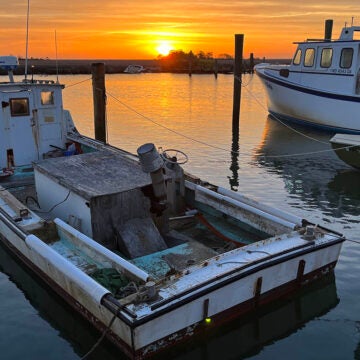
Every spring, a group of high school students from Rockingham County, Virginia, travel several hundred miles to Tylerton, Maryland. The two places at first glance seem worlds apart—one, a rural farming community in the Shenandoah Valley, the other a small town on a remote island in the Chesapeake Bay. But for 22 years they’ve been tied by this annual tradition, a chicken barbecue to kick off the blessing of the fishing fleet.
“The islanders know the school by name, and the kids know every one of the islanders,” says Eric Fitzgerald, who has been taking his high school agricultural education classes to Smith Island for decades. “The community is proud of it. It’s something that’s a big event, and kids will take ag classes just so they have the opportunity.”
Not Just Oysters
In the late 1980s, Fitzgerald took his own trip to Smith Island on a professional learning course with CBF. He thought it would be a good chance to fish. Now, he credits it with influencing the rest of his career.
“It changed our perspective on agricultural education and what we should be teaching, and every kid we took out there came back changed,” he says. “All of us thought the Bay was a really cool place to go on summer vacation. You could fish and swim at the beaches. But no one in our circles ever thought about why we need to talk about protecting the Bay up here.”
The island communities are integral to CBF’s Education program and its centers on Smith Island and Port Isobel. Captain Jessie Marsh, captain and educator for CBF’s Smith Island Environmental Program, says community members generously open their doors to curious students and teachers, answering questions and sharing memories about island life.
“I have really enjoyed sharing this unique community with the students and teachers, as well as other guests, that come to our program,” says Marsh, who grew up on Smith Island. “They’re amazed by the way we live here, and they’re also amazed by how close-knit the community is.”
It was these conversations that inspired Fitzgerald to begin inviting farmers, who found common ground with the watermen. The personal connections helped underscore the ecological connections, driving home how agricultural practices upstream can influence harvests downstream—and those who depend on them.
“What we are doing here in Rockingham County affects people down there,” Fitzgerald says. “It’s not just affecting oysters, it’s affecting people.”
Expanding Perspectives
Vice President for Diversity, Equity, Inclusion and Justice Carmera Thomas-Wilhite began her CBF career creating and nurturing Bay saving partnerships in Baltimore. Education helps communities, not just students, across the watershed connect local issues with the broader environmental and social context, she says.
I think that’s a lesson for diversity and equity, too. Let people be. Let people share their story. Listen.
Carmera Thomas-Wilhite, CBF Vice President for Diversity, Equity, Inclusion and Justice
“I think a lot of people, when they think about environmental issues, they think it’s an ambiguous thing. It’s not connected to me as an individual, and it’s not connected to my community,” she says.
Earlier in her career, when she was managing CBF’s Environmental Protection and Restoration program in Baltimore, Thomas Wilhite says she often partnered with the organization’s educators. Together they took policymakers onto Baltimore Harbor aboard the CBF workboat Snow Goose, collaborated on data collection and field experiences, and worked with teachers on professional learning courses.
Now, she’s looking forward to ways environmental education can help tell a fuller story of the Chesapeake Bay, with more perspectives reflective of the more than 18 million people who live here. Educators work every day with people of all backgrounds, at all levels of understanding and experience with the Bay. That provides lessons that reach far beyond a classroom.
“If you have a group of 28 students, you have to give very short instructions, center people where they are, let them observe and just be, because they could be feeling so many feelings—excited, scared, unaware of what’s happening next—and it’s important to just give them time and space to take it all in,” she says. “I think that’s a lesson for diversity and equity, too. Let people be. Let people share their story. Listen.”
Related Stories
-
 Blog Story
Like Mother, Like Daughter
When teacher Karen Earp first joined one of CBF’s professional learning courses on Smith Island, she had recently learned she was pregnant. Nearly 30 years later, she and her daughter—now a teacher herself—returned together.
-
 Blog Story
Our Bay, the Perfect Classroom
As Virginia teacher Tonya Humphrey knows first-hand, environmental education is critically important to her students and their futures
