Monitoring Maryland’s Freshwater Fish
Since 2002, CBF has been doing restoration and tree plantings along Beaver Creek, a tributary of the Potomac River. Now it’s time to find out how well its fish are doing as a result.
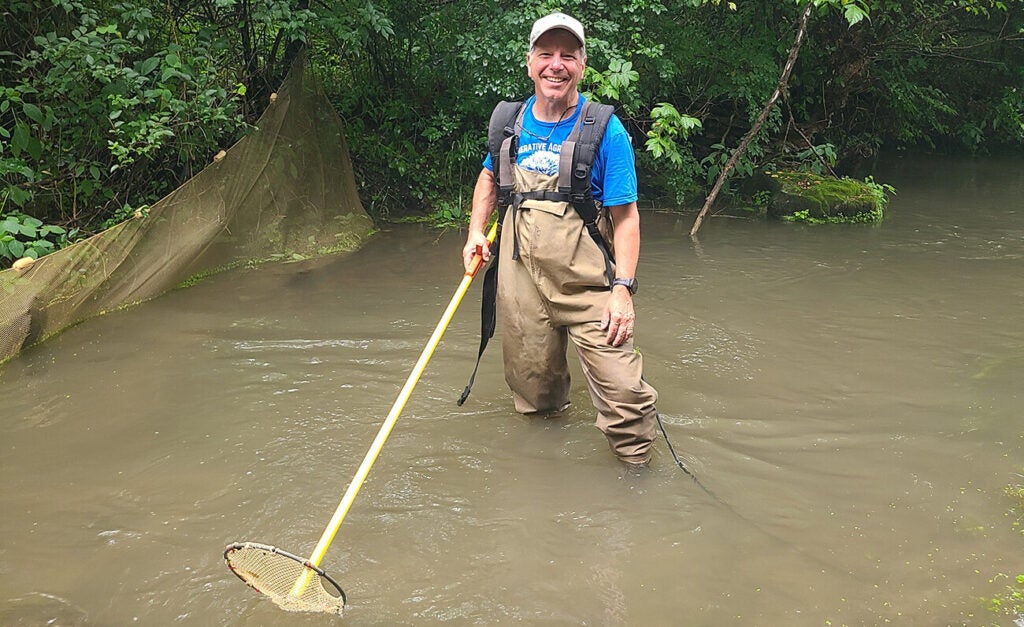
Even in thick rubber waders, the current felt cold against my legs. A stark contrast from the hot summer air. The creek was murky and moving fast. Not too surprising after the heavy rain we’d gotten the night before. But as I trekked upstream, with a net in one hand and a bucket in the other, I wondered if the fish would mind these conditions. Was this stream clean enough for them? Cold enough?
Let’s find out. That’s why we were there. It’s why I, and half a dozen restoration scientists and volunteers, were waist-deep in a Maryland creek, scooping up and counting fish.
Scoop, plop. Scoop, plop.
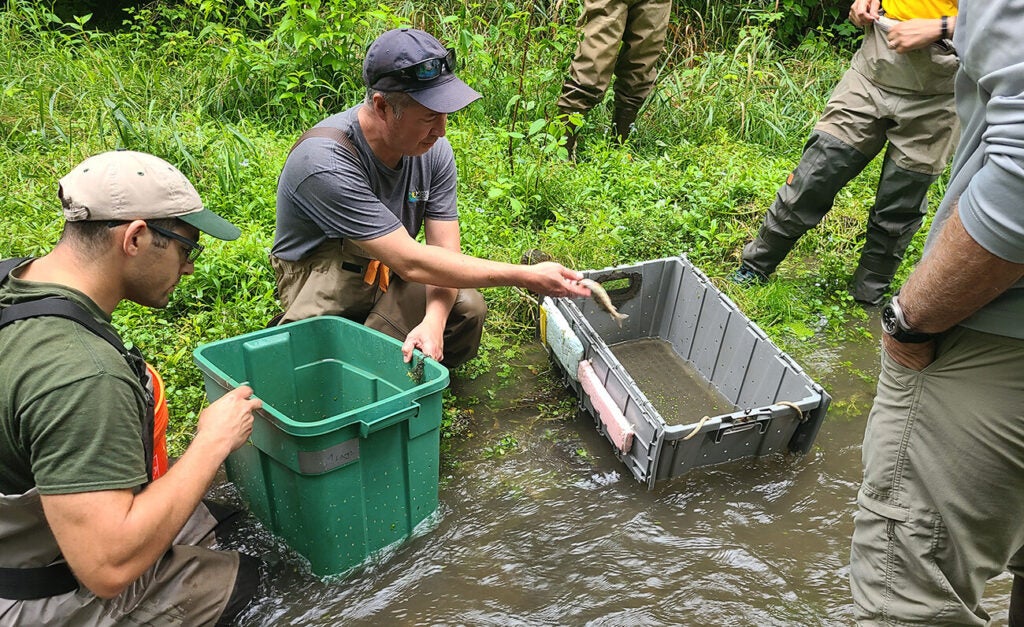
In my bucket were dozens of small fish that had been lightly stunned with an electro-fishing pole and scooped up to be counted.
“Got some coming down,” Jeff Gring with Coastal Resource Inc. would yell after he initiated a light shock.
I was trailing behind him as we worked our way upstream, looking for small white bellies to float toward me so I could net them up and promptly secure them into my bucket. They wouldn’t stay asleep for long, so I had to act fast. Before I knew it, the fish were jolting awake in my bucket, making it almost too heavy to bear.
This creek is actually one of the only places in Maryland where brown trout will naturally reproduce.
CBF’s Maryland Restoration Scientist Rob Schnabel
We were just south of Hagerstown in Beaver Creek, a tributary of the Potomac River. Highway I-70 was a stone’s throw away, yet all I could hear was the boiling brook, the plopping of fish, and the occasional plea to “grab that one.”
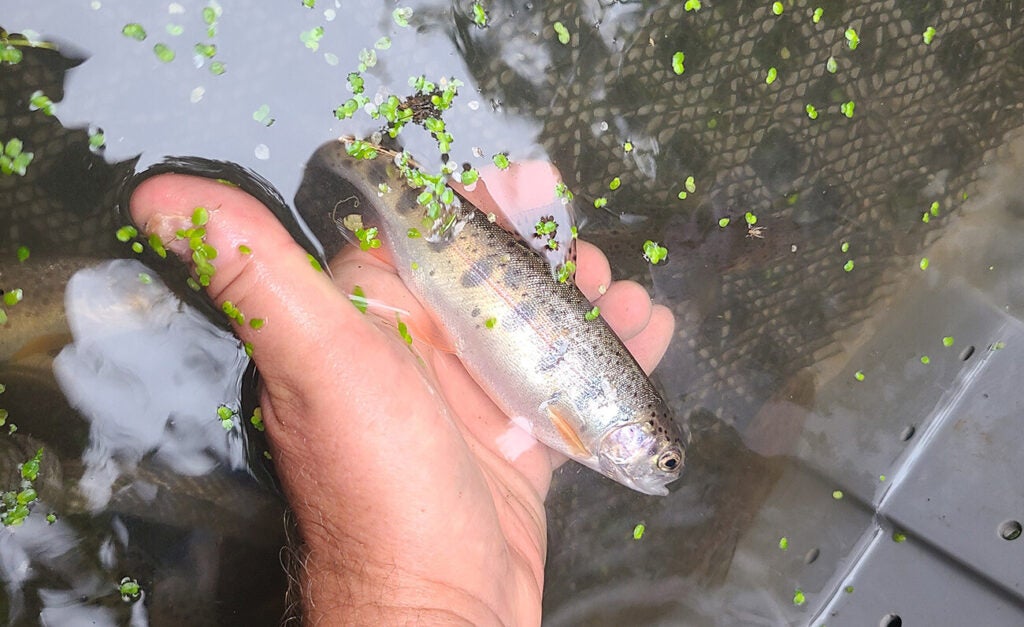
Scoop, plop. Scoop, plop. We collected over 350 different fish within a 75-meter section of the stream. Fish of all shapes, sizes, and species. Though we were most interested in the trout.
 Valerie DiMarzio/CBF Staff
Maryland’s trout species are truly special—and pretty high maintenance. They require ideal conditions including clean and cold water. From our initial surveying, they seem pretty content here.
“This creek is actually one of the only places in Maryland where brown trout will naturally reproduce,” CBF’s Maryland Restoration Scientist Rob Schnabel told me.
CBF and its partners have been working for decades to keep the rivers and streams in northern Maryland viable for trout. No easy feat, as this region endures more intense development pressure, agricultural and stormwater runoff, and extreme weather conditions from climate change.
This specific project is part of a new, holistic approach to watershed restoration in Maryland. In 2025, this watershed, called Antietam Creek, received $2 million for restoration as part of the state’s Whole Watershed Act pilot program. Part of that project will include removing an ineffective dam upstream, which can greatly improve ecological uplift and fish passage in the creek.
But to make sure it works, occasional monitoring is required. That’s why CBF joined Maryland Department of Natural Resources (DNR) and environmental contractors, Coastal Resources Inc., to do baseline fish monitoring in the creek. Then once the dam is removed, we’ll do it again and compare results.
 Valerie DiMarzio/CBF Staff
The baseline results alone were quite enlightening. Not only did we find brown and rainbow trout, but we also collected more than 10 unique fish species, including dace, sculpin, white suckers, and even a daring crawfish or two.
“We want to net up all the fish that we see. It doesn’t matter what kind,” Gring said. “That way we can calculate an index of biotic integrity, which will tell us how good the stream’s doing.”
In my humble opinion, it seemed to be doing pretty peachy. While the fish here still must endure occasional murky runoff and heat waves, this creek seemed like great habitat.
That’s mostly because it’s completely surrounded by trees, Schnabel explained. In fact, CBF has been doing restoration and tree plantings along Beaver Creek since 2002.
Trees along streams, called riparian buffers, help keep the water cool with shade. They are also one of the most effective ways we can reduce pollution from entering our waterways and ultimately the Chesapeake Bay. Their root systems help capture and slow down polluted runoff—which is getting much worse in our current climate.
“We’re in a drought, so the land is really dry,” said Schnabel. “Then we get these intense summer rainstorms, and the soil isn’t able to absorb it.”
 Valerie DiMarzio/CBF Staff
This same effect can be seen on roads and parking lots. When it rains, all the gas, oil, and toxins that are on land washes into our streams. When the pavement is baking in the hot sun, it makes the rain runoff even warmer. This pollution can be extremely harmful to fish, causing bacteria and algal blooms.
“I-70 is right there,” said Schnabel. “As summer gets hotter, it will be critical to address stormwater coming off the highway to maintain this cold-water fishery.”
There’s no single solution to polluted runoff, nor helping trout in the upper reaches of the Bay watershed. But taking a whole watershed approach, reducing pollution at the source, and planting trees are all good places to start. “These trees are the trout’s best line of defense,” Schnabel added.
And thanks to regular monitoring, we have the data to prove it.
Related Stories
-
 Blog Story
To Save the Chesapeake Bay, Save This Fish
Saving menhaden helps save the bay. Now, evidence of a crisis is impossible to ignore.
-
 Blog Story
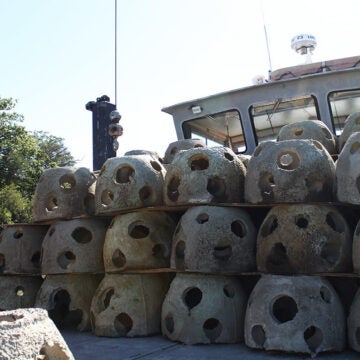
Field Notes: Building an Oyster Reef
Over the course of the summer, CBF built an oyster reef as part of a larger project to restore and protect an eroding shoreline along Maryland's South River.
