Oysters Find Sanctuary, With a Little Help
Sixteen years ago, Howard County, Maryland, students saw a problem up close: There weren’t enough oysters in the Chesapeake Bay. They’ve been working to solve it ever since.
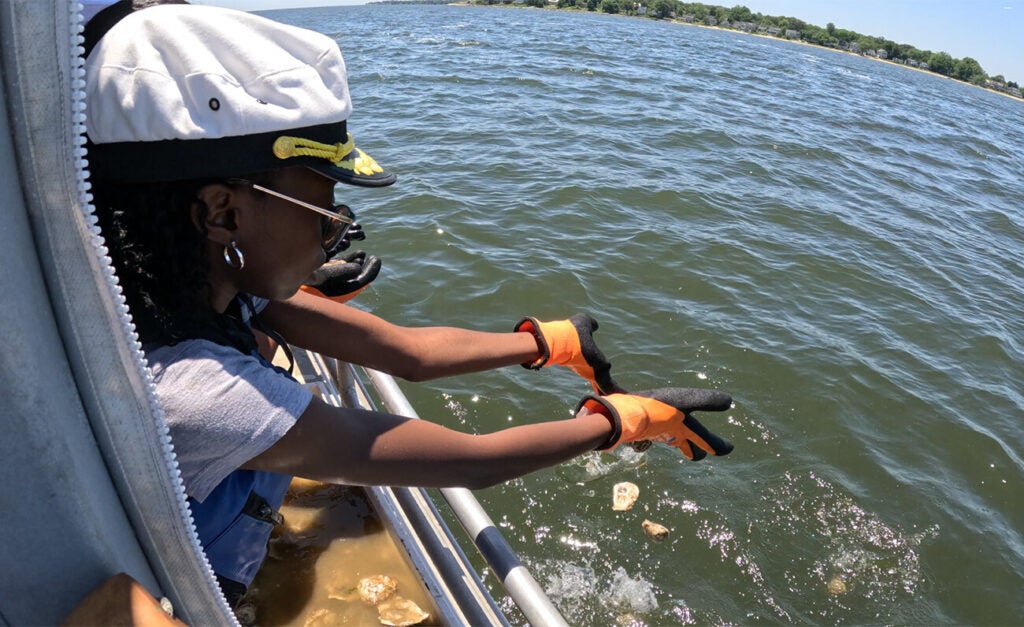
With shouts of encouragement and a symphony of splashes, students from Dunloggin Middle School set loose thousands of young oysters into the cool waters of the Severn River. The shells danced out of sight below the bright, choppy waves, settling onto a sanctuary reef where the Severn River sweeps into the Chesapeake Bay near Annapolis.
It was early June, and it was graduation day. For the oysters.
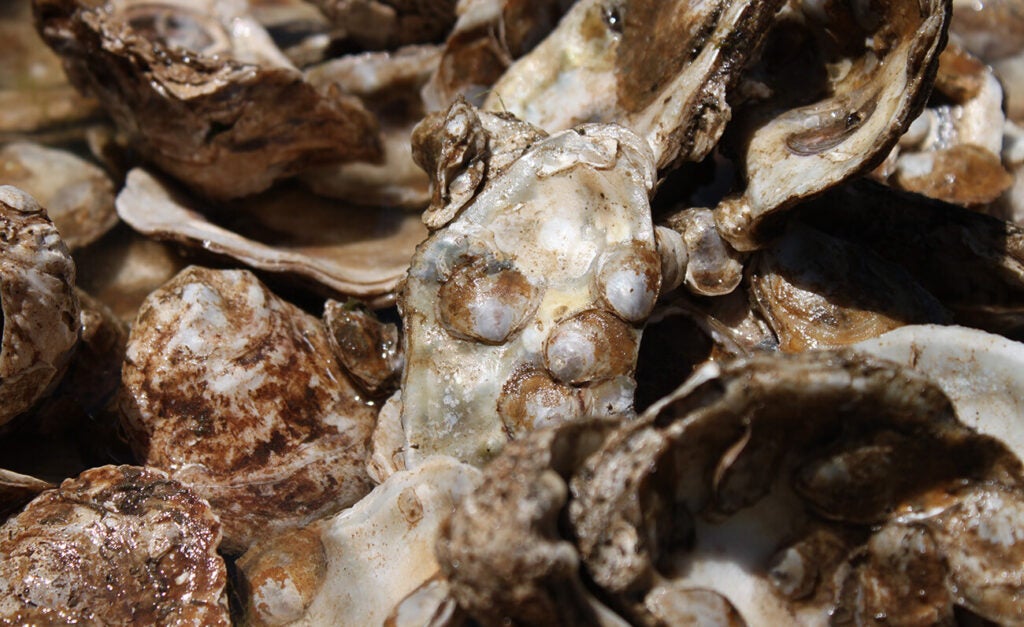
Since 2010, student oyster gardeners from the Howard County, Maryland school have raised and released over 150,000 young oysters into the Bay. The program grew—quite literally—from a field experience with CBF’s award-winning environmental education program 16 years ago. When they sampled a reef near Annapolis, the dredge pulled up only one live oyster in a pile of dead shell. It left an impression.
“The kids were really bummed out, and they kept thinking about it and thinking about it, so when they got back to school, they were talking about it more, and they wanted to figure out a way to make a difference,” said Tiffany Granberg, captain and educator at CBF’s Arthur Sherwood Environmental Education Program in Annapolis, who has worked with the Dunloggin oyster gardeners since 2010. “So, they did some research and found out about oyster gardening.”
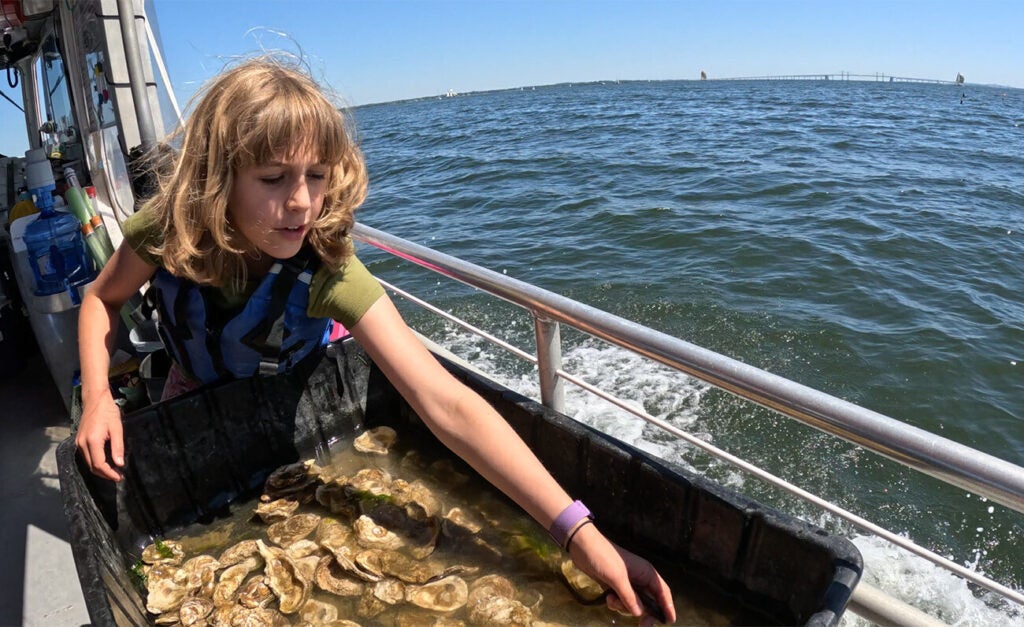
Now, every year, an all-volunteer group of 6th, 7th, and 8th-graders receives cages of baby oysters from CBF at the start of the school year. They care for the oysters throughout the year and record their growth from tiny larvae to larger “spat.”
 Codi Yeager/CBF Staff
It’s a unique chance for the students to participate in hands-on science and make a difference for the Bay at the same time.
 Codi Yeager/CBF Staff
“For the kids, it’s outstanding as a program because it’s real hands-on science and it’s an action-research project for them,” said Dan Blue, a 7th and 8th-grade science teacher at Dunloggin who leads the school’s oyster gardening program. “They’ve identified a problem and they’re actually taking an action to help solve it.”
Their enthusiasm has only grown over the years. The program started with 10 students taking care of four cages of oysters; now it involves 90 students caring for 30 cages of oysters.
“I saw the name ‘oyster gardening’ and it sounded really interesting,” said Rebekah Fapohunda, a 6th-grade oyster gardener at Dunloggin. “And when I learned about how there were almost no more oysters in the Chesapeake Bay, I felt like, if I could do something to help, I really want to.”
Oysters on sanctuary reefs, like the one where the Dunloggin students release their oysters, are protected from harvest. These sanctuaries provide immense ecological and economic benefits by creating habitat, filtering water, and supporting the long-term sustainability of the Bay’s oyster population. Sanctuaries are an important part of Maryland’s multi-pronged approach to oyster management that includes fisheries and oyster farming, known as aquaculture.
 Codi Yeager/CBF Staff
“We went out to the mouth of the Severn River because the whole river is an oyster sanctuary and we have a couple of restoration reefs there,” said Granberg. “The students added their oysters to that reef, we played the graduation march, and had a big party.”
Right before her group headed out on the boat, Fapohunda was looking forward to celebrating and seeing the rewards of a year’s hard work.
“Releasing the oysters, I’m really excited!” she said. “We got to count them all and so I’m excited to see how they’ve changed overall.”
How You Can Help
Want to get involved? We need your help right now to urge Congress to keep the Bay’s oyster sanctuaries protected. The U.S. House Appropriations Committee recently passed a bill that includes two harmful provisions. One would open up protected oyster sanctuaries to commercial fishing; the other would cut off restoration funds for oyster sanctuaries most in need of investment. This is a direct attack on one of the Bay’s most successful restoration stories. Take action now!
And if you want to volunteer, you can learn more about CBF’s oyster gardening programs in Maryland and Virginia.
Related Stories
-
 Blog Story
To Save the Chesapeake Bay, Save This Fish
Saving menhaden helps save the bay. Now, evidence of a crisis is impossible to ignore.
-
 Blog Story
Field Notes: Building an Oyster Reef
Over the course of the summer, CBF built an oyster reef as part of a larger project to restore and protect an eroding shoreline along Maryland's South River.
