From Books, to Brooks, to Bay
This spring, dozens of devoted college students helped CBF clean Maryland waterways from top to bottom—literally.
Instead of soaking up the Florida sun and waiting in long airport security lines, Sasha Sehgal spent her spring break helping clean the Chesapeake Bay. She and a dozen other University of Delaware (UD) students decided to trade sandy toes for muddy hands while volunteering with CBF restoration staff all across Maryland.
“What we’re doing here is right up my alley,” said Sehgal, a UD sophomore studying environmental engineering. Growing up in Hyattsville, Maryland, Sehgal said she feels very connected to the Chesapeake Bay and has always wanted to get involved with CBF.
But saving the Bay might not always look the way you’d expect. While some restoration activities require goggles and waders to clean our water, most efforts start way upriver, on land, to prevent pollution from entering rivers and streams in the first place.
 Valerie DiMarzio/CBF Staff
Stopping Pollution at the Source
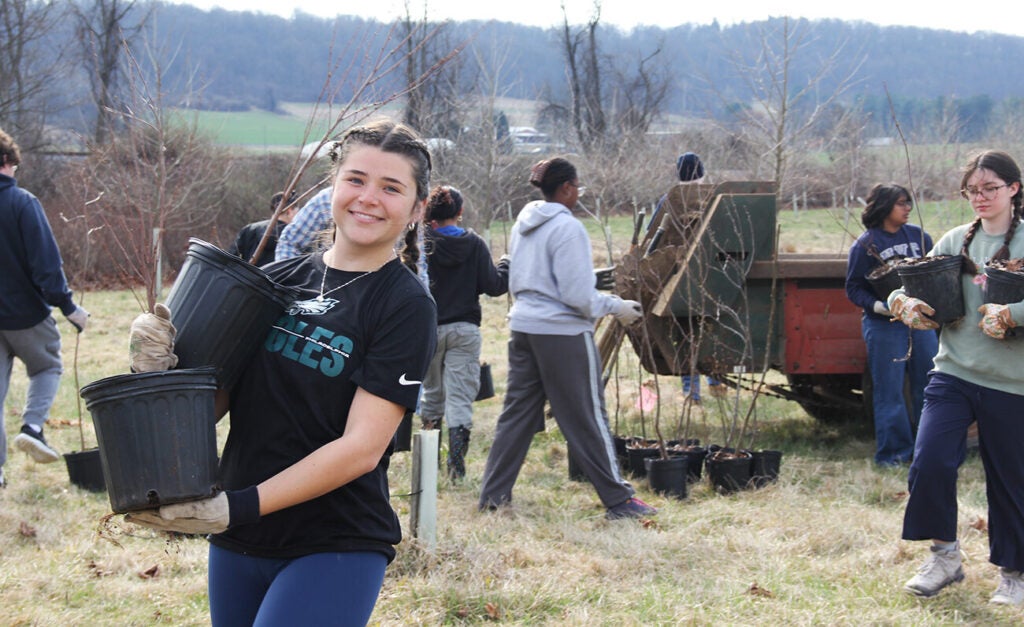
Planting trees, especially along streambanks in the inland areas where rivers start, is one of the most effective ways to reduce pollution entering the Chesapeake Bay. CBF and our volunteers plant thousands of trees each year on Maryland farms, which help absorb nutrients and stop pollutants from washing off the land into rivers and streams when it rains and snows. Much of this work happens far upstream in northwestern Maryland.
“I knew we’d be planting trees, but I didn’t know we’d be all the way up here,” said Hope Gottschling, a UD sophomore majoring in environmental studies and international relations.
The group spent one day planting roughly 70 trees on 20 acres of farmland in Sabillasville, Maryland, just below the Mason-Dixon Line. The property consists of valuable wetland habitat and a portion of Friends Creek, a stocked trout stream. The trees planted here will store nutrients and naturally filter pollution before it runs into the creek, which eventually flows into the Monocacy River and the Potomac downstream. They’ll also help keep the stream cool with shade, which is vital for native brook trout habitat.
“This land is like the sponge of the Bay watershed,” said CBF Restoration Scientist Rob Schnabel. “It retains precious water and reduces flooding, which is more important than ever as climate change worsens.”
CBF has recently prioritized restoration work in this area, known as the Upper Potomac watershed, thanks to a multi-year grant from the National Fish and Wildlife Foundation. This region, which is primarily agricultural land, has strategic importance for reducing nitrogen and phosphorus pollution in the Potomac River. The Potomac is the Bay’s second largest tributary and is the sole drinking water source for people in the Washington, D.C. area.
 Valerie DiMarzio/CBF Staff
Helping Water Quality and Wildlife with Oysters
Reducing pollution upstream, on the land, is just one part of restoring the Bay. Far downstream, CBF is also working to get more oysters back into the Bay in order to improve both water quality and habitat. Oysters naturally filter the water, and their reefs can provide homes for 300 other species.
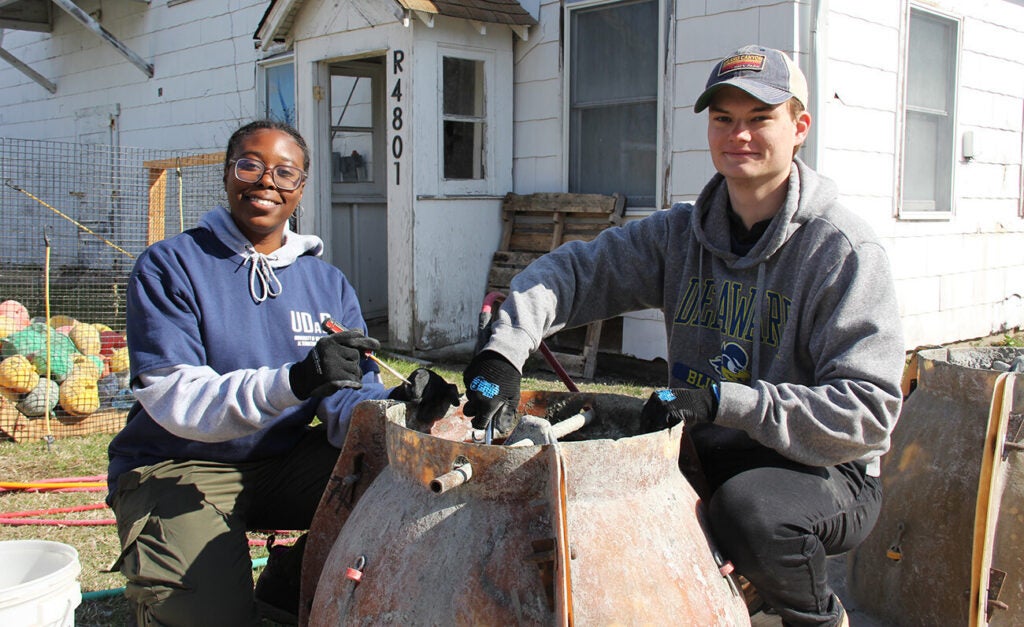
Oyster restoration has been a huge success story in the Chesapeake Bay. One way CBF supports oysters is by building reef ball habitat. Reef balls are large three-dimensional concrete structures where baby oysters can grow. The University of Delaware students helped build 42 reef balls, which will be covered with baby oysters, called spat, and used to build a new living shoreline at Quiet Waters Park in Anne Arundel County. Here, not only will the reef balls support habitat, they will also reduce wave energy and build resilience to flooding and climate change.
“I liked the oysters the best,” said UD junior Sadie Vaughn. “As a wildlife ecology major, I want to get as much hands-on experience as I can.”
Restoration on the land and in the water are key components to a healthy Bay. We are grateful to all of our spring break volunteers from University of Delaware, University of Maryland, and William & Mary for supporting our efforts this year. The Chesapeake Bay is in good hands with this next generation of exceptional environmental stewards.
