Investing in Oysters for a More Resilient Future
It’s no secret oysters are a powerhouse in the Chesapeake Bay. They naturally filter our water, provide essential habitat for fish and other species, and support a robust local seafood economy. But did you know oysters also help us mitigate the threats of climate change?
An oyster reef’s vibrant structure is extremely resilient and can help protect areas most vulnerable to sea level rise and the intense storms we’re experiencing from climate change. Restoring oyster reefs in our rivers, and incorporating them into our shorelines, can help absorb wave energy and reduce erosion in Maryland communities.
Recognizing the incredible power of oysters, and the role they’ll play in our future, CBF is scaling up our oyster restoration efforts and capability in Maryland. From major reef ball and living shoreline projects, to the development of our new Truman T. Semans Center for Oyster Restoration and Innovation in Galesville—there’s exciting growth on the horizon.
See below some of this season’s most anticipated oyster projects and consider supporting us through a donation or by volunteering.
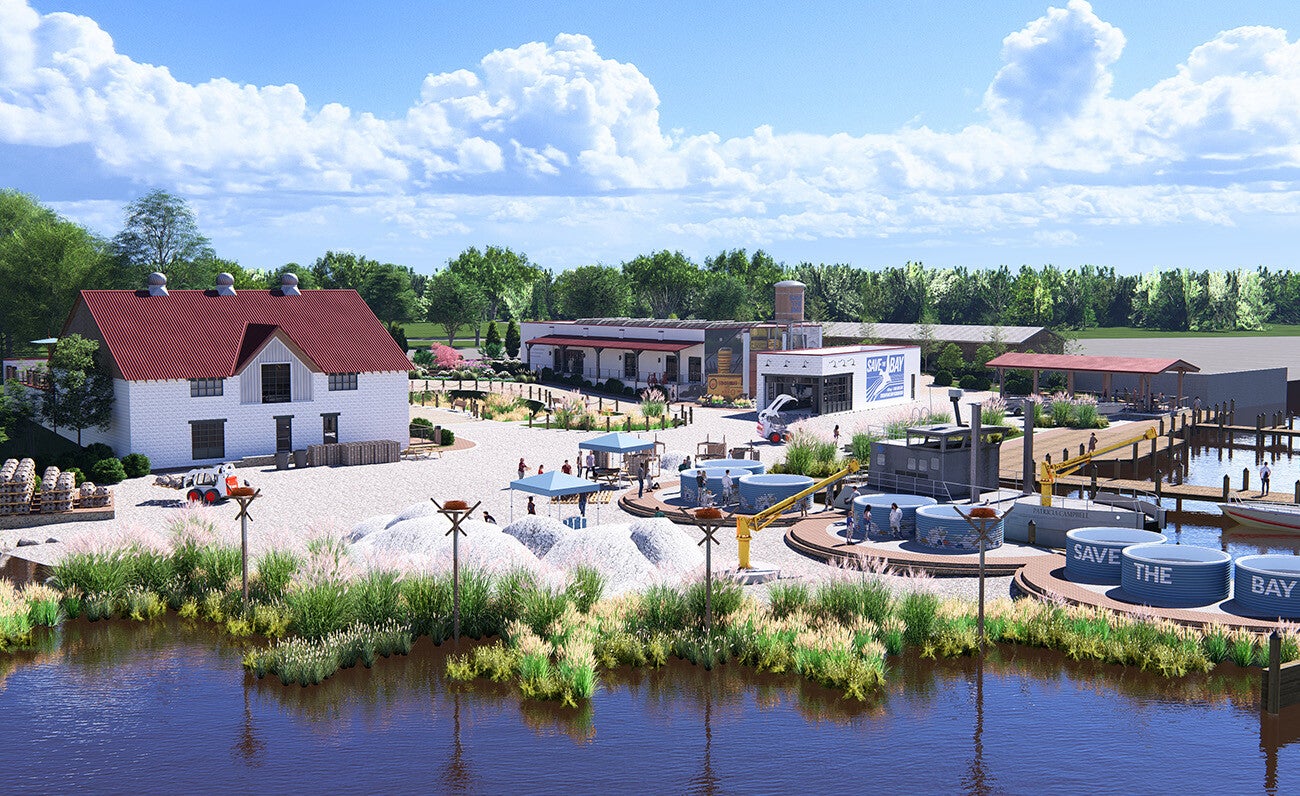 Bignell Watkins Hasser Architecture
Progress at the New Truman Oyster Center
In May 2025, CBF purchased a 2-acre waterfront property in southern Anne Arundel County, Maryland, with one vision: a thriving new oyster restoration center.
Nearly one year later, that vision is clearer than ever and on its way to becoming reality. Since our acquisition last summer, CBF has developed architectural plans for the site, hired a contractor, and affectionately named the center after one of CBF’s earliest supporters, Truman T. Semans.
The new Truman Oyster Center will not only allow us to expand and advance our oyster restoration work, but will foster greater scientific collaboration and offer more opportunities for people to connect with the Chesapeake Bay.
At the new site, CBF will recycle oyster shells, grow juvenile oysters called spat, build reef balls, and lead our annual oyster gardening program. The center will provide more space to scale up this work, including eight large tanks we use to grow spat-on-shell, and dock space for CBF’s 60-foot oyster restoration vessel, the R/V Patricia Campbell.
We hope to have the new and improved oyster center ready for operations by spring of 2027. In the meantime, we’re still hard at work restoring reefs and getting more oysters back into the Chesapeake Bay.
Strategic Restoration in the Severn River
Large-scale oyster restoration has been one of the Chesapeake Bay’s greatest success stories. Last year, Bay partners not only met but exceeded the Chesapeake Bay Agreement’s goal to fully restore 10 tributaries for oyster habitat by 2025 (they restored 11 instead!). But that doesn’t mean we should take our foot off the pedal. In fact, CBF has urged states and conservation partners to keep up the momentum and build off this proven success. The new Bay Agreement includes a goal to restore an additional 2,000 acres of oyster reef habitat by 2040.
As Maryland and Virginia set their sights on which tributaries to prioritize next, CBF and our partners will continue adding oysters to additional sanctuaries across the Bay.
In downtown Annapolis and at the U.S. Naval Academy, nuisance flooding has become commonplace. To better protect this community from the threats of storm surge, CBF is planting 30 million oysters in the Severn River, with support from Severn River Association and funding from National Fish and Wildlife Foundation. This project will expand oyster reefs and enhance a natural buffer in the Severn River that will reduce wave energy and storm surge in Annapolis.
Above: CBF’s oyster restoration vessel, the Patricia Campbell, deploying reef balls at the Hillsmere Marina living shoreline in Anne Arundel County. Credit Mal Box/Arundel Rivers Federation
Incorporating Oysters for Resilient Shorelines
We can also incorporate oysters into our shorelines for more resilient erosion control. Living shorelines—gradual, natural coasts—are a proven stabilization solution around the Bay. But despite their success, hardened shorelines like seawalls and bulkheads compose more than 1,000 miles of Maryland’s 7,000 miles of coastline.
CBF has been working to change that by making it easier for landowners to install living shorelines, which can include a combination of native wetland plants, grasses, trees, and even oyster reefs! Offshore reefs can gradually transition from thriving subaquatic vegetation, to marsh, and to coastal upland. Mother Nature got it right, and we’re working to bring those natural solutions back.
To do so, we use concrete structures called reef balls. Oyster larvae (called spat once they have settled onto a hard surface) can attach directly to reef ball structures, just like recycled oyster shells, and will grow into thriving oyster reefs.
This summer, we will deploy roughly 500 reef balls set with oyster spat along living shorelines on the South River. These projects led by the Arundel Rivers Federation will address erosion concerns and improve habitat in two Anne Arundel County parks.
As you can see, oyster restoration is heavy work and relies on partnerships and a long-term vision. We’re eager to scale up our efforts and increase capacity to build reef balls, grow baby oysters, host volunteers, and support watershed partners at our new Truman Oyster Center next year.
Related Stories
-
 Blog Story
To Save the Chesapeake Bay, Save This Fish
Saving menhaden helps save the bay. Now, evidence of a crisis is impossible to ignore.
-
 Blog Story
Field Notes: Building an Oyster Reef
Over the course of the summer, CBF built an oyster reef as part of a larger project to restore and protect an eroding shoreline along Maryland's South River.
