Press Statement
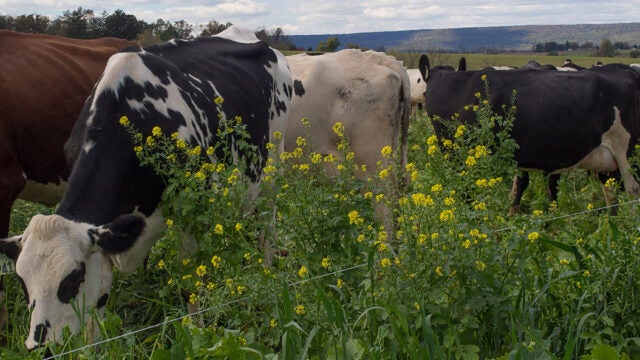
The Chesapeake Bay Foundation (CBF) applauded today’s announcement that $14.3 million will benefit farms and help farmers implement conservation measures to improve water quality locally and at the Chesapeake Bay. The grants came from the Environmental Protection Agency’s (EPA) Chesapeake Bay Program.
According to the EPA, funding provided by the bipartisan Infrastructure Investment and Jobs Act (IIJA), through the Most Effective Basins (MEB) grant program, is used to install forest buffers, manure storage, and fencing to reduce agricultural runoff from entering nearby streams.
In a press release, EPA said it is working with the Pennsylvania Department of Environmental Protection to direct at least $3 million of the MEB funding to a block grant that will deliver conservation funding to farmers more quickly. An additional $4 million will go to the state Department of Agriculture and State Conservation Commission to support the work of the Conservation Districts.
The announcement was made in Lancaster by EPA Mid-Atlantic Regional Administrator Adam Ortiz and U.S. Senator Bob Casey.
Following the announcement CBF’s Pennsylvania Executive Director Julia Krall issued this statement:
“We appreciate the investments announced today by the EPA and Senator Casey. These grants are welcome news and will provide a much-needed federal infusion of resources to help Pennsylvania’s farmers keep nutrients on the land instead of in the water, protect herd health, and benefit family farms.
“Long-term investments in programs like Pennsylvania’s new Clean Streams Fund and Agricultural Conservation Assistance Program, which is administered by the State Conservation Commission, can go a long way toward the Commonwealth meeting its clean water commitments.
“The upcoming 2023 Farm Bill will be another important opportunity to focus additional resources on farms in Pennsylvania to help achieve water quality goals and provide economic benefits on and beyond the farm.”
The House Appropriations Committee has approved a fiscal year 2024 Interior-Environment spending bill that shields key Bay restoration programs from deep cuts but guts the overall EPA and Interior Department budgets. It also halts action on rules important to advancing the cleanup effort. The vote was 33-27.
While many environmental protection and conservation programs face draconian budget reductions under the committee bill, EPA’s Chesapeake Bay Program and Interior’s Chesapeake Watershed Investments for Landscape Defense (WILD) program were held harmless.
The bill would continue Bay Program funding at $92 million and would again allocate $8 million for Chesapeake WILD grants in fiscal 2024. It also renewed the extra $47.6 million in annual Bay Program funding provided in the 2021 Infrastructure Investment and Jobs Act.
The EPA-led Bay Program coordinates the federal-state-local effort to restore and protect the Bay and its waterways. It got a $4 million boost from $88 million in the fiscal 2023 omnibus appropriations deal. The $92 million in the committee bill is in line with President Biden’s fiscal 2024 budget, which also called for level funding.
The Chesapeake WILD grant program helps finance local habitat restoration projects such as restoring freshwater mussel habitat in Virginia, removing barriers to brook trout migration in western Pennsylvania, and creating new habitat for shallow water fish species on Maryland’s Kent Island.
However, the House Appropriations Committee measure contains numerous provisions to block an array of other Biden administration initiatives and regulations, including programs to promote environmental justice and fight climate change, and rules needed to help restore the Bay and its tributaries.
The committee bill would deny EPA funding to finalize the “Good Neighbor” rule, which controls out-of-state ozone emissions by reducing the release of nitrogen oxides, an ozone precursor, from coal-fired power plants and some industrial sources.
Ground-level ozone, the primary component of smog, can cause serious breathing problems. It also contributes to the excess nitrogen that fuels the growth of agal blooms that suffocate aquatic life.
The bill would also repeal the wetlands protection rule the administration is currently revising to reflect the recent Supreme Court decision. Wetlands play a vital role in Bay restoration by filtering water pollution and providing habitat for Bay species.
Chesapeake Bay Foundation (CBF) Federal Director Keisha Sedlacek made the following statement about the bill:
“While CBF appreciates that the Chesapeake Bay Program and Chesapeake WILD grants were spared the budget ax, we are deeply disturbed by this bill’s draconian cuts to the EPA and Interior Department overall budgets next year. Protecting investments in these valuable programs is a hollow victory when the House Appropriations Committee would gut the budgets of the leading agencies responsible for protecting human health and the environment.
“We also strongly oppose the committee’s attempt to upend rules to control interstate ozone pollution that increases nitrogen pollution in the Bay and its tributaries and protect wetlands that play an important role in protecting water quality.
“CBF urges Senate appropriators to continue prioritizing Bay restoration by providing the necessary funds and rejecting policy riders that would hinder regulatory work to provide clean air, water, and a safe environment to those in the watershed.”
On Thursday, July 20, Gov. Moore renewed his commitment to Bay restoration and announced new strategies to move efforts forward. Citing recent research by leading Bay scientists the Governor pledged to follow the science and fully engage all of state government in restoration efforts. The Governor pledged that Maryland would be the first state in the region to wholeheartedly adopt the report’s recommendations and said that Maryland’s efforts would be driven by science and data.
In addition, today the Governor signed two Executive Orders. The first establishes the Governor’s Council on the Chesapeake and Coastal Bays Watershed. The second establishes an Oyster Shell and Substrate Task Force. A healthy oyster population is critical to the health of the Chesapeake Bay and oyster shells for use to create oyster reefs are in short supply.
Following the announcements, Chesapeake Bay Foundation Maryland Executive Director Allison Colden said:
“Leading Bay scientists recently released a report that identifies what has worked, what hasn’t, and suggested improvements that will accelerate efforts to achieve healthy rivers, streams, and the Chesapeake Bay. We commend the Governor for his leadership in beginning to align state policies with these scientific recommendations. Targeting the state’s efforts to areas where they will be most effective, both in reducing pollution and improving habitat for living resources, is an essential first step.
“We look forward to working with Governor Moore and Maryland’s state agencies to accelerate progress to achieve clean water for Maryland communities and future generations.”
In support of the Oyster Shell and Substrate Task Force, Ms. Colden added:
“Increasing the oyster population is critical to ensuring a healthy Bay. Oysters help improve water quality and create a rich habitat for more than 300 species of fish, crabs and other organisms.
“Maryland’s oyster restoration efforts, aquaculture industry, and public fishery would all benefit from expanding oyster reefs in the Bay, but oyster shells are in short supply. This task force will provide guidance on how best to support oyster reef expansion and utilize this limited resource. We look forward to serving on the task force in support of this critical effort.”
Osprey nests in Virginia’s lower Chesapeake Bay are failing at the highest rate ever recorded, according to data released this month by the College of William & Mary’s Center for Conservation Biology. Out of 167 nests monitored, only 17 produced young osprey, well below levels needed to sustain the osprey population. Researchers linked the nest failure to locally low numbers of menhaden, a highly nutritious forage fish that is the target of a large industrial fishery in the lower Bay by Omega Protein.
“Within Mobjack Bay young osprey are starving in nests because the decades long overharvest of menhaden has caused local depletion,” states Dr. Bryan Watts, Director of the College of William & Mary’s Center for Conservation Biology. Watts adds, “although osprey do feed on other fish species within the lower Chesapeake Bay none of these species offer comparable nutrient content.”
Chesapeake Bay Foundation Senior Regional Ecosystem Scientist Chris Moore issued the following statement.
“The osprey reproduction issues in the lower Chesapeake Bay are alarming. Menhaden are a key food for not only osprey, but many other iconic species, from striped bass to humpback whales.
“For decades we’ve been concerned about Omega Protein’s industrial harvest of menhaden in the Bay, and the Chesapeake Bay Foundation has long fought to ensure enough menhaden are left in the water for a healthy ecosystem.
“Given the latest data on osprey reproduction from William & Mary, it is more important than ever to quantify localized depletion of menhaden in the Chesapeake. Without this information, species like osprey will continue to bear the weight of Omega’s fishing activities while the company continues to profit. We urge Omega Protein to cooperate with state scientists to address this critical issue.”
Urges the Commonwealth to pay its fair share
The Chesapeake Bay Foundation (CBF) on Thursday filed an amicus brief asking the Pennsylvania Supreme Court to reverse a Commonwealth Court decision that the Borough of West Chester’s stormwater fee is a tax as applied to West Chester University of Pennsylvania property within the borough. If the Commonwealth Court decision would stand, the state Education Department would be exempt from paying the assessment.
This decision would also open the door to allow all Commonwealth properties, not just in the Borough of West Chester, to be exempt from any stormwater utility fees, in contradiction to current case law. These unpaid fees would then eventually fall on private citizen ratepayers.
The brief states that “the State’s properties discharge large quantities of polluted stormwater, not just in West Chester Borough. The Commonwealth’s opposition to paying any stormwater utility fees while simultaneously administering a stormwater compliance system admonishing the public to pay its fair share is an unjust double standard.”
In 2013, then Governor Corbett signed into law changes to the state Municipal Authorities Act which allowed certain local governments to form stormwater authorities. These entities can collect fees from residents for the management, maintenance, and improvement of stormwater infrastructure.
There are thousands of authorities across the United States. In Pennsylvania there are currently about 65 local governments that have formed an authority. Many of these local governments include areas with state-owned land.
As stormwater passes over impervious surfaces it often picks up oil, grease, dirt, and nutrients (nitrogen and phosphorus). According to Penn State Extension, uncontrolled stormwater flows cause increased flooding, pollutant loading, erosion, and property damage. Sediment —gravel and soil particles that have been eroded from the land, frequently by stormwater—is Pennsylvania’s largest surface water pollutant by volume.
According to a 2022 statewide scientific assessment of the health of Pennsylvania’s streams, urban runoff pollutes over 3,500 miles of streams statewide and sends over 15.6 million pounds of nitrogen pollution to the Chesapeake Bay a year.
The impact of outdated, undersized, and dilapidated stormwater infrastructure goes beyond stream pollution. It can worsen flooding in roads and basements, sweep away property, and even endanger public safety. That damage will only increase as precipitation continues to intensify.
Last year, the American Society of Civil Engineers gave Pennsylvania’s stormwater infrastructure a “D” overall, suggesting significant deterioration. The report finds that $6.7 billion in investments over the next three to five years is needed to keep existing infrastructure from risking failure.
By raising funds to repair and upgrade stormwater infrastructure, authorities help local communities protect the health, welfare, and quality of life of the residents in their communities. By exempting state-owned land from paying their fair-share, stormwater discharges from these areas contribute to the problem, but not the solution.
After the amicus brief was filed with the state Supreme Court, CBF Pennsylvania Staff Attorney Trisha Salvia issued this statement.
“Public and private landowners, including businesses, churches, and the federal government, are paying to support stormwater improvements in their local communities, as a result of federal and state mandates.
“The Commonwealth should start doing its part by paying its fair share of stormwater costs for state-owned properties.
“In Harrisburg, the Commonwealth owns acres of impervious land that discharges stormwater directly into the Susquehanna River, either directly or indirectly through the city’s stormwater system.
“Capital Region Water informed a Senate committee last January that the Commonwealth has not paid what it owes, $387,000 annually since October 2020. The Hampden Sewer Authority in Cumberland County testified it is owed more than $1.2 million since October 2015.”
In a filing today, the U.S. District Court for the District of Columbia was notified that the parties are dismissing a 2020 lawsuit against the Environmental Protection Agency (EPA) for its failure to require Pennsylvania to develop and implement a plan to meet its commitments to reduce pollution under the Chesapeake Clean Water Blueprint. The dismissal is the result of the parties having previously reached a settlement of claims brought in the litigation. EPA published the settlement agreement for public comment in April, ultimately approving it after considering the comments received.
The suit was filed during the Trump Administration by the Chesapeake Bay Foundation (CBF) and its partners including Anne Arundel County, the Maryland Watermen’s Association, and Bobby Whitescarver and Jeanne Hoffman. The Attorneys General for Delaware, Maryland, the District of Columbia, and Virginia filed a separate similar suit. The court combined the cases.
EPA previously failed to require Pennsylvania to develop a plan to fully meet the pollution reduction goals, including identifying the necessary funding, or imposing consequences. The settlement requires EPA to, among other things, look for ways to reduce pollution from agriculture–the state’s biggest source of pollution–and stormwater runoff from urban and suburban land. As part of the settlement, EPA also commits to increase compliance and enforcement efforts.
Under the settlement, EPA will prioritize efforts in Pennsylvania on the counties that contribute the most pollution to, or have the largest impact on, local rivers and streams. Those are Lancaster, York, Bedford, Cumberland, Centre, Franklin, and Lebanon counties.
Following the announcement, Chesapeake Bay Foundation President and CEO Hilary Harp Falk issued this statement.
“Clean water is essential to the health of local communities, economies, and our quality of life. This settlement addresses some of the most severe agricultural pollution problems by targeting efforts toward Pennsylvania counties where the need is greatest.
“A recent report from leading Bay scientists identifies several reasons that efforts to reduce pollution from agriculture and urban/suburban stormwater have not met expectations including the lack of targeting investments to the most effective places. This settlement takes a step forward with a focus on specific problem areas. And while we are encouraged by recent investments from the Commonwealth and leadership from EPA, we still have a long way to go.
“We look forward to working with EPA, Pennsylvania’s farming community, conservation organizations, and government officials as the Commonwealth, and all the states, seek to fulfill their commitments to clean water.
“By following the science and working together, we can leave clean water, strong economies, and a vibrant heritage to the next generation.”
Here are some of the key elements of the settlement.
In the agriculture sector:
- EPA will take a close look at farms not currently required to have federal permits that have proximity to rivers and streams to see if there is significant damage to water quality from manure generation, manure management practices and/or available storage capacity, and compliance history.
- If EPA determines that a farm is a significant contributor of pollution, EPA will confer with Pennsylvania about designating the farm as a point source subject to permitting.
Concerning urban and suburban polluted runoff:
- EPA will begin to evaluate whether sources of stormwater that are not currently subject to federal regulations are adding pollution to local rivers and streams.
- If EPA determines that a particular source, or sector of sources, contributes to a violation EPA will, at a minimum, confer with the Pennsylvania Department of Environmental Protection (PA DEP).
- EPA and PA DEP will examine the possibility of designating the sources as needing to obtain a point source permit that limits pollution by requiring the removal of impervious surfaces, the installation of best management practices (BMPs), or both.
Increasing enforcement:
- EPA will increase compliance-assurance activities in the priority counties to assess whether federally-permitted sources are complying with existing permit requirements.
- EPA will also determine whether there are any PA DEP-issued general permits or individual permits within the Pennsylvania portion of the Bay watershed that have been administratively extended.
- EPA will work with the Commonwealth to develop a permit reissuance strategy designed to bring permits up to date and significantly reduce the number of administratively extended permits.
The Chesapeake Bay Program has released the 2022 results of the annual Bay grasses survey, which found a 12 percent increase in Bay grasses over the previous year. The survey, conducted by the Virginia Institute of Marine Science, found approximately 76,400 acres of grasses in 2022. That is more than the long-term average of 69,600 acres, but well below the 2018 survey, which estimated approximately 108,000 acres of grasses. The Bay restoration goal is 185,000 acres.
Following the release of the results, Chesapeake Bay Foundation Maryland Senior Scientist Doug Myers (a member of the Submerged Aquatic Vegetation Working Group of the Chesapeake Bay Program) issued this statement.
“Bay grasses are essential to the health of the Bay and the increase over the last two years is good news. Bay grasses provide essential habitat for many Bay species like juvenile blue crabs, which rely on the cover provided by grass beds to avoid predators as well as adult crabs as they molt and “double up” for reproduction.
“The major barrier to increasing Bay grasses is water clarity, both over space and time. Reducing pollution improves water clarity and allows the grasses to thrive. Over the years we have seen that when water clarity improves, Bay grass acreage can increase dramatically.
“A recent report from leading Bay scientists identifies strategies that can accelerate improving water quality and the health of the living resources in our rivers, streams, and the Bay. Among the recommendations being considered is to focus restoration efforts on shallow-water habitat. If that is done, we could see significant increases in Bay grasses and the 185,000-acre goal could be reached. As we come together and design what comes next for the Bay clean-up, CBF believes we must continue to follow the science and thoroughly evaluate all the report’s recommendations.”
The Chesapeake Bay Foundation (CBF) welcomes the release of Maryland’s Climate Pathway Report. The report, developed by the Maryland Department of the Environment and the University of Maryland’s Center for Global Sustainability, charts a path to achieve Maryland’s climate goals while benefiting the economy, human health, and the environment.
Following the release of the report, CBF Maryland Executive Director Allison Colden issued this statement.
“Climate change is a critical threat to Maryland’s economy, communities, and the environment. Increasing temperatures, sea-level rise, and increasing rainfall will also make restoring local rivers, streams, and the Chesapeake Bay more difficult.
“Fortunately, many practices that mitigate climate change will also help restore the Bay. The report recognizes the importance of practices like regenerative agriculture that sequester carbon and improve soil health, the need to restore and expand blue carbon habitats including wetlands and underwater grasses, and the critical role that forests play in order to help Maryland achieve ambitious climate goals and move us closer to a restored Bay.
“The Chesapeake Bay Foundation looks forward to working with Governor Moore’s administration to implement actions outlined in the report.”
The Virginia Department on Environmental Quality (DEQ) today announced an updated process for protecting Virginia wetlands following the Sackett Supreme Court decision. That decision significantly narrowed the scope of waters that are considered “waters of the United States,” protected under the Clean Water Act. Many wetlands in Virginia will now be considered outside federal protection.
Virginia protects all waters in the Commonwealth, including wetlands, and the state’s rules prohibit impacts from development and other activities that would allow a net loss of wetlands.
Before the Supreme Court decision, developers could secure permits for projects in wetlands from the U.S. Army Corps of Engineers and from DEQ. Following Sackett and the loss of federal protection over some wetlands, developers will have to secure permits from DEQ. Some have raised concerns about potential delays at DEQ, due to the need for handling a larger volume of permit applications. The new DEQ guidance should help address this concern while also protecting Virginia’s strong existing wetlands rules.
Permit applications for projects in areas including wetlands must include a precise delineation of the wetlands, as well as an identification of the project’s potential impacts to those wetlands. This was frequently done by the Army Corps. In cases where the Army Corps is no longer able to review wetlands impacts, DEQ this week announced it will prioritize its review of permit applications that include delineations completed by private individuals who are certified professional wetlands delineators. DEQ stated this will “restore certainty in the permitting process and allow projects to move forward in a timely manner.”
Chesapeake Bay Foundation Virginia Executive Director Peggy Sanner issued the following statement.
“Wetlands are important for many reasons—they reduce pollution to rivers and streams, provide valuable wildlife habitat and help protect vulnerable shorelines from destructive storms.
“Fortunately, Virginia has had a wetlands protection program in place that extends across the Commonwealth, unlike the Federal wetlands program that has recently been reduced in scope by the United States Supreme Court. The Commonwealth must continue to live up to its longstanding standard requiring no net loss of wetlands.
“While we are still reviewing this guidance, we are encouraged that DEQ has developed a thoughtful process to help address the need for wetlands protection and permitting efficiency following the Supreme Court decision. But many questions remain. It is imperative that Virginia continues to safeguard wetlands that are no longer federally protected.”
Following declines in both the blue crab and striped bass populations in recent years, today the Virginia Marine Resources Commission (VMRC) lowered striped bass size limits and modestly increased blue crab bushel limits for some commercial watermen. The Commission will review bushel limits again later this Fall after requests from watermen and some Associate Commissioners.
Striped bass populations along the East Coast have experienced a worrisome decline. In May, the Atlantic States Marine Fisheries Commission voted to implement an emergency action to decrease the maximum size limit to 31 inches for most striped bass fisheries in the East Coast. States have until July 2 to implement the change. Today the VMRC took action to ensure Virginia’s compliance. That includes in Virginia reducing the maximum size limit for the Chesapeake Bay fall season, the Potomac River spring and fall season, and the Atlantic Coast season from 36 inches to 31 inches.
Blue crabs in the Chesapeake Bay reached record low numbers last year, but the population showed some signs of improvement in the 2023 Blue Crab Winter Dredge Survey results released in May. In 2022 the VMRC significantly decreased bushel limits for commercial blue crab fisheries. Today the VMRC approved a modest increase in bushel limits for some commercial watermen.
In Virginia, bushel limits are set based on how large a crabbing operation is. As a result of today’s action, crab limits did not increase for the smallest operations, increased by one bushel per day for medium-sized operations, and increased from 27 bushels to 36 bushels per day for the largest operations licensed to use up to 425 crab pots.
After the 2022 decrease in bushel limits, the largest crabbing operations lost the greatest percentage of their catch. Today’s increase was an attempt to restore balance so that crabbing operations of all sizes lose an equitable percentage of their catch when compared to levels several years ago.
Chesapeake Bay Foundation Senior Regional Ecosystem Scientist Chris Moore issued this statement:
“Though the modest rise in the Bay’s blue crab numbers this year is encouraging, numerous concerns remain about the blue crab population. Virginia and the other Bay jurisdictions should continue to manage crab harvests cautiously. The VMRC’s adjustments to crab harvest bushel limits restores balance to the bushel limits adopted last year. This helps ensure more equitable harvests limits for crabbing operations of all sizes, while maintaining most of the conservation benefits adopted last year.
“Striped bass are struggling to recover in the Chesapeake Bay and along Atlantic Coast, while recreational fishing pressure has been increasing. Striped bass reproduction has been below average for the past four years in the Chesapeake Bay. The size limit decrease is a step in the right direction, requiring large fish to be released and then hopefully spawn and rebuild the population. Anglers must remain vigilant to ensure the survival of fish that are caught and released, especially in the summer months when water temperatures are high and oxygen levels are low.
“Both striped bass and blue crabs in the Chesapeake Bay suffer from many of the same challenges—loss of underwater grass habitat, threats from invasive species including blue catfish, and pollution. The recovery of both blue crabs and striped bass depends on careful management of the fishery and accelerating work to improve water quality and habitat in the Bay.”
